

EFSA Admits Need to Boost Regulatory Expertise & Clarity for Novel Foods


The European Food Safety Authority has highlighted the need to sustain scientific expertise and ensure regulatory clarity to avoid approval delays for novel foods like cultivated meat.
The EU must strengthen its regulatory readiness around novel foods to keep pace with innovation in the industry, its own food regulator has said.
In a new paper intended to inform its future strategy, the European Food Safety Authority (EFSA) has outlined gaps in scientific preparedness for the approval of new food innovations and a need for “faster and fit-for-purpose risk assessments to better inform decision-making”.
Writing in the EFSA Journal, its authors lay out the scientific developments necessary to ensure that they’re prepared for novel foods like cultivated meat and precision fermentation and can evaluate submissions based on Europe’s robust food safety requirements, instead of responding to authorisation requests as companies make them.
“EFSA remains largely document-centred,” the paper states. “Scientific opinions, data sets, evidence reviews, assumptions, uncertainty assessments, models and reasoning trails are often produced and stored as separate artefacts. This limits reuse, slows assessments, increases manual burden and makes it harder to connect evidence across domains.”
The regulator names cultivated meat and precision fermentation among the key “priority scientific areas for sustainable food/feed innovation”, and its methods to speed up approvals cover a range of pathways, including investment in new methodologies, social science to inform risk assessment earlier, and structured cooperation with the One Health approach.
EFSA proposes ‘human-led, AI-enabled’ regulatory model
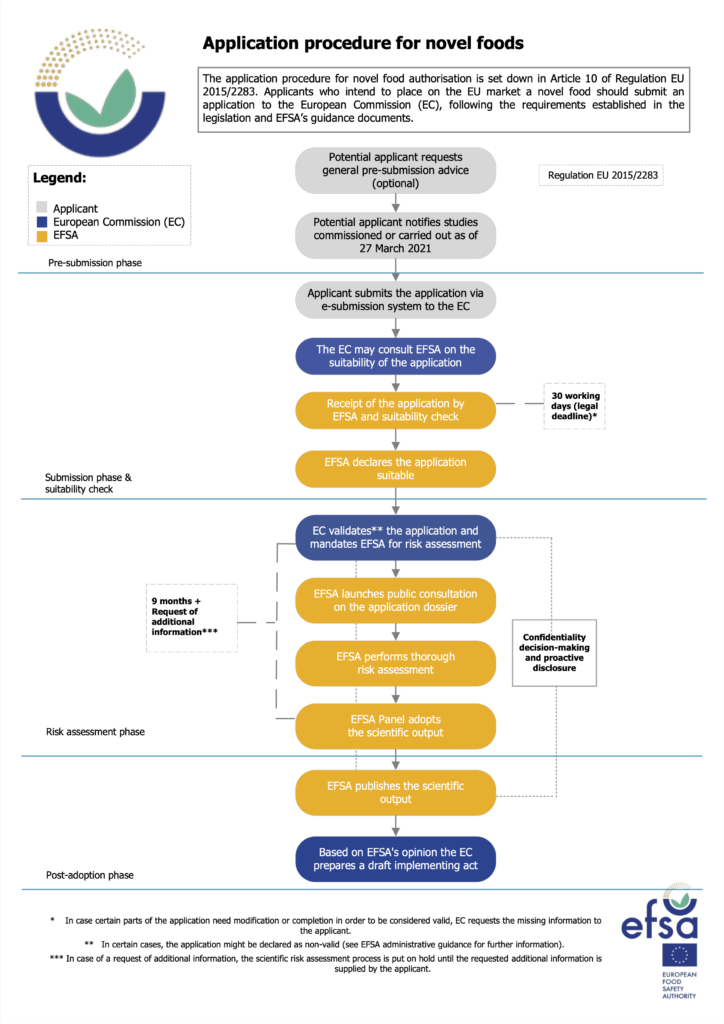
The EU’s novel food regulatory framework is among the strictest in the world, to a point where it’s viewed as too complex, lengthy and expensive. This ends up raising costs for startups and driving away investors from the region.
To get the green light, applicants generate data and gather studies to support their dossiers, which are then validated by the European Commission, before being passed on to the EFSA to perform a suitability check (which takes 30 days).
The regulator then conducts a scientific risk assessment before publishing its opinion, which can take nine months (or more if it wants more information). Based on this opinion, the EU Commission prepares a draft implementing regulation, which 55% of member states must approve. The legal timeline for this process is seven months.
In reality, however, the average time for a novel food product to be cleared in the EU is 30 months, far higher than the stipulated 18-month timeline. And it can stretch to as long as five years. In comparison, average timelines in Singapore, Australia and New Zealand are 12 to 24 months.
“The 20th-century risk assessment approach is generally considered slow and resource-intensive, as it was mostly animal-based, presenting challenges with reproducibility and ethics, and often questioned the human relevance of the data generated,” the EFSA explains in its paper.
“It was marked by the lack of structured data to ensure the development and deployment of models with a high throughput. Today’s scientific methodologies and technical advances develop rapidly, challenging agencies towards the adaptation of their assessment approaches for incorporation of this new type of evidence,” it adds.
One of the ways the regulator proposes to overhaul its regulatory system is by moving to an AI-enabled, human-led model, which it describes as not just a new technology to be adopted, but a function that requires it to “connect scientific evidence and methods, data governance, digital platforms, quality assurance, cybersecurity, legal compliance and scientific accountability into one coherent operating model”.
“The target is an end-to-end AI-supported risk assessment production environment. Incoming mandates, terms of reference, dossier materials and stakeholder questions would be converted into structured mandate objects,” the EFSA says.
EU faces calls to include novel foods in regulatory sandbox scheme

The paper notes that the EFSA’s updated guidance on novel foods outlines the “high-level scientific requirements” companies need to provide in regulatory dossiers, but acknowledges that this doesn’t provide an exhaustive list of all elements required for risk assessment.
It adds that the agency needs to build its own specialist expertise to ensure risk assessments are carried out efficiently, and to address a lack of open-access information about rapidly developing food innovations.
Alternative protein think tank the Good Food Institute welcomed the EFSA’s paper, and said the highlighted issues underscore the need for novel foods to be included in the EU’s regulatory sandboxes. These are controlled environments that let businesses and researchers design standards and guidance for new products with regulators.
The EU Commission proposed excluding novel foods from its food and feed sandboxes introduced under the first Biotech Act last year, but that decision could still be overturned as discussions in the Parliament and Council continue.
Food and biotech trade groups representing some of the world’s largest food companies – from Nestlé and Coca-Cola to Danone and Mars – pushed back against the proposal earlier this year, arguing that the omission of novel foods from this scheme is “not justified on legal, scientific or innovation grounds”.
MEPs on the EU’s climate and food safety committee have also said the blanket exclusion must be removed, and member states like Germany and the Netherlands – two of the region’s future food leaders – have called for a rethink.
“EFSA’s food safety assessment processes are among the most robust in the world, and it’s positive to see the agency acknowledge the need to keep pace with innovation and develop a more proactive system that avoids unnecessary delays,” said Lea Seyfarth, policy manager at GFI Europe.
“Regulatory sandboxes would be a particularly powerful tool to boost regulatory preparedness and learn about new food innovations. In order to build a future-proof regulatory system, EU policymakers must look at the evidence and reverse the Commission’s proposal to exclude novel foods from the Biotech Act’s sandbox scheme.”