

Food Companies Using More AI to Scale Bioprocesses, But Expectation-Reality Gap Remains


A majority of executives say their use of AI in bioprocess development is accelerating, but only 8% believe the tech is fully meeting their expectations. Why does that gap persist?
Last year, Spanish startup MOA Foodtech launched an artificial-intelligence-powered (AI) turnkey service to help fermentation companies optimise their bioprocesses.
And in March, New Wave Biotech and iMEAN teamed up to offer companies an end-to-end solution for bioprocess optimisation, built on the former’s AI-led technology.
An increasing number of food companies are turning to AI to streamline their R&D and manufacturing processes, in a bid to scale up and reach the market faster.
In fact, 76% of executives say they’re accelerating the use of AI in their bioprocess development work, according to a qualitative survey conducted by Israeli firm Algocell and researchers at the University of California San Diego.
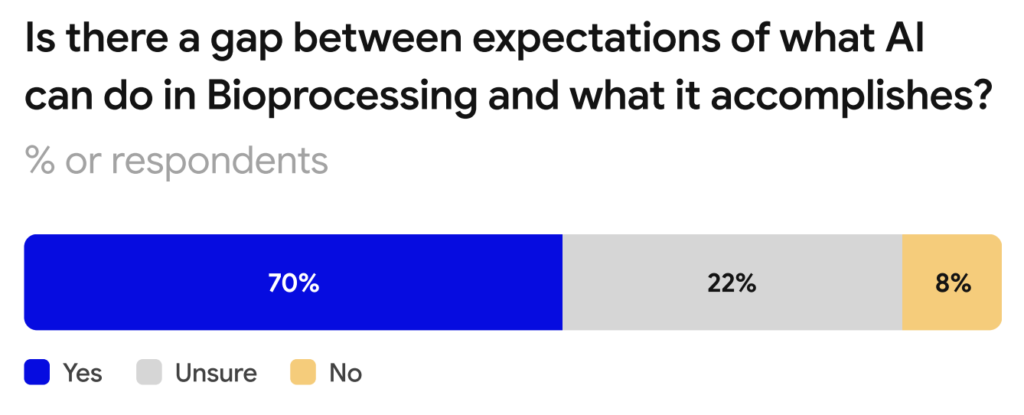
However, 70% also believe there’s an expectation-reality gap when it comes to what AI is actually accomplishing in bioprocessing right now. Only 8% say the tech is fully doing what they thought it would.
The findings suggest the industry is moving beyond AI experimentation, but still struggling to operationalise it. “Executives view AI as a fast-forward button for project timelines, but bench scientists view it through the lens of experimental risk,” explains Algocell co-founder and CEO Omri Schanin.
“In bioprocess R&D, altering an established protocol carries real, immediate costs – wasted feedstocks, ruined pilot runs, or unusable scale-up data – while the promise of an algorithmic prediction is often unproven.
“On top of that, the tech stack is a patchwork: only 21% of teams buy ready-to-use software from commercial vendors, leaving most labs stitching together open-source scripts and academic models on top of disconnected internal systems. Scientists simply won’t swap out trusted protocols until an AI tool proves beyond a doubt that it won’t ruin a run.”
The hurdles hindering AI adoption in food tech
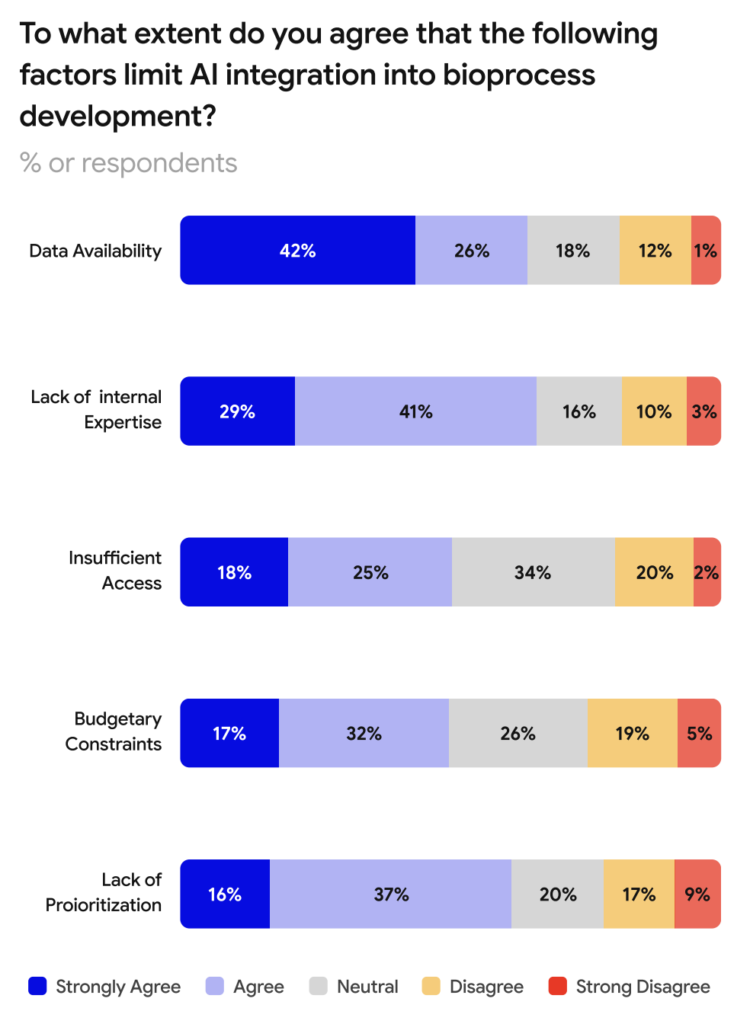
The survey found that experiment designs and real-time optimisation benefit the most from AI integration. But data availability and a lack of internal expertise are the two leading barriers, cited by 42% and 29% of executives, respectively.
“Data availability is an issue because biological data is brutally expensive to generate. Every biotech company works with its own proprietary strain and its own specific biological design space, meaning you can’t just scrape generic data off the internet,” says Schanin.
While a sixth (17%) of executives said they use open-source libraries as their primary source of AI tools (second only to purchasing from commercial vendors), he states that these models don’t solve the data bottleneck.
“An open-source model gives you a free algorithm, but it does not give you unified data. It’s like buying a high-performance engine without any fuel,” he outlines. “The real solution isn’t training models from scratch using massive datasets – it is deploying hybrid models that use smaller, targeted experimental datasets to calibrate existing mechanistic and biological models.”
Schanin suggests that a “patience and mindset gap” is a primary limitation for AI adoption. “Unlike software engineering – where an LLM gives you instant code and immediate proof of value – proving an AI model’s worth in biology requires months of physical lab experimentation,” he notes.
Since results aren’t immediate, teams view AI as an added burden rather than a time-saver and default to traditional trial-and-error methods. “Overcoming this requires a fundamental mindset shift and upskilling bench scientists. In fact, if you were launching a biotech company today, you should build the digital model of your process before buying your first lab bench, media, or bioreactor,” he says.
Will AI’s climate impact be a ‘net positive’ for bioprocessing?
AI is increasingly being adopted into the food tech ecosystem and attracting investor interest. That said, it does bring with it some real perils.
“The single biggest threat is blind reliance on ‘black box’ models that hide how the AI reaches its conclusions. Biology is inherently unpredictable, and when an opaque model recommends a process adjustment without showing its reasoning, scientists can’t tell if the AI generated a genuine biological insight or just reacted to noisy background data,” Schanin says.
“Following it blindly risks dumping an expensive batch down the drain. The fix is demanding explainable AI tools and keeping models grounded in offline tasks, like experimental design where scientists can audit the reasoning before trusting it with a live run.”
One of AI’s leading criticisms is its climate impact: it’s likely to increase energy use and fuel climate disinformation. The UN argues that these calculations don’t account for the use of models to answer daily prompts. The energy needed to generate a single AI image can power a 10-watt LED bulb for 17 minutes and use two tablespoons of water. Data centres, meanwhile, are regularly accused of leeching resources from public infrastructure.
But advocates argue that the tech needs to be evaluated on net impact in this context, given the much larger climate footprint of the agrifood (and livestock) sector. Algocell is also in that camp.
“AI is a net positive for sustainability in bioprocessing. Training models burns electricity, sure, but if an algorithm helps a team run three physical bench trials instead of twenty, or prevents a single massive batch failure, you save tremendous amounts of water, raw feedstocks, and energy. At the end of the day, digital trial-and-error is infinitely greener than physical trial-and-error,” says Schanin.
He believes AI’s biggest benefit to food manufacturing would be facilitating the journey through the “valley of death”. “Most foodtech startups fail because they can’t scale up efficiently or hit the financial KPIs – like cost and scale parity – needed to survive on tight margins,” he explains.
“AI tools address this directly by accelerating time-to-market and reducing the burden of physical experimentation. By optimising feeding strategies, protocols, and critical process parameters offline, predictive modelling helps teams maximise volumetric productivity at minimum cost, preserving vital capital and unlocking commercially viable gross margins.”