

‘Measurable Progress’: Beyond Meat Cuts Losses & Costs Despite Falling Sales in Q3 2026

US plant-based giant Beyond Meat saw revenues decrease by 8.1% in Q3 2026, but narrowed its losses and shrank production costs to a five-year low in what its CEO called “measurable progress”.
At a time when affordability trumps everything – as can be seen by the midterm election results – Beyond Meat has lowered its production costs to their lowest in five years.
That’s the positive read on the plant-based meat maker’s earnings results for the third quarter of 2026, with its cost of goods sold shrinking by 10.1% to reach $3.90 per lb.
“This is the most important takeaway of the quarter, early proof that the efficiencies we believe we have built into our manufacturing and into the supply chain are finally seeing the light of day as we pursue our goal of a return to margins of 30% and above over the long term,” Beyond founder and CEO Ethan Brown said in an earnings call.
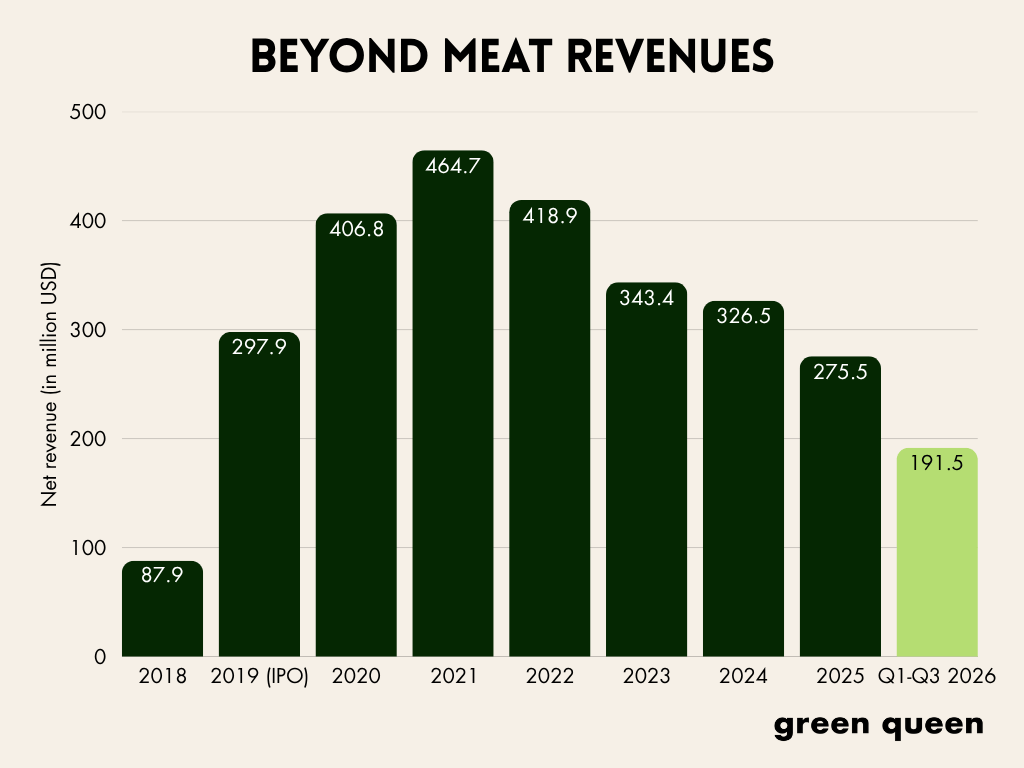
On the flip side, though, is the reality that the company has now suffered a decline in revenue for seven consecutive quarters. Its sales totalled $64.5M in the July-to-September period, down by 8.1% from Q3 2025.
Still, this total was closer to the higher end of its guidance for the quarter, and represented an improvement from declines of 19.7% in Q4 2025 and 15.3% in Q1 this year, while being roughly equal to the 8.2% decrease in Q2.
Meanwhile, Beyond posted a gross profit of $12.4M, up by 58% from the corresponding period last year. Its net losses dropped by 14.6% to reach $82.8M, a figure that included an impairment charge linked to long-lived assets and non-cash charges related to certain activities in its El Segundo headquarters.
“Our third quarter results represent measurable progress,” said Brown. “Total net revenues came in at the high end of our guidance range, gross margin was our highest in five years, adjusted EBITDA loss narrowed, and we used less cash year-over-year.”
That said, the Nasdaq-listed business said it continues to experience “an elevated level of uncertainty and volatility within its operating environment”, causing unforeseen impacts on its actual realised results. That has led Beyond to limit its Q4 outlook to $54-59M. At the higher end, that would represent a 9% drop in full-year sales compared to 2025.
Cheaper-than-beef mycelium steak the ‘most compelling product’ since the Beyond Burger
Beyond’s performance in its home market continued to falter. In retail, its revenues fell by 13.2% to $24.8M in Q3 2026, driven primarily by a 20.8% decrease in volume as a result of lower sales of burger and sausage products to club channels, reduced sales of its breakfast sausages, decreased distribution points, and overall weak category demand.
In foodservice, meanwhile, its sales plunged by 9.7% to $9.5M, thanks to a 12.6% volume decline caused by weaker distribution and category demand.
“Inflation and misinformation about the healthfulness of our products continue to weigh on US retail, and, for that matter, US foodservice,” said Brown, touching upon a familiar rhetoric. “We are responding through both product development and messaging, and I believe nutritional science will, over time, prevail over today’s inverted nutrition narrative.”
One of the key pillars of its turnaround strategy is the stabilisation of its US business while continuing to invest in European growth. Brown noted that its plant-based burger, beef and sausage products are exhibiting signs of resilience at some retail accounts, but admitted that the performance varies.
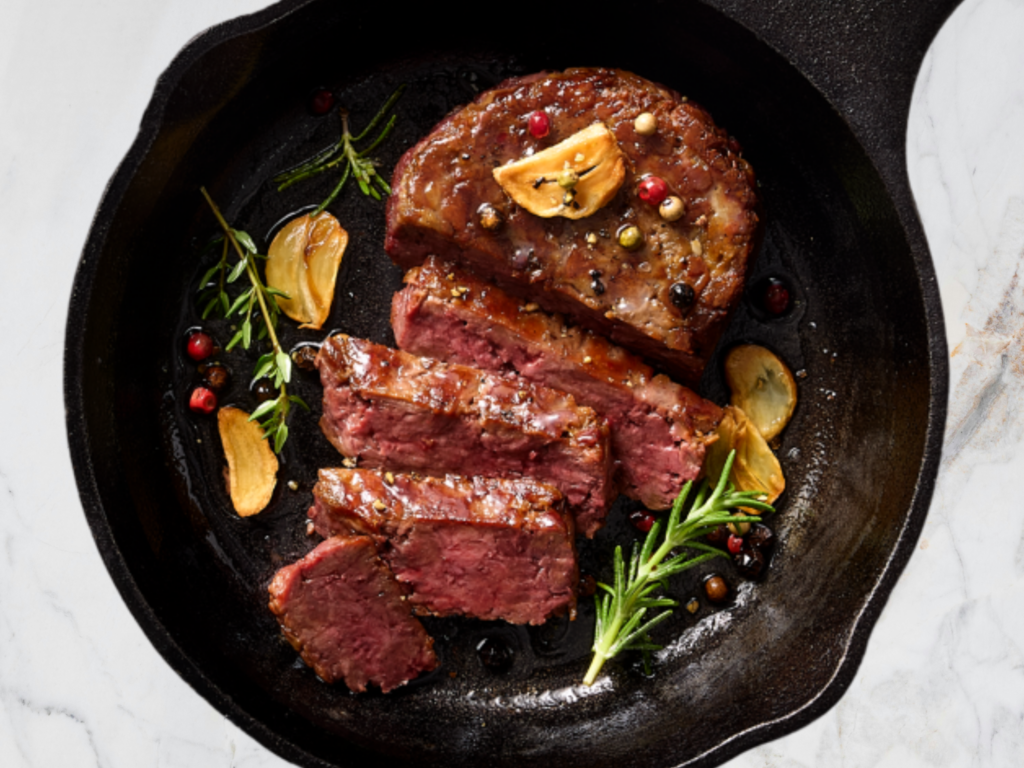
He called the mycelium steak filet the clearest example of where its “centre-of-the-plate innovation” is headed, labelling it the company’s “most compelling product since the Beyond Burger”.
Built on its clean-label and nutritional credentials (each filet delivers 28g of protein and 3g of fibre), the whole-cut steak is one of its bestselling products online, and has made it into supermarkets like Sprouts Farmers Market, Erewhon, Wegmans, H-E-B, and Meijer.
But what may be driving its success most is economics. “At one major US retailer, Beyond Steak Filet is priced at $1.23 per ounce, roughly 40% below the lowest-cost beef steak, choice tenderloin, and less than a third of the price of grass-fed Angus tenderloin,” revealed Brown.
“As we make progress on unit costs, it may one day compete with lean proteins like chicken for people who want high protein and low saturated fat.”
Beyond ‘not waiting for the pendulum to swing back to plant-based meat’
Beyond’s steepest fall in revenue came in the international foodservice segment, where sales dipped by 19.4% to reach $12.4M in Q3 2026, mainly due to lower sales of burger products to certain QSR customers.
However, the retail sector outside the US continued to be a growth driver for the company, where its revenues shot up by 13.3%, totalling $17.9M. This was helped by a 17.4% increase in product volumes, itself driven by higher sales of burger and ground beef products in Europe, and (to a smaller extent) burger SKUs in Canada.
“Europe does not face the same misinformation, and in part, because we have not had to resize our operations footprint as we have had to do in the US, unit economics are more favourable,” said Brown. “We expect continued progress and are fostering strong collaboration across the organisation to bring innovation to these growing markets.”
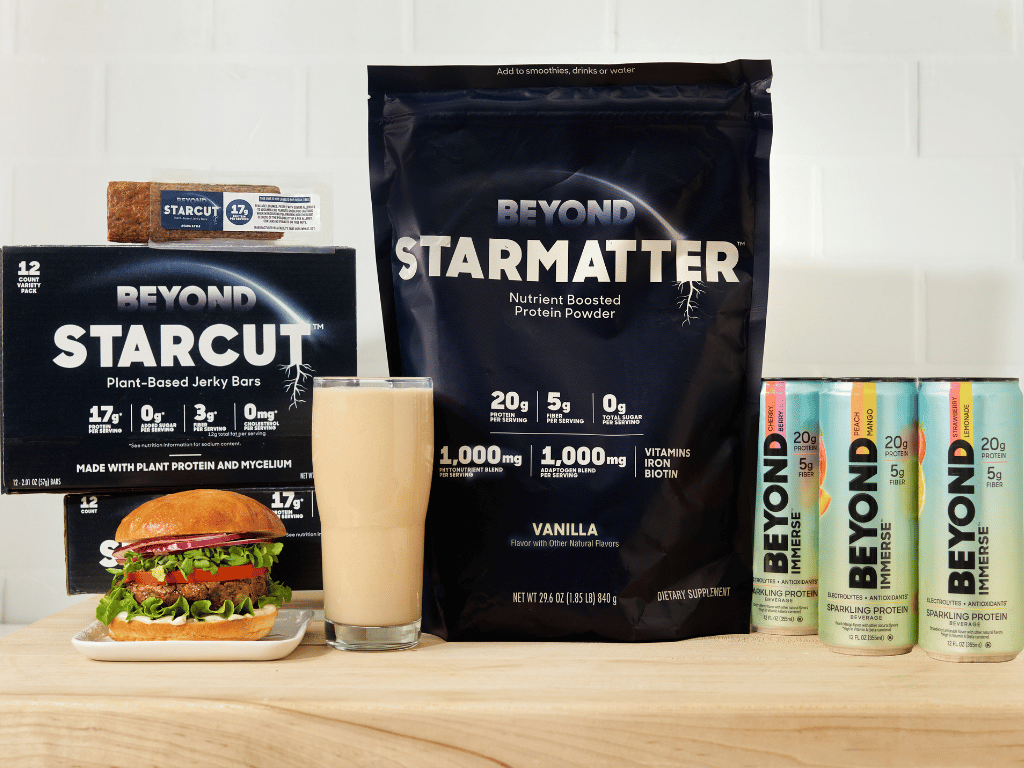
Looking ahead, Brown reiterated the second pillar of Beyond’s recovery plan: “We’ve been repositioning the company around delivering powerful plant-based nutrition to the consumer in convenient and delicious products, and have entered the faster-growing adjacent categories of beverage, powders, and bars.”
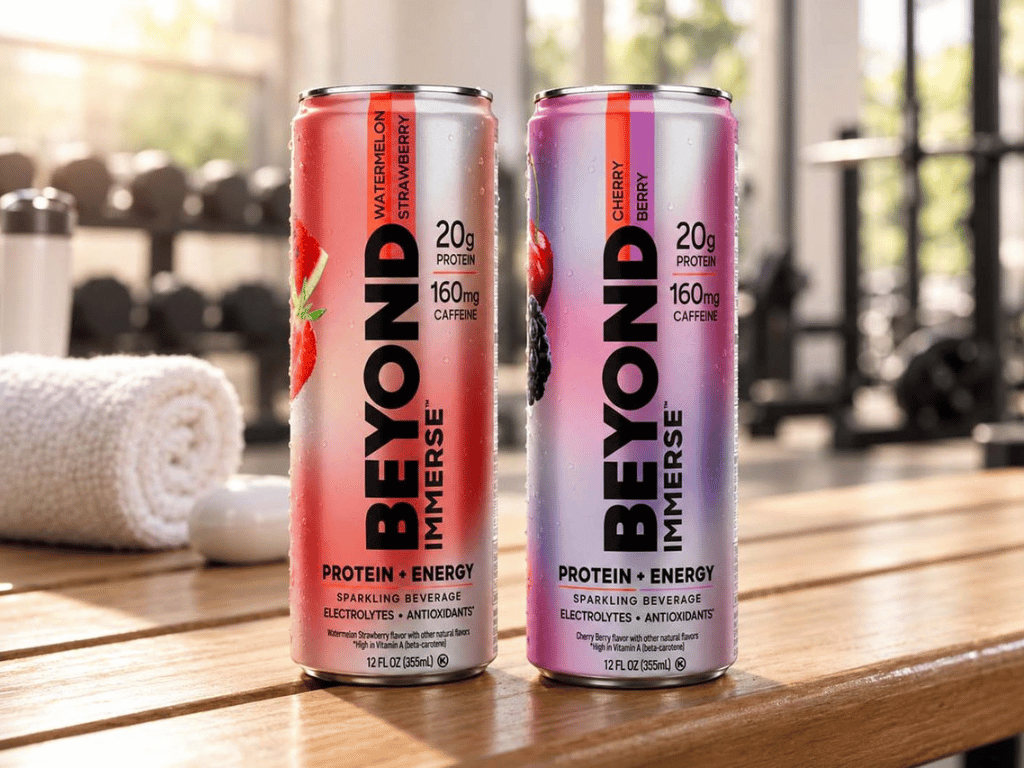
The company’s Phytosphere portfolio comprises the Beyond Immerse line of protein drinks (which was recently expanded with caffeinated variants), the Starmatter protein powder range, the Starcut line of jerky bars, and two veggie burgers. “[The] numbers are still quite small, but Immerse grew impressively quarter-to-quarter, and we are encouraged by its direction,” he said of the sparkling protein beverages.
The final pillar focuses on driving operational efficiency and improving unit economics. Beyond has consolidated its network and built a continuous production line in Columbia, Missouri, bringing more volume in-house. Further investments in throughput and automation are set to remove additional costs.
Despite inflation, it has lowered material costs through contract renegotiations, and it’s now pursuing proposals for secondary sourcing and formulation adjustments. Plus, it has lowered logistical expenses by consolidating its warehouse footprint and exiting less profitable product lines.
“We are not waiting for the pendulum to swing back to plant-based meat. We are forging what we believe is a bright path forward that centres on making the nutritional powerhouse contained within plants available to the consumer in convenient, delicious, and clean products,” said Brown.
“We execute with a hyper-focus on a leaner operating model and a disciplined approach to innovation and market entry. We are pleased with our direction of travel, even as we see clearly there is much work ahead.”