

Global Fashion Industry Emits Four Times More Methane Than France


The fashion industry emits 8.3 million tonnes of methane every year, and animal-derived materials are primarily to blame. Experts say non-action would mean climate and health disasters.
Leather, cashmere and cotton are pushing fashion industry emissions into overdrive, with grave consequences for workers, the economy and the planet, warns a new report.
US charity Collective Fashion Justice has conducted the first-ever calculation of the global fashion sector’s methane emissions, and found that it generates 8.3 million tonnes of the harmful gas annually – that’s nearly four times as high as France (2.1 million tonnes).
Reviewed by researchers at New York and Cornell Universities, the report combines comprehensive data from a systematic literature review and a life-cycle inventory, and points to an urgent need for a shift away from animal- and fossil-fuel-derived materials.
“If no action is taken, over the next 20 years, the fashion industry is set to emit 712 million tonnes of CO2e,” Emma Håkansson, founder-director of Collective Fashion Justice, tells Green Queen.
“With the fashion industry set to overshoot the Paris Agreement by 50%, this is unacceptable and will result in intense supply chain insecurity, less availability of materials, [and] health hazards for fashion workers – not to mention environmental breakdown and the natural disasters that will come from this,” she adds.
“We can change this by aligning with the Global Methane Pledge and cutting methane 30% by 2030, from a 2020 baseline.”
Which materials emit the most methane?
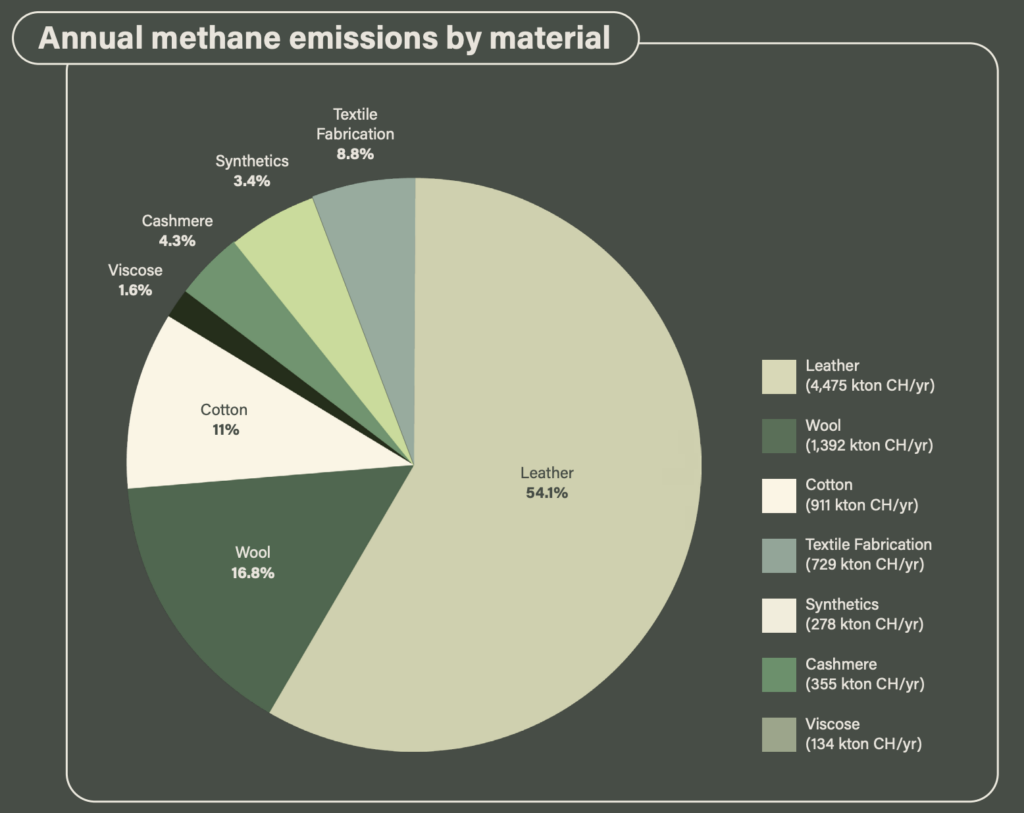
Despite making up just 4% of the materials produced in the fashion industry, animal-derived materials leather, cashmere and wool are responsible for 75% of its methane footprint. Leather alone accounts for 54%.
Cotton, at 11%, has a sizeable contribution too, but unlike most other materials, the majority of emissions came from fibre processing rather than raw material production. Synthetics, which account for 65% of all items produced, produce 3% of the industry’s methane.
For animal-based leather and wool, the main source of methane is enteric fermentation, the process of methane being released when cows and sheep belch and pass gas. Other sources, like manure management, are fall smaller.
“The other ~20% of methane emissions are tied to the use of non-renewable energy sources like coal and gas fuelling material processing and fabrication,” says Håkansson.
“It is essential we prioritise both a rapid reduction in our reliance on virgin animal-derived materials (replacing them with recycled and bio-based materials), and a rapid transition to renewable energy across the fashion supply chain.”
Leather is at the heart of fashion’s methane problem

Leather provides the biggest opportunity to cut the industry’s methane footprint. When derived from cow skin, leather produces 110kg of CO2e per sq m. This falls to 15.8kg for plastic-based synthetic leather, an 85% reduction.
But plastic, derived from petrochemicals, itself is highly problematic. Its production is responsible for 3.4% of global emissions, and it takes 20 to 500 years to break down. Plastic-based leather can also shed toxic microplastics that can enter waterways – thus destroying aquatic life, and our food system.
“Our report specifically states that fossil fuel-based, virgin synthetic materials should never be used as a replacement for animal-derived materials,” notes Håkansson.
“While animal-derived materials are the worst culprits from a methane perspective and therefore must be transitioned beyond, we need to consider a holistic range of environmental factors, and we know synthetics are inherently unsustainable too. This is why investment in recycled materials and bio-based, next-gen materials is so essential.”
The report points out that bio-based leather alternatives – made from mycelium or plants – are much more eco-friendly. Uncaged Innovations‘s grain-based leather, for example, has a 97% lower GHG footprint than the conventional counterpart, and MycoWorks‘s mycelium material has a 98% lower impact.
Collective Fashion Justice warns against “pseudo-solutions” like regenerative or carbon-positive leather, “which does not reduce methane emissions at all” and is not backed by science for long-term CO2e reduction.
Why methane must go out of fashion

The report’s two central recommendations to curb fashion’s methane footprint are to move away from animal-based materials and transition to renewable energy sources. Aside from the environmental benefits, these actions would help brand enhance their reputation with consumers, save $1,600 per tonne of methane from lost productivity, and comply with existing and future legislations.
So why is methane so bad? The gas contributes to 20% of global warming, and emissions are rising faster than ever before. It’s 86 times more potent than carbon over a 20-year period, and is the main contributor to the formation of ground-level ozone, a hazardous pollutant that causes a million premature deaths every year.
According to Collective Fashion Justice, curbing methane emissions is the fastest way the fashion industry can help reduce global temperatures. “If we slash methane emissions now, we will more quickly reduce global temperatures, see the positive impact of this action within our lifetimes, and protect the possibility of a liveable future for generations after us,” it says.
This is why the UN and over 158 countries (plus the EU) have endorsed the Global Methane Pledge. The goal is to reduce methane emissions by 30% by the end of the decade, though this has been thrown into doubt.
The report calls on fashion companies to track their methane output and set specific reduction targets, and asks governments to prioritise regulating methane mitigation and make emissions disclosure mandatory. “In order to future-proof its own survival, the fashion industry must also accept the very real dangers the climate crisis presents to the ongoing capacity to create clothing at all,” warns Collective Fashion Justice.
“Without urgent methane mitigation, we cannot solve the climate crisis,” says environmental journalist George Monbiot. “The industry’s role in methane-intensive animal agriculture through leather and wool use can no longer be ignored. We must reduce our reliance on these animal-based systems and shift to plant production not just in food but in fashion.”