

Hoogwegt Eyes Next-Gen Cheese & Butter After Buying Opalia’s Cell-Based Milk


Dutch dairy giant Hoogwegt will become the first buyer of Opalia’s cell-cultured whole milk next month, which it will test in cheese, butter and yoghurt products, both as a full replacement and in hybrid formulations.
A year after signing a commercial supply deal for Opalia’s cell-based milk, Dutch dairy major Hoogwegt will purchase its first batch next month.
The latter has been an investor in the Canadian food tech firm since 2023, and has a two-year agreement in place to create cell-cultured dairy products for commercial use.
“The first batch will be formally handed over to Hoogwegt at Fi Europe in Frankfurt on 17 November 2026, where the companies will also present a prototype,” Hoogwegt’s global technology director, Roland Wientjes, tells Green Queen.
While the exact quantity and costs are confidential, he says the price reflects the cost of producing this first batch: “At this stage, the purpose is to evaluate the technology, not to make a commercial margin.
“The significance of this milestone lies less in volume or price than in what it represents: a concrete step in the collaboration between Hoogwegt and Opalia, and the first opportunity to evaluate milk produced with Opalia’s technology outside the lab.”
Hoogwegt to explore both 100% and hybrid cell-based milk products
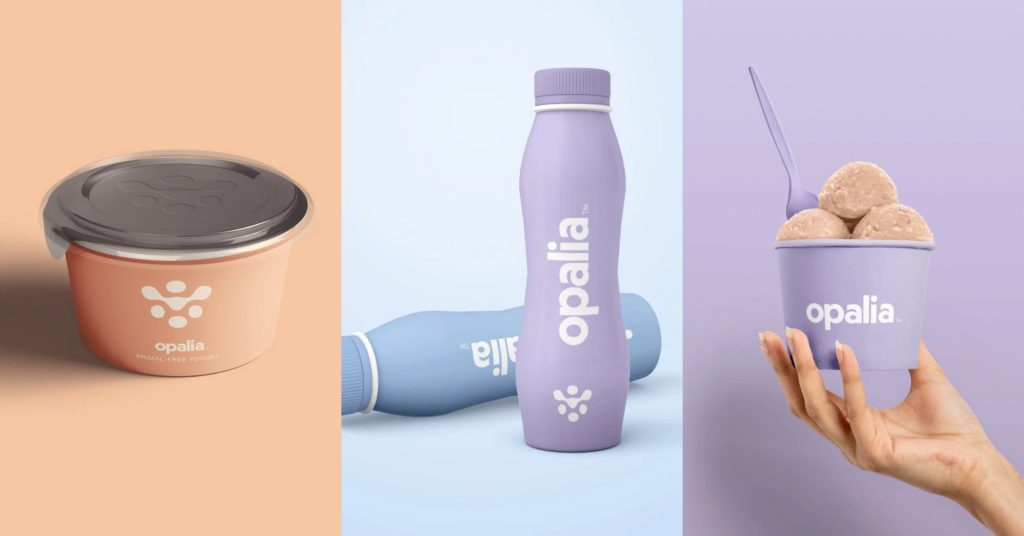
Founded in 2020 by CEO Jennifer Côté and CTO Lucas House, Opalia grows bovine cells in bioreactors and induces lactation to produce the full composition of milk – including proteins, fats and sugars – in a similar downstream process to that of cow’s milk.
It has established an immortalised bovine mammary cell line, which means it doesn’t need to harvest any more tissue from the cow. And unlike precision fermentation, which companies use to produce bioidentical dairy proteins or fats, Opalia’s serum-free cell-based process delivers milk as a ready-to-use product, not an ingredient.
It can be sold directly as fluid or powdered whole milk to B2B customers, seamlessly integrating into existing dairy supply chains and enabling companies to incorporate animal-free dairy into their portfolios. The patent-pending technology can produce products like butter, cream, cheese, yoghurt, and other dairy products.
The process has been validated at lab scale, and Hoogwegt will now test the milk in a range of applications. “We will start by analysing the milk’s composition and evaluating its functional properties for dairy applications such as fresh cheese, yoghurt and butter,” says Wientjes.
“This will show us how the product can be used in future product development. As the technology is at an early stage, further testing is needed before specific applications can be determined.”
He confirms that Hoogwegt will explore both 100% cell-based dairy products, as well as hybrid formulations: “Based on current knowledge, we see real potential for full replacement in several product applications, and hybrid applications offer an interesting route as well. We will focus on the most promising options as our development work with Opalia progresses.”
Wientjes suggests it’s too early to confirm specific product launches, markets or timelines. “Our current focus is on evaluating the functional properties of Opalia’s whole milk and identifying the most promising applications, while Opalia continues to develop and scale its technology,” he says. “The results of this work, together with regulatory progress, will determine the next steps towards commercialisation.”
At Fi Europe, the two companies will look to connect with strategic partners interested in supporting the tech’s development and exploring its commercial potential once it reaches the market, with the aim of securing commercial or offtake agreements.
Opalia plans 2027 filing for Canadian regulatory approval

“Our partnership with Hoogwegt demonstrates that cell-based milk is moving beyond a scientific concept and toward real commercial applications,” says Côté.
Opalia has also signed a paid pilot with the Canadian division of one of the world’s largest dairy companies. Its partnerships span five countries across three continents, and it’s already advancing discussions with other food and dairy giants in North America, Europe, and Asia to convert signed letters of intent into additional commercial pilots over the next two years.
The development comes months after the startup raised C$3.2M ($2.3M) to build a modular bioreactor to produce higher volumes of its whole milk at lower costs, run pre-commercial pilots with Hoogwegt, as well as advance patent and regulatory filings.
The proprietary bioreactor will be able to produce the equivalent of one cow (28 litres a day) at its Montreal facility and help validate its scale-up to larger volumes, laying the foundation for rapid, capital-efficient capacity expansion with a view to entering the market in 2028 alongside Hoogwegt and other partners.
This capacity expansion is set to significantly cut costs, with Côté outlining the company’s intention to reach a unit price of $2 per litre. Once its technology is validated at scale, Opalia will license it to interested customers with the help of Hoogwegt.
It has been working to file regulatory applications in North America, with Asia and Europe in its sights too. In the US, where one state has already preemptively banned the sale of cell-based dairy, the company will require approval from both the Food and Drug Administration and the Department of Agriculture.
But Opalia’s first target is its home market. “The company plans to submit a novel food pre-market notification to Health Canada in mid-2027. Pathways for other markets, including the EU, will be determined as the Canadian process progresses,” says Wientjes.
The firm is also reviewing labelling requirements with regulators. “As regulatory pathways become clearer, accurate labelling and transparent communication will be essential to building consumer trust in this new category,” he notes.
Opalia is one of just a handful of companies working on cell-based dairy, alongside Wilk, Accellta (both Israel), Senara (Europe), and Brown Foods‘s UnReal Milk (US/India). France’s Nūmi and US-based 108Labs, meanwhile, are developing cultivated breast milk.