

Book Excerpt: Agriculture Risks Erasing ‘Generations of Knowledge’ Across Central Asia
Ryan Huling is a senior writer at the Good Food Institute Asia Pacific and the author of the new book The Hidden Nations of Animals, from which this guest essay was adapted.
As we skidded off the main road and onto a mud path maintained only by tire treads, lines began to blur.
Flanking our two-track trail were a series of parallel lanes no more than a foot wide, which forked, merged, and crisscrossed our own. The dashboard GPS showed us headed toward a cluster of green and red dots. In the distance, I saw what looked like a ghost train, faintly visible and thrust forward by howling Siberian winds.
Through borrowed binoculars, I soon got my first glimpse of an ancient tableau, seemingly untouched since Neanderthals roamed the earth. On the far horizon, hundreds of nomadic travelers pierced the frigid air with their ringed horns, inhaling the brittle shards through Snuffleupagus snouts as they sprinted across the desolate steppe. Watching them charge through the treeless plain at full bore, I was reminded of a saying I’d heard shortly before arriving in this remote corner of Kazakhstan: “The saiga is a freedom-loving animal.
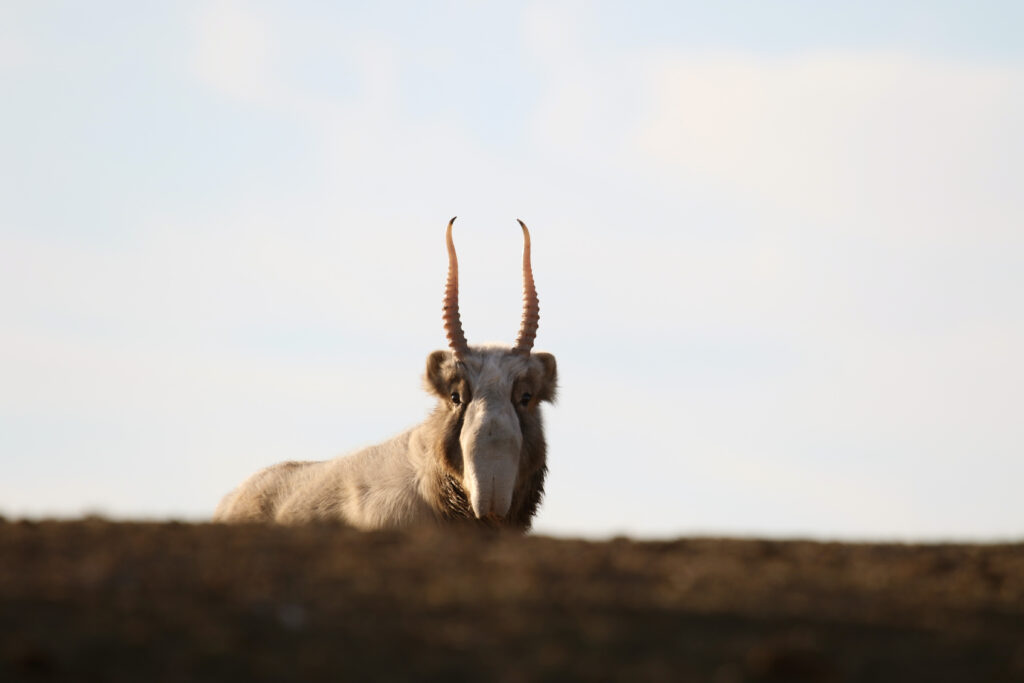
Saiga antelopes have spent nearly every waking day since the last ice age roaming vast open spaces. To survive in a region where hiding places are few and far between, their large herds have developed a hyperalertness to the faintest sight of encroaching predators. Satellite tracking data has revealed that when saigas choose a place to give birth, they will intentionally pick spots that straddle the known ranges of local wolves to minimize the risk of encountering one.
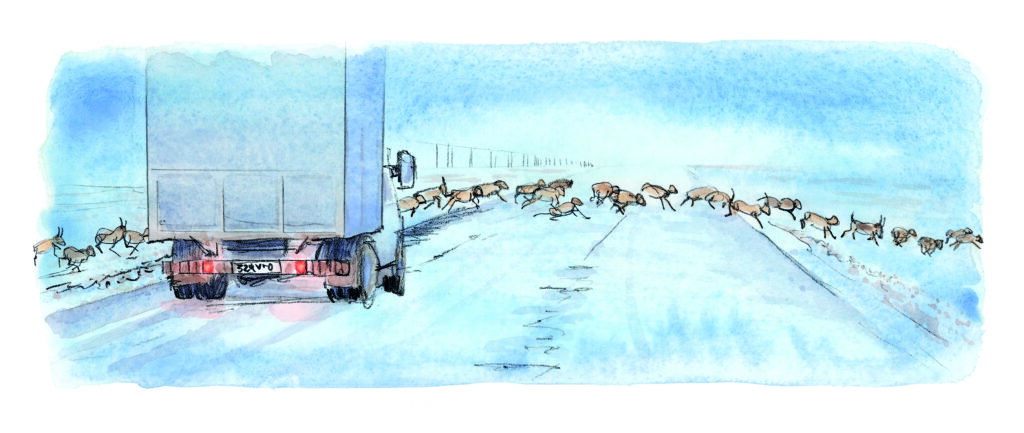
It’s an evasive strategy that served the saigas well for millennia—at least until the stillness of the steppe was brusquely pierced by the construction of rattling railroads and roaring highways, which now crisscross the region, fragmenting antelope populations into smaller, more isolated groups.
Historical GPS data reveals how saigas once routinely zipped back and forth across the Kazakh and Uzbek border. But when a new rail line cut across their traditional route in 2014, the animals instead spun around despondently on the northern side of the tracks, while the fresh grasses and water they had come to rely on withered away to the south. In that moment, many saigas appear to have updated their mental maps and cordoned off whole sections of their former range as simply too dangerous for any self-preserving antelope to consider approaching.
For an individual who was born to run, it’s hard to imagine a worse fate.
Feverishly transformed by agriculture
A tradition of nomadism has loomed large in this corner of the world since at least the Early Iron Age. The very word kazakh is thought to be derived from the Turkic word qaz, which means “wanderer” or “vagabond.” For millennia, small human groups routinely migrated to higher altitudes in the hot summer months, where melting snow made for abundant water and greenery, before returning to sheltered valleys ahead of winter’s whipping winds. At various times of the year, disparate nomads would also congregate for formal meetings and large cultural festivals, complete with physical challenges like wrestling and tug-of-war. When the gatherings were finished, the nomads dispersed once again.
Historical analysis has shown that nomads’ seasonal migrations and time-honed transit corridors may have helped pave the way for portions of the Great Silk Road, which was less a singular route than an ever-evolving web of pathways and bypasses that linked together reliable stopovers. At the Silk Road’s peak, this corner of western Kazakhstan along the fertile banks of the Ural River became a vital transcontinental crossroads. To this day, the river still serves as a natural boundary between Asia and Europe, meaning this part of Kazakhstan is, quite literally, where East meets West.
The land above the Caspian Sea also served as a main artery that linked together key transit points. Strategic settlements along the riverbank allowed weary caravans to rest their heads, unwind in large public baths, exchange knowledge, stock up on essential supplies, and regroup before moving onward.
Among overland voyagers traversing the continental divide, saigas have long been spoken of with an almost mythical reverence. Cave paintings of the antelope created as far back as the seventh century BCE depict them as resilient, elusive, and charismatic. Expert navigators who embody the true spirit of a most inhospitable terrain.
In human society, traditional nomadic practices persisted even as the land itself was variously claimed and reclaimed by Turkic tribes, Genghis Khan, and the Russian Empire. Only with the rise of the Soviet Union in the twentieth century did mandatory sedentarization efforts successfully manage to lock nomadic people in place, force them to farm, and extinguish a cultural flame that had burned brightly for millennia. Denied the ability to live in perpetual motion, people’s navigational muscles began to atrophy.
This transition was viewed by many as an inevitable shift toward “modernization,” but it also represented a significant diversion from our own history as a species. Of the roughly 300,000 years that Homo sapiens have existed, we spent the first 288,000 of them living in small, mobile groups that followed the migratory patterns of other animals. Forcing nomads into agricultural plots was also a colossal failure because much of the steppe soil was unsuitable for growing crops, which is why so many people were nomadic in the first place. Iconic filmmaker Werner Herzog once remarked that “whatever went wrong and makes our civilization something doomed is the departure from the nomadic life.”
Whether by choice or necessity, most Kazakh people now lead stationary lives in urban centers. The world that nomads once freely roamed has also been feverishly transformed, not only by agriculture but through construction of new roads and railways to support it.
For the saigas, whose nomadic days never ceased, these new layers now represent an existential threat.
The biggest modern-day driver of wildlife displacement
Humanity has already “significantly altered” roughly 75 percent of the world’s land, leaving less room for other species with each passing year. Agricultural land-use change is, by far, the biggest modern-day driver of wildlife displacement, and development begets more development. As the amount of livable space dwindles, human and nonhuman populations become increasingly compressed, creating conflict and competition over finite resources within and between species.
In many emerging markets, that damage is only just beginning. Humanity has been projected to construct the equivalent of a New York City every month from 2020 to 2060, with developing countries in Asia expected to see some of the biggest transformations.
In an effort to mitigate humanity’s impacts on wildlife, the United Nations released its first Atlas of Ungulate Migration in 2024—a living map that uses GPS data to identify high-traffic corridors relied on not only by saigas, but also mule deer, ibex, gazelles, reindeer, zebras, and other hoofed nomads. Research has shown that many ungulates share knowledge and cultural transmissions to maintain ancient routes, meaning transit interruptions can “expunge generations of knowledge.”
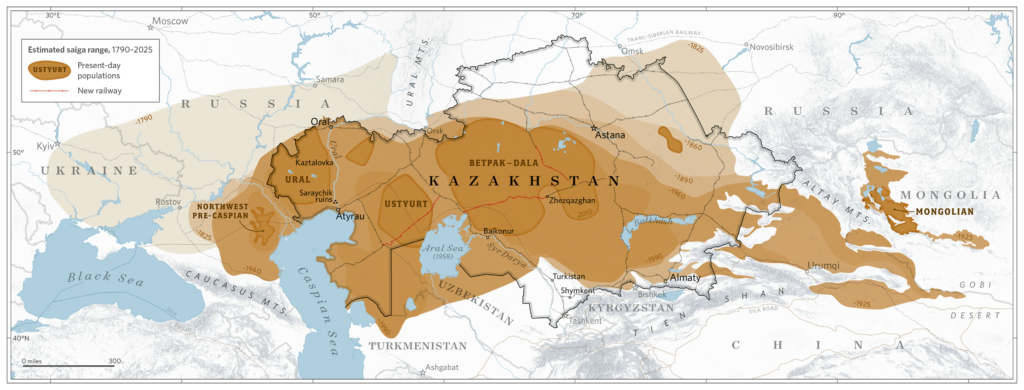
In Kazakhstan, conservationists have partnered with government officials to construct dozens of saiga-friendly crossing points over new train tracks. Border fences along the Uzbek border have also been reshaped from a barbed-wire wall to an X-shaped barricade that blocks vehicles from driving through but leaves just enough space for saigas to pass. Over time, experts are hopeful that such efforts will enable the antelope to confidently return to a region they once relied on.
But as I traveled southeast along the Syr Darya, a major river that feeds into the Aral Sea, I was reminded of the precariousness of the saigas’ situation. Once the world’s fourth-largest lake, the Aral began its precipitous decline starting in the 1960s when the Syr Darya and other rivers were diverted as part of an ill-conceived agricultural irrigation project. In some years, not a drop of the river reached the sea, ultimately pushing the Aral to the brink of collapse.
In subsequent decades, what had been an inland refuge for humans and nonhumans alike shrank to a tenth of its original size. By 2007, it was surrounded by so much exposed lake bed and desert that what was once a single body of water effectively split into four small ones, including the North Aral Sea and the South Aral Sea—the latest indication that this land, once an unbroken expanse, has become increasingly disjointed.
The Kazakh government has initiated a handful of projects designed to revitalize and preserve what remains of the Aral, but these belated efforts are fighting an uphill battle. The summer of 2014, the same year that the new rail line abruptly cut off the saigas’ southbound access, was the first in recorded history where the eastern basin of the South Aral Sea dried up completely—a sign of the region’s severe ecological distress.
This sets the stage for a potentially agonizing visual that few if any humans will be there to witness. The moment the saigas finally walk back to a familiar haunt after more than a decade of interruption, to find that the world is not as they left it.
The Hidden Nations of Animals by Ryan Huling (Avery/Penguin Random House) is now available wherever books are sold.