

AMSilk Expands Ajinomoto Partnership for Industrial-Scale Production of Bio-Based Silk Proteins

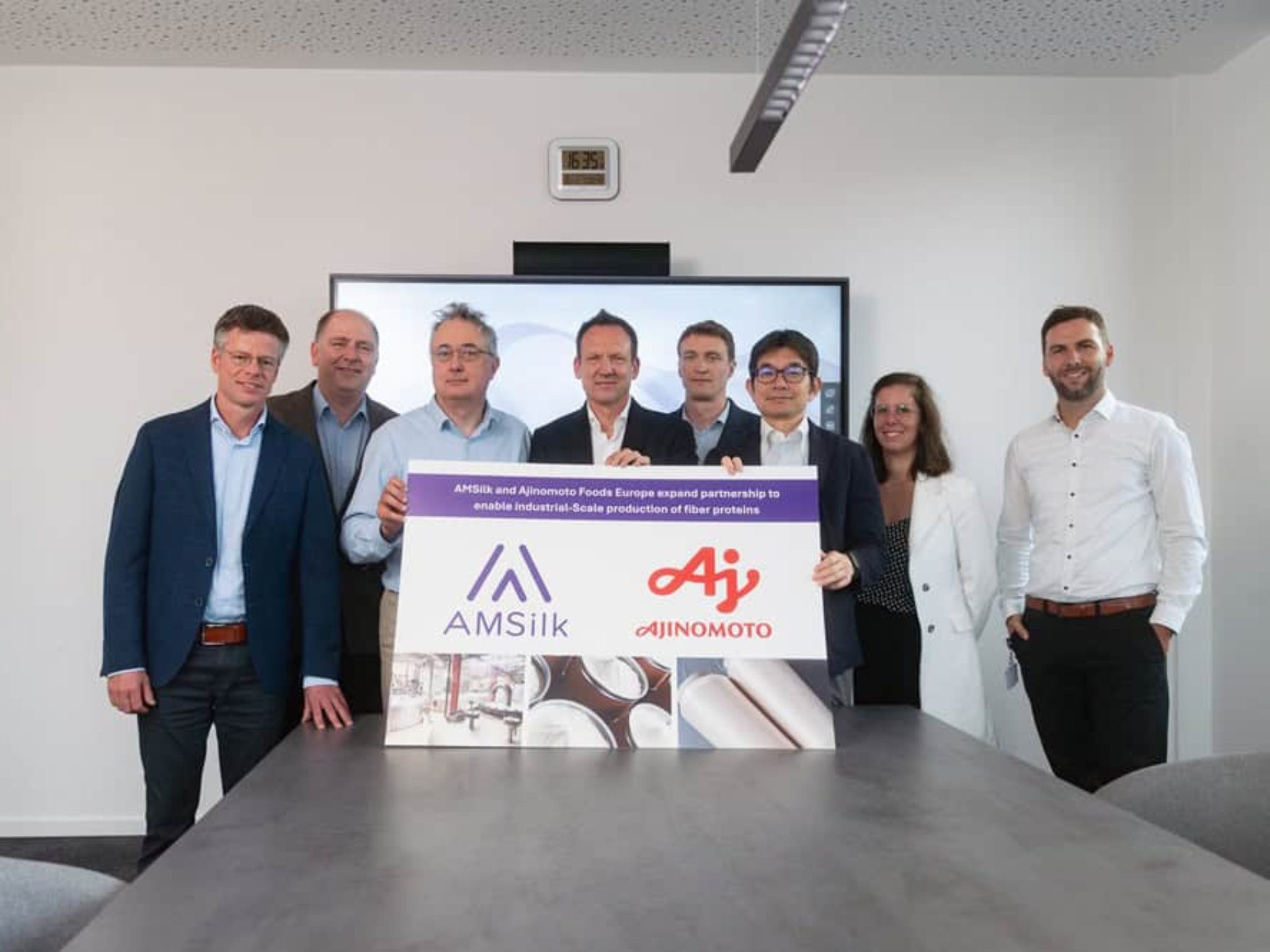
German biomaterials firm AMSilk has extended its collaboration with Ajinomoto Foods Europe to enable industrial-scale manufacturing of its bioengineered spider silk proteins.
Three years after forming their strategic collaboration, German bio-based silk maker AMSilk and industrial fermentation giant Ajinomoto Foods Europe are doubling down on their manufacturing partnership.
The two companies have now entered into a long-term manufacturing and supply agreement to enable the transition from industrial validation of AMSilk’s bioengineered silk proteins to dedicated, large-scale production.
As part of the deal, Ajinomoto Foods Europe will establish a dedicated line for producing AMSilk’s materials at its biomanufacturing site in Nesle, France, built on a multi-million-dollar joint investment in equipment, installation and facility upgrades.
The setup is based on a 160-cubic-metre bioreactor capacity, combined with customised downstream processing capabilities. The purpose-built manufacturing environment is designed exclusively for AMSilk’s proprietary biotech process.
“We are proud to expand our strategic collaboration with AMSilk, further demonstrating AFE’s capabilities as a trusted contract-manufacturing partner in industrial biotechnology,” said Hiroshi Kaneko, president of Ajinomoto Foods Europe.
Using AI and fermentation to reimagine silk
A pioneer in the industrial biomaterials space, AMSilk leverages AI-driven protein engineering and precision fermentation to produce recombinant spider silk proteins.
The firm programmes bacteria with the genetic code of spider silk, which are then fed with nutrients and sugar in a bioreactor to multiply. The silk protein is isolated from the biomass in a downstream process through multiple steps, leaving a light-coloured liquid.
This is then spray-dried to evaporate the water and leave a white powder, which is stirred into a solvent in the spinning mill. This mass is degassed and filtered to exclude impurities.
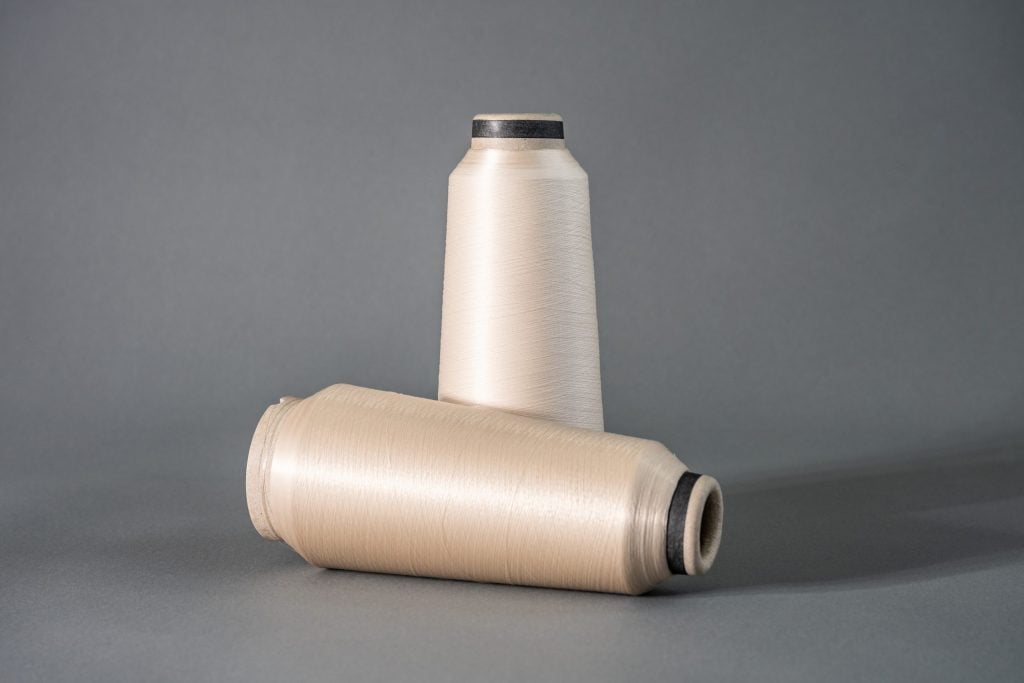
After this, the solution is pressed through a spinneret into an agglomeration bath, where the protein solidifies and molecules align. The fine filaments are stretched and combined to form a thread, which is passed through a water bath, dried on heated rollers, and wound onto a bobbin. When fully wound, this holds one km of the spider silk thread, weighing just 9g.
Aside from fibre and yarns, AMSilk turns these bioengineered proteins into sprayable silk formulations, hydrogels and silk powder for textiles, medical use, and CPG applications.
AMSilk’s yarns are either biodegradable or fully recyclable, and are based entirely on renewable carbon, eliminating the issue of microplastics, a major source of pollution and a detriment to human health.
A life-cycle assessment also shows that these biomaterials are far superior in their environmental friendliness, with AMSilk’s fibre generating 81% fewer emissions than mulberry silk, while using 92% less land and 97% less water.
These credentials have spawned interest from leading companies in the luxury, footwear and mobility sectors, including Mercedes, Airbus, Balenciaga, and Omega.
Collaboration leaves room for further expansion of precision fermentation capacity
“As we move into the next phase of growth, scaling our production capabilities is a key priority. With its strong manufacturing expertise and strategic location in the heart of Europe, Ajinomoto Foods Europe is an ideal partner to support this growth,” said AMSilk CEO Christian Wichert, who took over from his predecessor Ulrich Scherbel last month.
”Leveraging our industrial infrastructure and our expertise in precision fermentation and downstream processing, we are well positioned to efficiently scale AMSilk’s silk proteins to commercial volumes and support their growth toward hundreds of tons per year and beyond,” noted Kaneko.
The Nesle facility is said to offer a strategically advantageous location to support supply chain efficiency, reduced lead times, and a competitive cost structure. In addition, it is integrated with locally sourced raw materials and a renewable energy supply, further enabling AMSilk’s sustainable and resource-efficient production philosophy.
At full performance, the new production line is expected to reach the manufacturing volumes of industrial-grade silk protein with consistent quality, significantly boosting AMSilk’s ability to meet expanding demand across the textile, automotive, and consumer care markets.
The collaboration provides a framework for further expansion by adding precision fermentation capacity in the coming years, strengthening Ajinomoto Foods Europe’s role as a strategic manufacturing partner within AMSilk’s network of industrial collaborations. This also enhances operational resilience and supply security.
”The addition of dedicated manufacturing capacity is an important step in translating our technology into sustainable commercial growth,” said Wichert.
”It strengthens our ability to reliably serve leading brands and supports our ambition to establish biotech-produced silk materials across multiple high-performance applications.”