

SCO2 Captures $2.7M in Funding to Create High-Value Products from Reclaimed Food Waste


US agrifood tech startup SCO2 has secured $2.65M in seed funding to advance its supercritical carbon dioxide extraction tech, which can recover valuable compounds from food waste for use in various industries.
SCO2, a Minnesota-based startup developing a platform to extract its namesake gas, has raised $2.65M in an oversubscribed funding round to accelerate its waste-to-value technology.
The firm has developed Nextract, an industrial supercritical carbon dioxide extraction technology that can recover and refine valuable compounds from underutilised biomass.
“These compounds can become premium ingredients for food and beverage, nutraceutical, beauty, pharmaceutical, and speciality chemical applications,” SCO2 CEO Michael Sigel said in a LinkedIn post.
These can include nutritive molecules like proteins, fats and sweeteners, techno-functional ingredients such as emulsifiers, stabilisers, and enzymes, sensory compounds like flavourings, acids and colourants, as well as bioactives ranging from prebiotics and amino acids to antioxidants and preservatives.
SCO2 outperforms legacy supercritical CO2 processes
Founded in 2019, SCO2 is modernising a technology that has been around since the 1970s. Supercritical CO2 is produced by applying high pressure and moderate heat to carbon dioxide, forcing it into a fluid state above its critical temperature and pressure.
Supercritical CO2 is prized for its non-toxic, non-fossil-based, and renewable profile and can replace harmful solvents in processes such as extraction and cleaning. It dissolves many compounds effectively without leaving residue, and is used in the food and industry to decaffeinate coffee beans and extract essential oils.
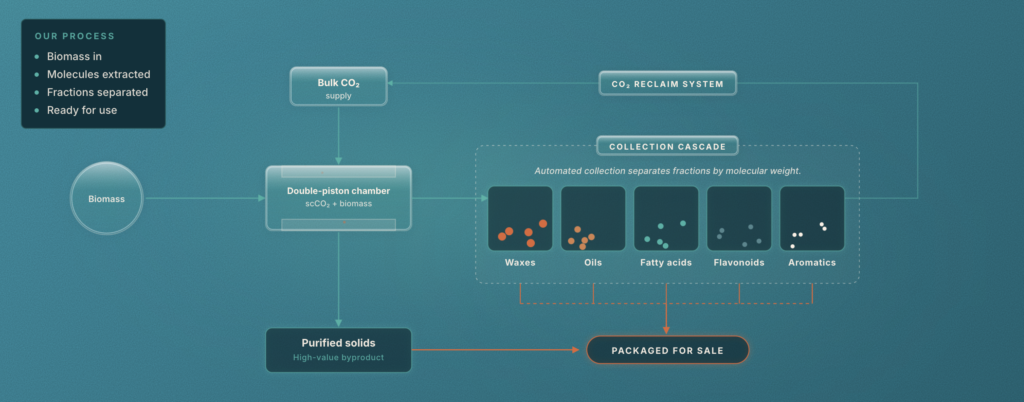
And while this form of CO2 is highly effective, it can be expensive to produce and scale up. That’s the gap SCO2 is targeting by leveraging its founders’ decades of experience to develop Nextract, which it calls a breakthrough technology. It replaces manual steps with automation and high-end electric pumps with hydraulics, handling molecular separation inline.
The startup applies this supercritical CO2 extraction to food waste, which is full of compounds like fibres, oils, bioactives and proteins. These are, however, locked inside material that gets composted, burned, or hauled away.
SCO2’s patented process sees this fluid CO2 move through five controlled pressure stages, separating moleculed by mass and capturing each fraction cleanly, without any solvents or additional steps.
Compared to legacy supercritical CO2 processes, whose cycles take anywhere between 40 minutes to 60 hours, Nexture can extract the gas in less than 20 minutes. It also fits existing operations, doesn’t require any pre-processing steps, and can process 1-25 tonnes of biomass per hour (versus 2 tonnes a day for existing technologies).
Supercritical CO2 extraction can unlock enormous revenue returns from food waste
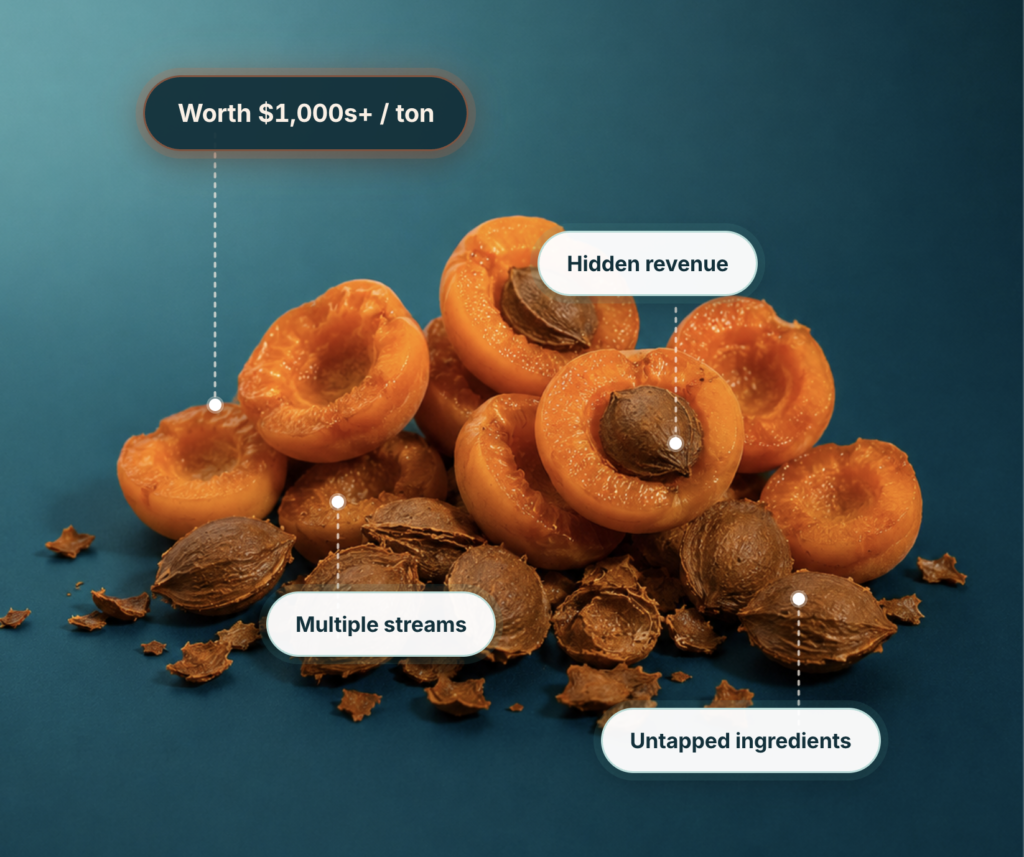
SCO2 is aiming to help manufacturers unlock new revenue streams from existing biomass and sidestreams, improve margins, reduce ingredient volatility, enable cleaner product labels, and boost supply chain resilience.
For instance, it can turn spent coffee grounds into coffee fibre or a cocoa powder alternative, and purify plant proteins by removing oils and undesirable flavours, odours and colours at industrial scale.
The tech can transform tomato pomace, valued at $3 per tonne and typically composted, into dietary fibre worth over $2,000 a tonne and linoleic-rich tomato seed oil (for the skincare and specialty culinary sectors) for nearly $1,000 per tonne.
Likewise, while wheat bran is usually sold as animal feed for $150 per tonne, the supercritical CO2 extraction could turn this into prebiotic fibre and protein with a value close to $3,900 per tonne and wheat bran oil for $1,200.
Globally, billions of tonnes of nutrient-rich material are currently being lost each year globally. UN data shows that a third of all food produced is wasted or lost, resulting in up to 10% of global emissions and $1T in economic costs.
SCO2’s technology pairs sustainability with financial benefits, underscoring the commercial potential that hooked investors. “SCO2 will use the financing to accelerate the commercialisation of Nextract, expand customer co-development programmes, scale its operations, and advance commercial deployments,” said Sigel.