

Teens Have the Most Polluting Diets, But Seniors Fuel Global Rise in Food-Related Emissions


A new study reveals the impact of age-related dietary patterns on climate change, with teens responsible for the highest greenhouse gas emissions and older populations the fastest-growing contributors. Meat is the biggest culprit.
Gen Z might have been deemed the climate generation at one point, but recent data has thrown that assertion into doubt.
In the last few years, research has shown that young people – especially men – are eating more meat and are less worried about its climate consequences than before.
Now, a new global study has solidified that trend, finding that teens and young adults (between 11 and 29) tend to have the most polluting diets, driven by higher consumption of meat, dairy and processed foods.
However, the 2.1-gigatonne rise in global dietary emissions between 2000 and 2019 was actually driven fastest by older populations, with people over 60 accounting for over a quarter of that increase, led by seniors in high-income countries.
“Understanding who contributes to dietary emissions is essential for designing effective climate solutions. Sustainable diets, therefore, need to account for differences across life stages, nutritional requirements and regional contexts,” said Yuli Shan, a professor at the University of Birmingham and co-author of the study.
Meat the single largest driver of dietary emissions growth

The study, published in Nature Food, looked at diets across 149 countries and 22 age groups, analysing emissions from 141 food products. The researchers combined global food consumption data, dietary surveys, population statistics, and consumption-based GHG emission inventories.
They found that rising meat consumption, especially red meat, was the single largest driver of food-related emissions growth, coinciding with worsening nutritional quality.
Previous research has shown how beef is the most polluting food, emitting twice as many emissions as the next-worst product. Red meat is also linked to greater risks of obesity, type 2 diabetes, cancer, heart disease, and early death.
While meat and dairy products were the major sources of dietary emissions in high-income countries, changing consumption patterns played an important role in emerging economies. In China, the rise in emissions was largely associated with increased meat intake. In India, however, it was a shift towards more dairy products.
“In emerging economies, rising incomes are driving increased consumption of animal products, sharply increasing emissions among younger populations. This creates a growing dilemma for policymakers, namely, how to reduce emissions without undermining nutrition,” said Shan.
As for the rise in food-related emissions among older people, this is simply due to there being more of them (as a result of longer lifespans and fewer children), not because their diets are especially harmful.
“Older people are often seen as having a higher contribution to carbon emissions. We found a more nuanced pattern: The increasing contribution of seniors to dietary emissions is driven largely by population ageing (a rising share of seniors in the population), rather than more carbon-intensive diets among seniors,” said Yanxian Li, who contributed to the research.
Policy interventions should be tailored to age groups and development stages
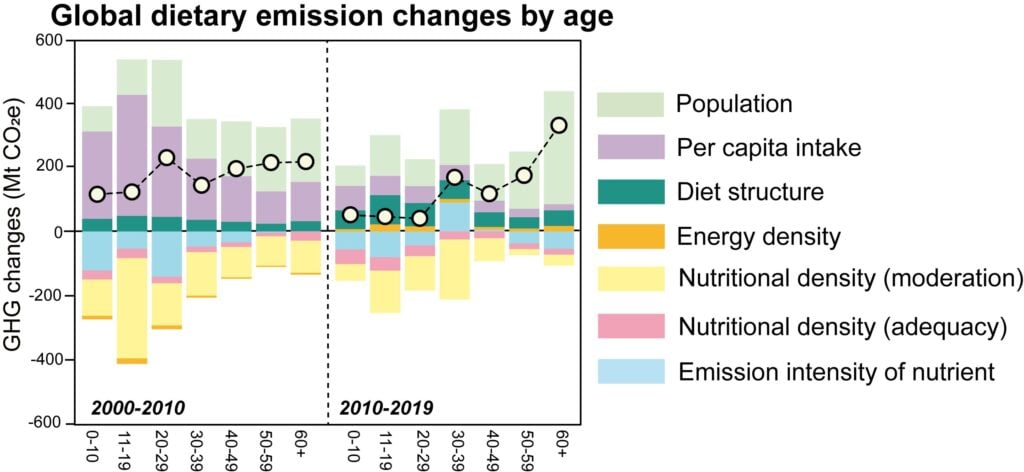
The researchers call for a shift away from a one-size-fits-all approach that focuses solely on diets, and instead advocate for targeted strategies that account for demographic shifts, dietary patterns, nutritional needs, and regional differences.
For instance, teens and young adults eat more high-emission foods, such as meat, dairy, and sugary products. In developing countries, as incomes rise, people consume more food overall, which increases associated dietary emissions.
To tackle this, policymakers should prioritise education and behavioural change, particularly through reforms that encourage schoolchildren to switch to healthier, lower-carbon meals.
Meanwhile, in more affluent regions like the US, Western Europe, and Japan, older adults now account for 22-29% of national dietary emissions. So policy efforts should focus on low-emission, nutritionally adequate diets for ageing populations.
Shan added: “Our findings challenge the dominant narrative that older populations are the most carbon-intensive consumers and prompt policymakers to face some tough challenges.”
In low- and middle-income nations, nutritional needs must be balanced with sustainability transitions, alongside increased investment in local food systems, productivity, and access to diverse diets.
“In many low- and middle-income countries, dietary shifts toward certain nutrient-rich foods have improved nutritional quality, but have also contributed to rising emissions. This means that simply reducing certain types of food may have unintended health effects,” said Klaus Hubacek, a professor at the University of Groningen and co-author of the study.
“We must rethink climate responsibility or face a policy blind spot if interventions focus on only one age group – identifying clear intervention points by age group, whether children and adolescents, young adults, or seniors,” added Shan.