

Independent LCA Confirms Savor’s Carbon-Derived Fats Cut Emissions By Up to 98%

US food tech startup Savor asked scientists to independently verify the climate gains from its carbon-derived fats, which were found to lower emissions by 50-98%.
Savor’s agriculture-free fats dramatically slash the climate footprint of butter, palm oil, cocoa butter, and other conventional lipids, a new independent life-cycle assessment (LCA) has shown.
The Californian firm employs a thermochemical process to convert point-captured carbon, green hydrogen, and methane into climate-friendly short-, medium-, and long-chain triglycerides to replace incumbent fats and oils in food and cosmetic applications.
In an important validation for the alternative fat industry, third-party analysis has confirmed that Savor’s technology can cut the greenhouse gas emissions of fats by 50-98%, depending on the lipid they’re replacing and the carbon source they’re using.
The LCA was conducted by Boundless Impact Research & Analytics and conforms to multiple ISO standards. “Across every major category, Savor’s process cuts the climate footprint of fats and oils by roughly half to nearly all – and the advantage is largest where land matters most,” Savor co-founder and CEO Kathleen Alexander wrote in a blog post.
“We’ve measured our process, and independent verification confirms both the impact available today and where the most powerful opportunities lie as we scale and the grid decarbonises,” she added.
Land use change and carbon opportunity costs amplify impact
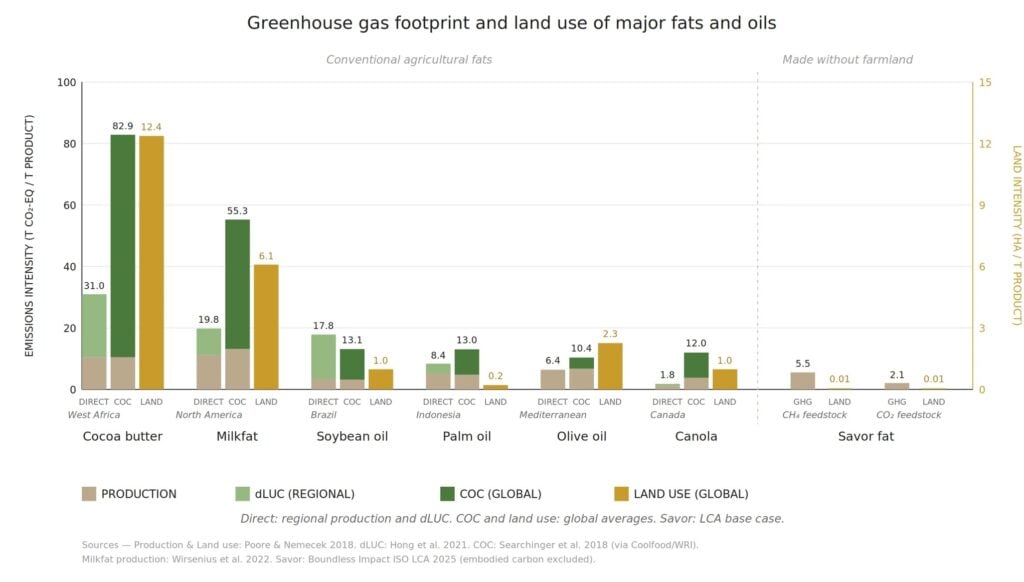
The LCA found that under today’s conditions and an average US grid mix, a kg of Savor’s fat roughly emits 2.1kg of CO2e when it sources its carbon from CO2, and 5.5kg when it does so from methane.
Aside from the carbon source, this footprint is driven by how much energy the process consumes and how clean that energy is. For agricultural fats and oils, the emissions range from 2kg to 30kg of CO2e, including direct land use change. But the LCA explicitly excluded Savor’s impact of land use emissions; when these are counted, the climate gap becomes even wider.
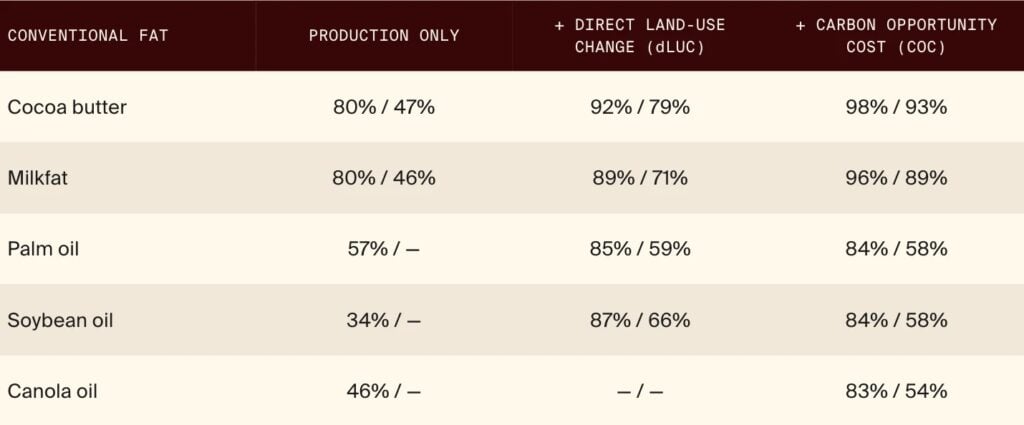
For instance, when accounting solely for production emissions, the company’s carbon-sourced fat cuts emissions by 80% compared to cocoa butter, though this rises to 92% when you include direct land use change emissions. Likewise, the emissions reduction goes from 80% to 89% for milk, and 57% to 85% for palm oil.
There are even bigger gains when you take into account the carbon opportunity costs (COC), or the amount of carbon land could be storing if it weren’t in agricultural use.
Factoring this metric in, Savor’s emissions cuts reach 98% in comparison to cocoa butter and 96% to milkfat, when its alternative fat uses carbon sourced from CO2.
“Production emissions account for less than half of the impact of most fats and oils. When impact is assessed on a COC-basis and the full potential of the carbon that land could be storing is considered, Savor’s low-land use production maps to a dramatic opportunity to reduce emissions across every category,” Alexander explained.
“Because Savor’s fats require so little land to produce, their full climate potential isn’t realised on production alone – it depends on what happens to the land that’s no longer needed: preventing future deforestation, and, ultimately, enabling the active restoration that turns a low-footprint product into a net-positive one,” she added.
To approach a zero-emission footprint, the company can source its carbon from captured CO2 on an entirely decarbonised grid. “Unlike a crop whose footprint is largely fixed by biology and geography, our footprint will continue to approach this minimum as our efficiency improves with scale-up and the grid decarbonises,” she said.
Savor eyes land restoration projects amid scale-up
Savor’s first product was its EcoButter, which has been self-affirmed as Generally Recognized as Safe (GRAS) in the US and appears in baked treats and confections at establishments in San Francisco.
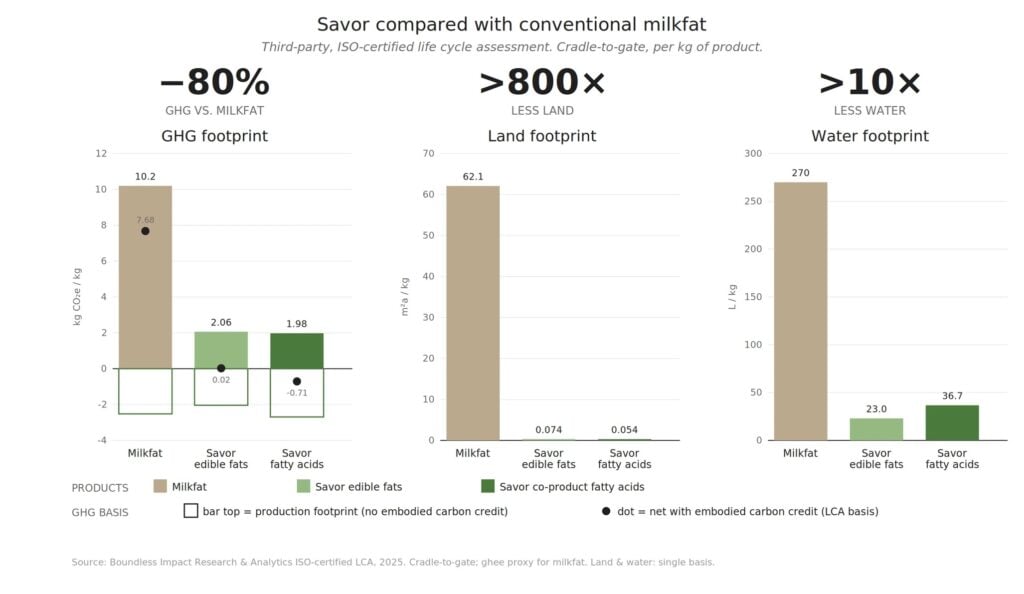
The third-party LCA found that its carbon-derived fat brings down greenhouse gas emissions by over 80% compared to conventional milkfat, while using over 800 times less land and 10 times less water.
The food tech company noted that its full emissions reduction opportunity depends on land use and isn’t realised unless the transition “either prevents future deforestation or actively restores native ecosystems to their full carbon potential”.
Because its fats free up the land that conventional lipids would have required, that land becomes available for something else – that includes restoration. “A product that occupies almost no land doesn’t just avoid emissions; it can create room for carbon to be pulled back down,” Alexander said.
“That turns a low-footprint product into a potentially net-positive one, where the same production that displaces land-intensive fats and oils also underwrites the restoration of the land it no longer needs.”
To showcase this impact, she pointed to an analysis for Savor’s cocoa butter substitute, which replaces a palm-kernel-derived fat. Each tonne of its alternative spares 0.23 hectares of land in palm-growing regions – reforesting this land could take the net footprint from 5.5 kg to 2.4kg of CO2e per kg.
“We’re actively developing our workstreams on this front – the partnerships, the accounting, the mechanism by which restoration gets funded and credited,” said Alexander.
The LCA comes shortly after Savor raised $32M to scale up production from a few tonnes to a couple hundred per year. Among the investors in this round was AAK, a Swedish speciality fats leader that has struck a two-year joint development agreement to commercialise the startup’s fats for use in dairy alternatives and baked goods.
And earlier this year, it launched a beauty and personal division with four ingredients targeting problematic fats like palm oil. The firm has secured $65M to date (with investors including Bill Gates), and eventually plans to raise a Series B round to build a 10,000-tonne facility.