

Can Oyster Mushrooms Unlock the Umami Potential of Tofu’s Protein-Rich Byproduct?

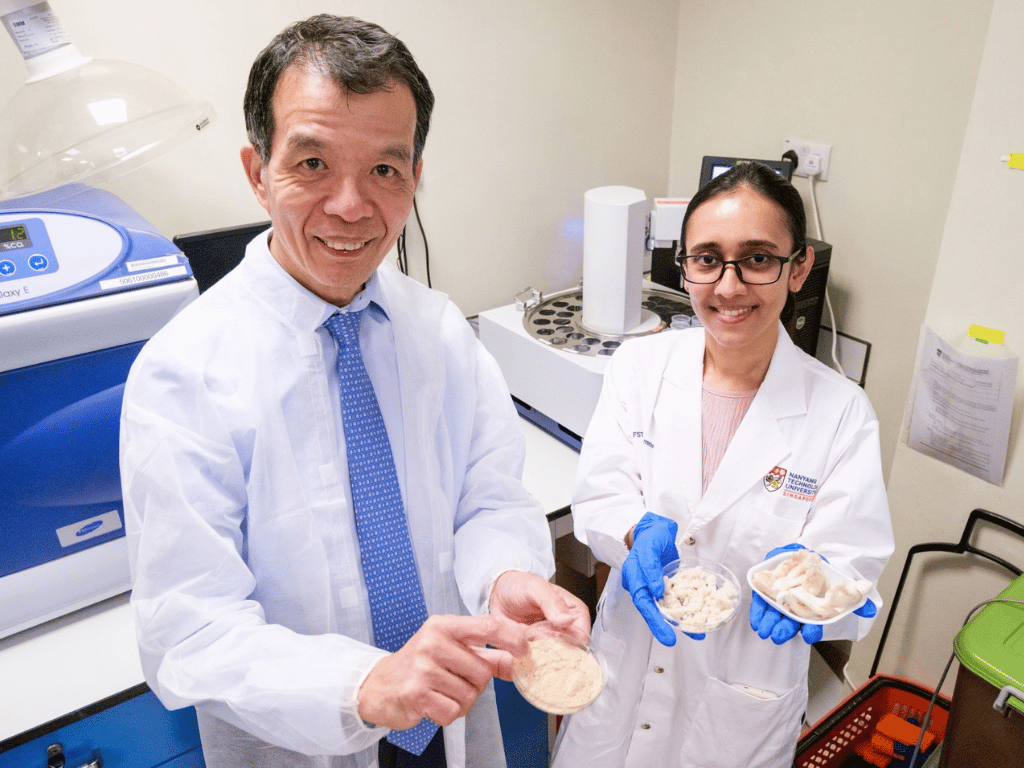
Scientists at Singapore’s Nanyang Technological University have developed a mycelium fermentation process to transform okara, the leftover pulp from soy milk and tofu production, into an umami-rich ingredient.
At Singapore’s Nanyang Technological University (NTU), scientists have come up with a fermentation method that uses oyster mushroom mycelium to transform okara, the pulp left over from the production of soy milk and tofu, into a high-value ingredient rich in protein and umami.
Okara is produced in large quantities, but its high moisture content makes it highly perishable. It also has a high insoluble fibre content, coarse texture, and slightly sour flavour – attributes that limit its valorisation for human food applications. As a consequence, this sidestream is often discarded or used as low-value animal feed.
But NTU’s process, demonstrated at lab scale, shows that fermenting okara with mycelium can improve its nutritional and flavour profile, making it a more palatable ingredient that could lower food waste and support the circular economy.
“Our findings show that oyster mushroom mycelium can naturally improve okara by changing its composition and producing compounds that give it a savoury, umami taste,” said Prof William Chen, director of NTU’s food science and tech programme at the School of Chemistry, Chemical Engineering and Biotechnology (CCEB).
“In addition, a separate study by my team also showed that oyster mushrooms grown on a substrate containing okara have enhanced nutritional value,” he stated.
Mycelium helps elevate protein content of okara
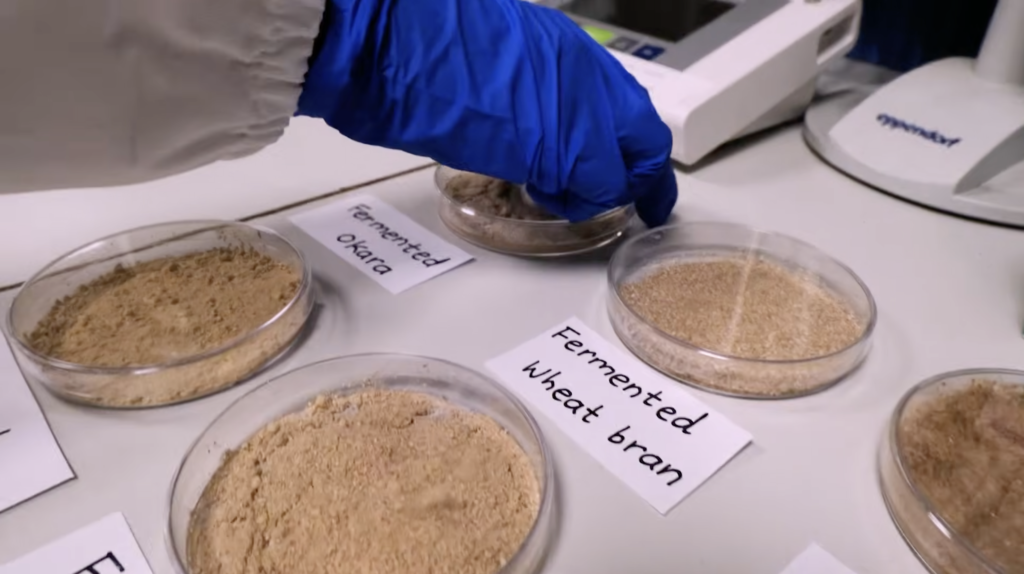
Working with Japanese food manufacturer Ichimasa Kamaboko, NTU’s researchers used solid-state fermentation to explore how to fine-tune okara’s properties. This is a form of biomass fermentation that involves growing microbes atop a moist solid surface.
They tested various formulations, including fresh okara, dried pulp, and okara blended with mushroom-growing materials like wheat bran and sawdust. The fresh okara supported dense growth of the oyster mushroom mycelium, which covered the material in an 11-day lab incubation period.
As the fungus grew, its natural enzymes broke down the okara’s complex plant fibres into simpler, easier-to-digest nutrients. This released beneficial sugars and amino acids, which are the building blocks of protein.
In fact, fermentation raised the nitrogen level of okara, an indicator of protein content, with analysis showing that the ingredient’s protein concentration increased to between 27.7-30.2% by dry weight. Further, the process elevated glucose concentrations by 2.8-6.4 times from low initial baseline levels, as the mycelium converted complex carbs into simpler sugars.
“Okara is a soybean by-product that is rich in nutrients, but its high fibre content, short shelf life and less appealing flavour have long limited its use in food products for people,” said Chen.
“This proof-of-concept approach offers a promising way to turn okara into more valuable food ingredients instead of discarding it, though further research is needed to evaluate pre-treatment requirements, energy efficiency, scale-up feasibility and production economics alongside food safety and consumer acceptance,: he added.
Fermentation boosts amino acids responsible for umami notes
To analyse the flavour changes in the fermented okara, the researchers used an electronic “tongue” device equipped with chemical sensors to objectively measure different taste traits. The sensory evaluation confirmed that the fermentation reduced sourness and significantly enhanced umami and overall richness.
This is because the fermented version contained 2.2-6.6 times more free amino acids than unfermented soy pulp, which naturally contains low baseline levels. Among these, glutamic and aspartic acids – the principal molecules responsible for umami flavours – increased by up to 4.1 times. Fresh okara, in fact, recorded the highest concentration of savoury amino acids among all tested media.
The fermentation process further boosted 5′-nucleotides, a class of natural flavour boosters that work together with amino acids to intensify umami notes, by 3.2-6.3 times.
Meanwhile, succinic acid, known for its savoury profile, became the predominant organic acid post-fermentation, witnessing a surge of nearly 15-fold in certain formulations. On the other hand, citric acid – a precursor of sourness – generally decreased after fermentation.
These natural chemical shifts explain the stronger umami notes and reduced sourness recorded by the electronic tongue. However, the researchers noted some increases in bitterness and dryness in some samples. That may be linked to changes in bitter-tasting amino acids and other compounds, some of which may have potential health benefits.
The findings therefore highlight the need to further refine the fermentation process to achieve a balanced and appealing flavour profile overall. But the study, published in Food Chemistry: X, does show how oyster mushroom mycelium can convert an underutilised sidestream into a nutritious, tasty ingredient.
The NTU team will now evaluate operational energy needs; verify food safety, storage stability, aroma profiles, and human sensory evaluation; optimise fermentation parameters; and assess the financial viability to potentially scale up the fermented okara.
“Rather than treating okara solely as a waste stream, our research demonstrates that mushroom fermentation can create new, high-value opportunities to use this soybean by-product in food applications, contributing to a more circular and sustainable food system,” said Malsha Samarasiri, a research fellow at NTU’s School of CCEB, and first author of the study.