

European Think Tank Launches Regulatory Sandbox for Novel Food Startups


Netherlands-based think tank the Ministry of Future Affairs has established a novel food regulatory sandbox to help startups gain insight into pre-submission advice for the approval of innovations like cultivated meat.
If the EU won’t do it, we will, says a Dutch think tank.
Last year, the European Commission proposed excluding novel foods from the food and feed regulatory sandboxes it introduced under the first Biotech Act. These are controlled environments that let businesses and researchers design standards and guidance for new products with regulators.
Everyone from trade groups representing the world’s largest food companies to member states and MEPs has pushed back against the proposal, with parallels drawn with the UK’s fruitful cultivated meat sandbox, which has resulted in the publication of a host of guidance documents over the last year.
As discussions in the European Parliament and Council continue, there’s still a chance the exclusion is overturned. The Ministry of Future Affairs, a think tank based in the Netherlands, isn’t waiting around to find out.
Weeks after the European Food Safety Authority (EFSA) admitted a need to boost regulatory expertise and clarity for novel foods, the group has launched the New Foods RegLab, a cross-border sandbox designed to work with novel food applicants and provide pre-submission advice for approval of their innovations, which include cultivated meat and precision-fermented proteins.
It takes inspiration from the UK Food Standards Agency’s aforementioned sandbox, with British firms encouraged to apply before the November 30 deadline. It also comes as the UK and the EU finalise a new Sanitary and Phytosanitary (SPS) agreement, which could force companies looking to enter the former market to go through the latter’s notoriously long and complex novel food process.
“We want closer UK-EU cooperation to work for both sides. Britain has been running Europe’s first novel foods sandbox and has produced a strong body of regulatory learnings, but with novel foods sitting outside the Biotech Act’s sandbox, there has been no formal route for any of it to reach EU regulators,” said Marnie Hewat, programme manager at the London-based Alternative Proteins Association.
“The RegLab gives it one! That means building understanding of these technologies ahead of the applications rather than during them, which is better for innovation and for trade in both markets.”
Findings from regulatory sandbox to be shared with EFSA

The New Foods RegLab is described as an EU-focused regulatory learning platform built as a prototype to identify gaps in the novel foods framework and use those learnings to inform the design of future pre-submission advice.
A systematic understanding of how applicants interpret and apply existing guidance will help identify opportunities to strengthen applicant support and preparation. That will, in turn, reduce delays from a lack of understanding of the EU’s novel food approval process. So far, though, that understanding has not specifically been tested with applicants as regulatory users.
The sandbox, first announced last year, will comprise 10 startups across product categories and company sizes, who will spend two days engaging with food safety regulatory experts who have been taking novel food dossiers through the EU authorisation procedure for over 15 years.
It will include a structured look at the firms’ regulatory positions and strategies to identify gaps and next steps, as well as a policy session on the introduction of pre-submission advice under the first and second Biotech Acts.
It’s open to companies planning to bring a novel food product to the EU market and aiming to boost their understanding and in-house experience of the approval process. Those based outside the EU are also eligible to apply, and a complete dossier or fully developed regulatory strategy is not required.
The workshop will be led by Atova Regulatory Consulting, which co-runs the programme with support from the Dutch Province of Zuid-Holland, the Limburg Development and Investment Company), and ROM-Nederland.
It will follow the Chatham House Rule, with anonymised findings shared with the European Food Safety Authority (EFSA) and the EU Commission as part of a framework of policy recommendations for the expanded pre-submission advice.
“The EU wants to introduce a much broader pre-submission advice for novel food applicants. However, this would only help one applicant at a time,” said Anna Handschuh, founder and managing director of the Ministry of Future Affairs. “Shared cross-border learning platforms as enhanced collaboration mechanisms can inform a whole system and support food safety, competitiveness, and strategic autonomy.”
Delays caused by knowledge transfer and process design, not regulatory rules
The sandbox is underpinned by a new paper, Building on Draghi: Regulatory Learning With The New Foods RegLab, the first in its Future Prototype series of solution-oriented proposals. It argues that the expanded pre-submission advice under the first Biotech Act should be complemented by a better, applicant-centred understanding of the questions companies encounter when interpreting and applying guidance documents.
It builds on former Italian Prime Minister Mario Draghi’s suggestion to enhance collaboration and proposes opt-in regulatory learning platforms across member states. These would share the knowledge gained from applicants and member states with the EFSA and the Commission, helping promote discourse on how regulations can keep pace with the rapid advancements in science, which have further been accelerated with the rise of AI.
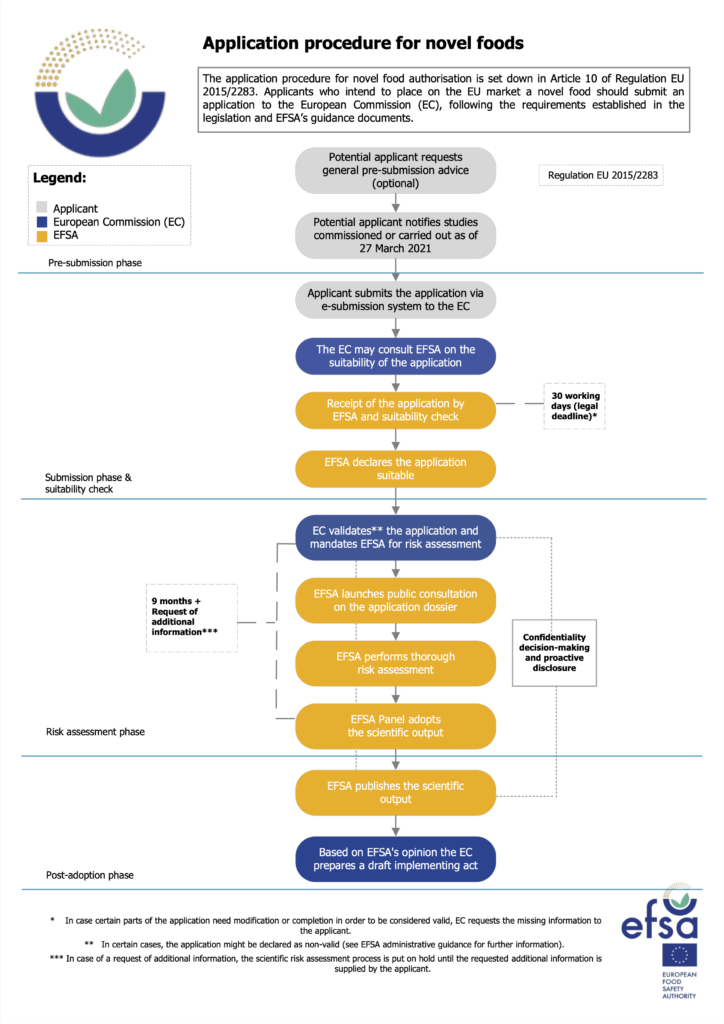
While the EU’s statutory timeframe for pre-market authorisation is 18-24 months, in reality, cases take 30 months on average, and some go on for over five years. Research shows substantial variability in the duration, with administrative steps during the validation phase and additional data requests during the scientific evaluation causing delays.
The paper suggests that these are problems of knowledge transfer and process design, not authorisation rules. There’s no institutionalised mechanism for enhanced collaboration that passes on what’s learned at a national level to the EU-wide regulator, and specialised novel food expertise in member states has declined.
Through the Future Prototype, the think tank proposes a targeted provision for member states to set up joint regulatory dialogue and learning platforms under the first Biotech Act, and a durable legal basis and EU-level funding to support shared tools, cross-border training, and structured reporting of findings to translate into EFSA guidance under the second.
Participating countries can report their learnings and the Commission can publish them and facilitate cross-border exchange. The model follows opt-in concepts that already exist in EU law, including AI regulatory sandboxes and the European Forum for Innovation Facilitators.
“The UK’s regulatory sandbox for cultivated meat has shown very well how regulatory learning should be organised to enable the regulator to keep pace with scientific development and thereby guarantee high food-safety standards,” said Handschuh.
“Europe – and its member States [that] want to move on and keep attracting industry investment – should have the opportunity to collaborate on regulatory learning. They can hugely benefit from the learnings from the UK. If embedded in EU legislation, Biotech Act I and II could provide a space to enable regulatory learning, without changing a single safety requirement.”