

Umami Bioworks Gets EU Registration to Sell Two Cultivated Fish Products for Pet Food


Singaporean food tech startup Umami Bioworks has registered two cultivated seafood ingredients for pet food in the EU, and is eyeing a Q2 2026 launch.
In a year of milestones for the industry, cultivated pet food has landed on another.
Singapore’s Umami Bioworks, which specialises in cell-cultured seafood, has registered two pet food ingredients with EU authorities, paving the way for commercialisation in the EU.
While human-grade food still remains a fair way off, this is the third startup cleared to sell cultivated pet food in the EU. The two ingredients registered with the EU Feed Materials Register involve cultivated white fish, with one suspended in a liquid nutrient broth.
They’re classed under the register’s Category 10, which involves fish, aquatic animals and their derivative products. “This marks an important regulatory milestone for us and establishes a clear pathway to market,” Gayathri Mani, product manager at Umami Bioworks, tells Green Queen in an email.
“We’re already working with partners… We are targeting Q2 2026 for initial launches in the EU,” she adds, outlining that the development ensures it can now “move forward with the next steps to bring cultivated seafood into real products for pets in Europe”.
Further, the startup has announced a renewed partnership with California’s Friends & Family Pet Food Company, which earned its own regulatory approval for cultivated pet food in Singapore in June. It comes a year after the two firms first began collaborating.
“We have signed an MoU with Friends & Family Pet Food Company to bring cultivated seafood-based pet food to market, with initial launches planned in Singapore, the UK, and the EU,” says Mani.
Umami Bioworks’ EU registration covers cultivated white fish
In the EU, companies looking to sell animal-derived ingredients to pet food manufacturers need to meet legal requirements ensuring the ingredients are safe, and register as a user of animal byproducts.
There’s no pre-market approval process to sell feed ingredients, unlike human food ingredients. This means it isn’t the cultivated pet food ingredients that are subject to registration, but the facility producing these proteins.
Umami Bioworks’ cultured white fish is derived from a non-GMO cell line and grown in a controlled, antibiotic- and animal-free medium. The second ingredient is the same biomass, but suspended in a liquid nutrient broth. Both are described as sources of omega-3 fatty acids, protein and nutrients for pet food.
The startup’s pet food exploits go back to 2023, when it partnered with Canada’s Cult Food Science to unveil the Marina Cat brand of cultivated fish treats. “With nearly 90 million European households owning a pet and the region’s pet food market growing at over 5% annually, the appetite for innovation has never been stronger,” the company said.
Asked about the ingredient list of its future products, Mani says: “The EU Register of Feed Materials does not set inclusion rate limits. Inclusion levels will be determined by our pet food manufacturing partners, based on their specific formulations.”
Umami Bioworks, which merged with fellow cultivated seafood producer Shiok Meats in 2024, has additionally developed cultured Japanese eel and bluefin tuna for human food use, and is in the early stages of developing a white fish too.
“Our eel programme is the most advanced, with regulatory filings made in several key markets and production running at pilot scale. We are planning multiple product launch campaigns with our partners and will share more on those campaigns in the near future,” Mani told Green Queen last month.
“Our human food dossier is in the final stage of approval in Singapore. Applications to the EU, UK, Australia, and the US are planned for submission by the end of September 2025,” she says.
The startup has raised $7.5M to date. “We are preparing for our next round of fundraising to accelerate commercialisation and launch market-ready products,” she reveals.
Cultivated meat regulation continues to progress in 2025
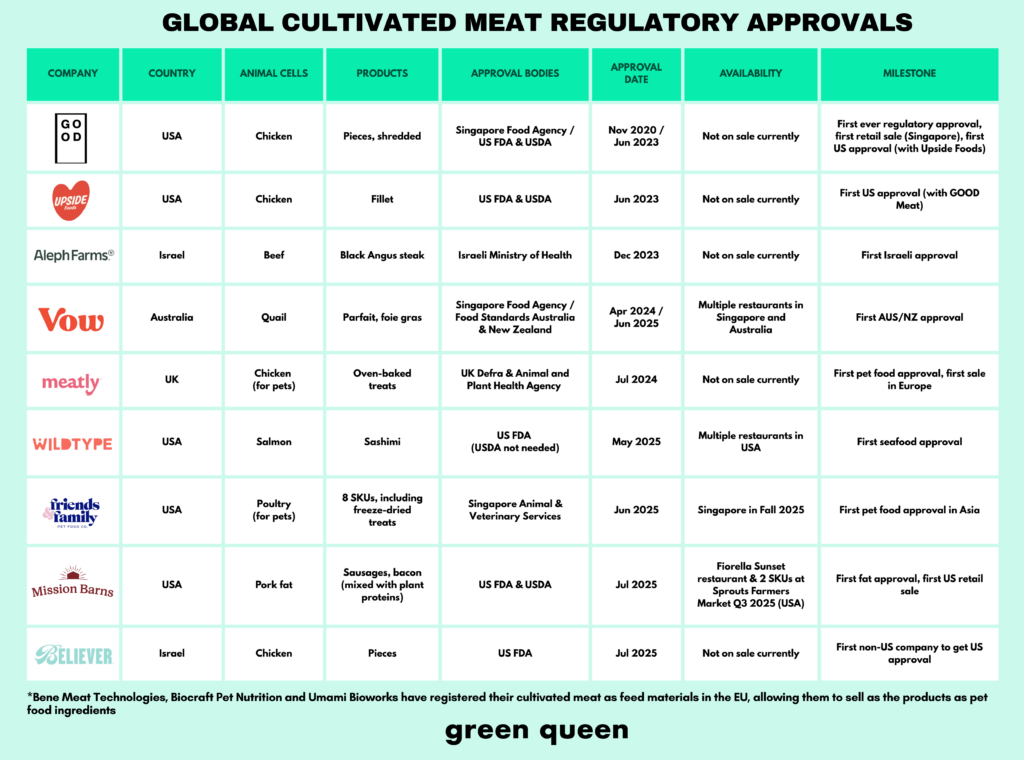
In March, Austrian-American firm BioCraft Pet Nutrition registered its cultivated mouse meat for pet food use in the EU, under the Category 3 animal byproducts category. Czech startup Bene Meat Technologies was the first to register cultivated pet food as an EU feed material back in 2023, although it did so under the fermentation category instead of as an ABP. It has since filed an application to the US Food and Drug Administration.
Speaking of which, Cult Food Science has conducted feeding trials in the US in pursuit of regulatory approval for its Noochies! brand.
Last year, London-based startup Meatly passed stringent inspections from UK regulatory bodies to receive approval for its cultured pet food, which made it onto Pets At Home shelves in a partnership with vegan dog food maker The Pack this spring.
And as reported by Green Queen, Friends & Family secured approval from Singapore’s Animal & Veterinary Services (AVS) to sell cultivated meat for dogs and cats. It will roll out eight SKUs this autumn.
It’s not just cultivated pet food that has seen a surge in regulatory progress this year. Four startups making cultivated meat for humans also received some form of approval. Vow got cleared to sell its cultured quail in Australia and New Zealand, following its Singapore green light in 2024.
Meanwhile, Mission Barns secured the US Department of Agriculture (USDA) green light for its cultured pork fat (its debut tasting event is next week), Believer Meats received a ‘no questions’ letter from the Food and Drug Administration (FDA) for its cultivated chicken, and Wildtype began selling its cultivated salmon after earning the FDA nod (the USDA doesn’t oversee seafood).
These developments may continue this year, with industry experts hopeful of approvals in Thailand and South Korea by the end of 2025, too.