

UMass Amherst Launches $120M Future of Food Initiative Backed By State Funding

The University of Massachusetts Amherst has kicked off a $120M Future of Food Initiative to establish R&D hubs focused on novel proteins, sustainable food production, precision nutrition, and more.
The state of Massachusetts has partially funded a new climate project to accelerate the future of the food economy.
The University of Massachusetts Amherst (UMass Amherst) has launched the $120M Future of Food Initiative, through which it will establish new R&D facilities and speed up interdisciplinary solutions to global food system challenges.
It will be funded through four $30M tranches from PBM Capital CEO Paul Manning and his wife, Diane; the state of Massachusetts; the university itself; and the remainder to be raised by the UMass Amherst Foundation.
“By bringing together researchers and partners across disciplines, this initiative will tackle some of the biggest challenges facing our food system, create new opportunities here in Massachusetts and help build a safer, healthier and more sustainable future,” said Massachusetts Governor Maura Healey.
University to create R&D and collaborative hubs
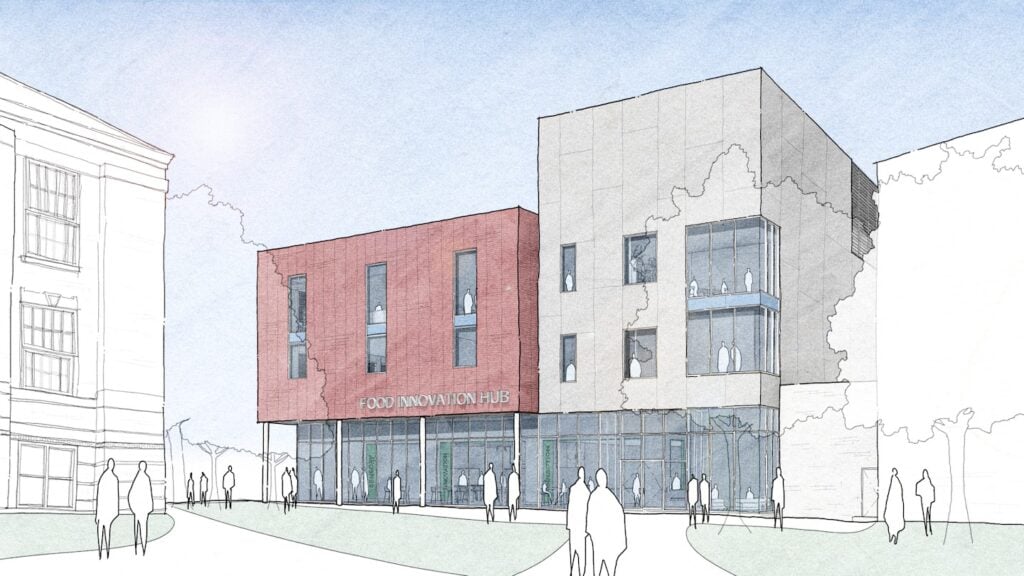
The funds will be used to build a 36,000-sq-ft Paul and Diane Manning Food Innovation Hub, which is set to break ground in late 2027. It will boost capabilities in research, innovation, and product development; sustainable process development; food safety and sensory analysis; consumer feedback; food entrepreneur training; and workshops.
Attached to the university’s Chenoweth Laboratory, the new building will feature sensory testing labs, innovation kitchens, a food-grade pilot plant, a clinical testing lab, a demonstration kitchen, and collaborative research labs.
UMass Amherst will also create a Center for the Future of Food (CFF) as an organisational structure pairing top-ranked faculty in food and agricultural sciences, nutrition, dining services programmes, and external partners with the translational research infrastructure of the Institute of Applied Life Sciences.
Together, they will explore all aspects of the future of food, from health and wellness and novel foods, to food safety, security, processing, and chemistry, to soil cultivation, seed efficacy, clean water, and food production.
The CFF is set to respond to major shifts in the food system with “significant societal and economic relevance” – think climate pressures, AI-enabled production, precision or personalised nutrition, and increased demand for food-as-medicine solutions.
The investment will further establish five permanent endowments (including a food science chair), interdisciplinary professorships, and a catalyst fund to drive long-term, groundbreaking research and innovation.
“With a changing environment and a growing global population, the future of food and agriculture is one of the most critical grand challenges facing our planet,” said Mike Fox, dean of the College of Natural Sciences.
“UMass Amherst is preparing to lead the nation in providing innovative solutions to real-world problems associated with food production, food safety, food sustainability, and foods for health and wellness.”
Massachusetts at the heart of future food transition
The university noted how the global food system is set to undergo a “profound transformation” driven by factors like novel proteins, advanced manufacturing, sustainable food production, precision nutrition, AI and robotics, advanced chemistry, packaging tech and biofilms, food safety, and water management.
Marty Meehan, president of UMass Amherst, revealed that the Mannings’ donation is the second-largest gift in the university’s history, suggesting that it reflected deep confidence in its mission and research capabilities.
“This historic donation […] will enable UMass Amherst to continue to lead the nation to find solutions to address the enormous challenges ahead such as the impacts of climate change on agriculture, feeding a growing world population, and better addressing connections between nutrition and public health,” he said.
Massachusetts represents around 45% of food system jobs and sales in New England, so UMass Amherst plays a pivotal role in regional food security, workforce development and industry innovation.
The university noted that the agrifood sector has been one of the few clusters in the region to sustain growth over the last decade. And a recent report by the Western Massachusetts Economic Development Council identified “food science, non-pharmaceutical biomanufacturing and the food ecosystem” as a top economic development opportunity for the state.
This Future of Food Initiative can help lift the regional economy by growing new businesses, bolster farmers and the local food industry, expand the pipeline of trained talent, and support adjacent industries like biomanufacturing, renewable energy, and animal feed.
Massachusetts is a trailblazer in government support for the future of food. It’s home to Tufts University, which runs the Center for Cellular Agriculture, and will this year open the Foodtech Engineering for Alternative Sustainable Technologies hub, partly backed by a $2.1M grant from MassTech, the state’s public innovation agency.
In 2024, the state pledged $2.2B for climate tech and alternative proteins through the Economic Development Bill, with Senator Barry Finegold telling Green Queen at the time: “We feel that food science is going to be a big part of the future. And food science is not only good for the economy, it’s good for the climate, and it’s good for our health.”