

Americans Aren’t Unaware of Food Waste – They’re Just Too Busy


A new study reveals that losing track of food and being too busy are among the key drivers of household food waste in the US. Retailers, manufacturers, and policymakers are all part of the solution.
An American family of four throws away roughly $3,000 worth of food every year, amounting to 73kg per person. In fact, 31% of the US food supply ends up being wasted, and 35% of that happens in the home.
As inflation drives up food prices (in some cases, to record-highs) and cuts to food assistance programmes threaten food security, food waste is in full focus, especially since the country is aiming to halve it by the end of the decade.
The Biden administration launched the country’s first national food waste policy last year, while 12 states have already restricted or banned organic waste. However, household food waste is still the major pain point.
A new report by the World Resources Institute (WRI) highlights the true cause driving individuals to throw away so much food, and how best to tackle this epidemic. It conducted a systematic review and two surveys to identify the leading drivers of food waste, and tested three behavioural change solutions in a simulated supermarket.
Supported by the UN Environmental Programme and the US Environmental Protection Agency, the researchers found that the ability to manage food (making too much or not knowing what to do with it) and the opportunity to engage in preventative behaviour (like losing track of food and simply being too busy) are the biggest causes of household food waste in the US.
How food waste drivers differ across the world
The report was based on the motivation-opportunity-ability (MOA) framework, which outlines how household food waste is a result of multiple factors working together, and so each must be addressed simultaneously.
For example, if people are concerned about the environmental impact of food waste (it accounts for up to 10% of global emissions) but lack the time or cooking skills to manage leftovers, waste will persist until the latter elements are tackled.
WRI’s analysis demonstrated how American homes differ from other high-income countries when it comes to waste-related behaviour. They conducted a survey involving people in the US, the UK, the Netherlands, and Australia.
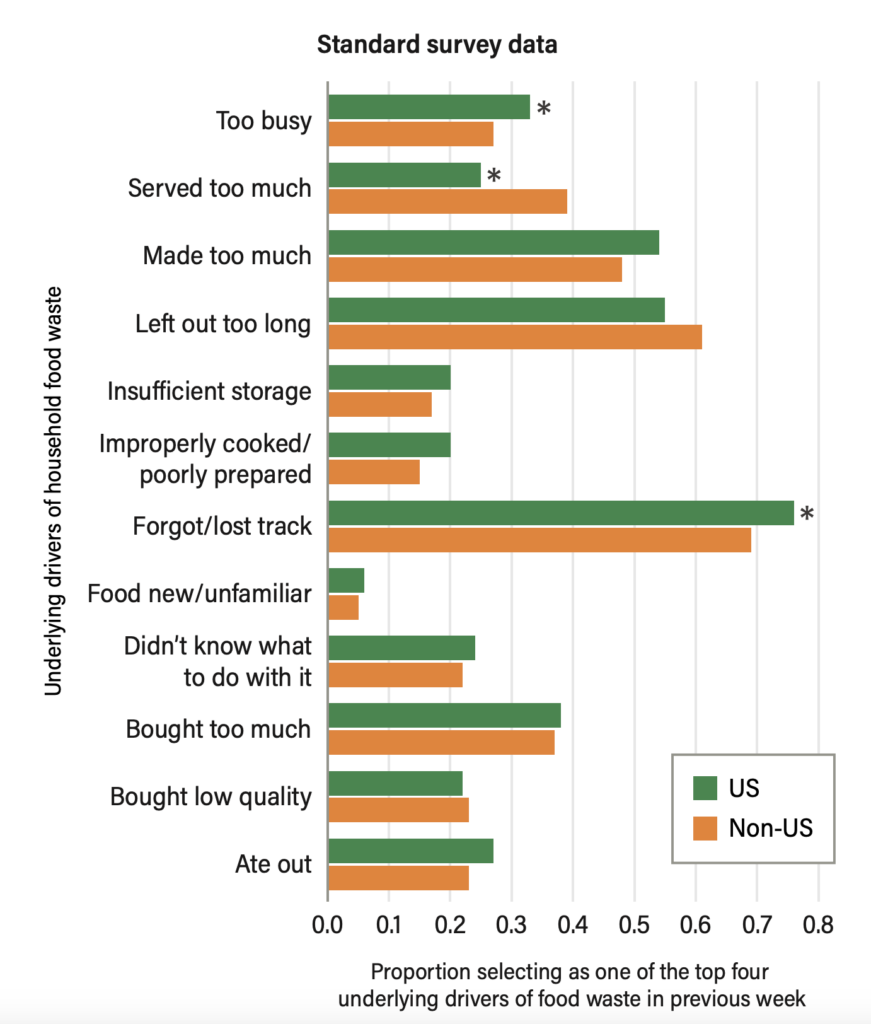
When exploring the immediate reasons that participants wasted food on the most recent occasion, Americans were more likely than others to say that the discarded items were inedible parts of food, were not tasty, or there was too little left. Conversely, foods going past their expiration date or spoiling weren’t as big an issue for US consumers as their survey counterparts.
When asked about the drivers of food waste over the previous week, forgetting or losing track of food was cited as the biggest factor in each country, though this was significantly more likely among Americans.
Moreover, making too much food was a top cause, as were not knowing what to do with excess, expiring, or leftover food at home, and being too busy to manage food at home; in each case, US respondents were more likely to report these behaviours.
US participants reported more frequently binning food that was past its expiration date when preparing and storing it, and were less likely to eat or cook food past its best-by date, despite items having no obvious signs of spoilage. And though Americans were more likely to eat leftovers as a meal by themselves, they also reported more frequently throwing leftovers away because no one wanted them.
On the flip side, consumers in the UK, Australia and the Netherlands are more inclined to throw out food because it’s been left out too long, or they served too large a portion.
Different factors require specific solutions
WRI conducted three trials in a simulated online grocery store to explore the impact of three behavioural change solutions: selling smaller or single items at the same price as larger or multi-packed ones; adding messages to fresh foods and their canned/frozen counterparts to encourage buying those that last longer; and providing pre-filled baskets based on prior shopping date or meal plans.
Though the findings were largely inconclusive (largely because the virtual shopping behaviour was unrealistic), all interventions influenced people’s attitudes in ways that could reduce food waste. The researchers noted that trials in real-life supermarkets, with real money and products, may expand upon these findings.
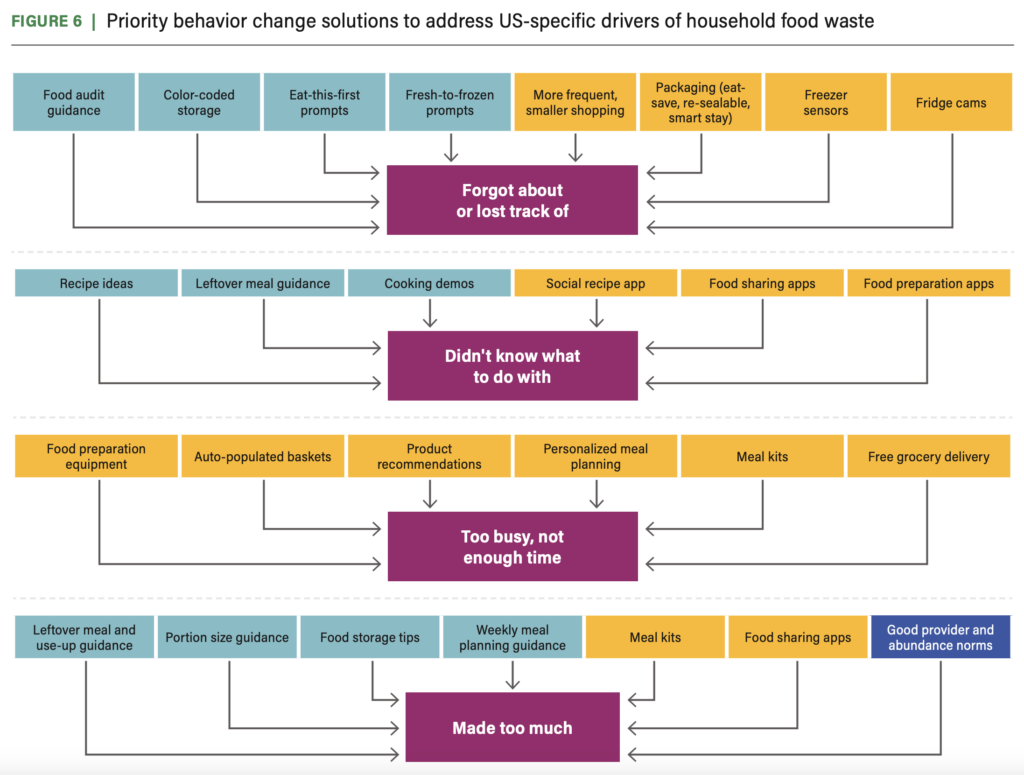
There are a host of ways to address each of the drivers identified. For those losing track of food waste, solutions range from buying non-perishable food and putting “eat me first” stickers in the fridge to freezer sensors and food inventory apps. Retailers play a key role here: an innovative action would be to sell a pack of avocados where two are ripened and two require some more time.
To encourage busy consumers to waste less, meal kits and personalised meal planning tools can be handy, alongside free grocery delivery. Meanwhile, waste-focused recipe ideas and food-sharing apps can help people who don’t know what to do with food, and portion size guidance, ideas for using up leftovers, and food storage tips could mitigate waste derived from making too much food.
Companies and policymakers all have a role to play

Further, the report highlights specific actions that businesses and policymakers can take to help lower food waste. Food manufacturers should adopt novel packaging and preservation techniques to extend the shelf life of fresh foods, and promote canned or frozen goods by ensuring their continued availability.
Retailers could provide tools to optimise shopping habits, stock longer-lasting foods, provide recipe and storage tips, and encourage changes to the frequency of grocery trips. Pricing strategies that discourage overpurchasing are also important.
Governments, for their part, can propose legislations that shape consumer behaviour (such as standardised date labelling), fund further research to identify cost-effective and scalable solutions, and support non-profits’ efforts to reduce household food waste through effective behavioural change campaigns.
“The burden should not be on households alone to solve the problem. Food waste is a systemic problem that requires a systemic solution,” said Crystal Davies, WRI’s global director of food, land use and water. “And so, food manufacturers, retailers, city leaders, and others must step up to help households do more with the food they buy.”