

Beyond Meat Endures Another Poor Quarter As It Charts New York Rollout of Protein Drinks

Beyond Meat experienced a 15% decline in sales in Q1 2026, with hopes of a turnaround hinged on retail launches of its plant protein drinks and mycelium steak.
After posting its worst financial year as a public company in 2025, this year wasn’t off to a much better start either for Beyond Meat.
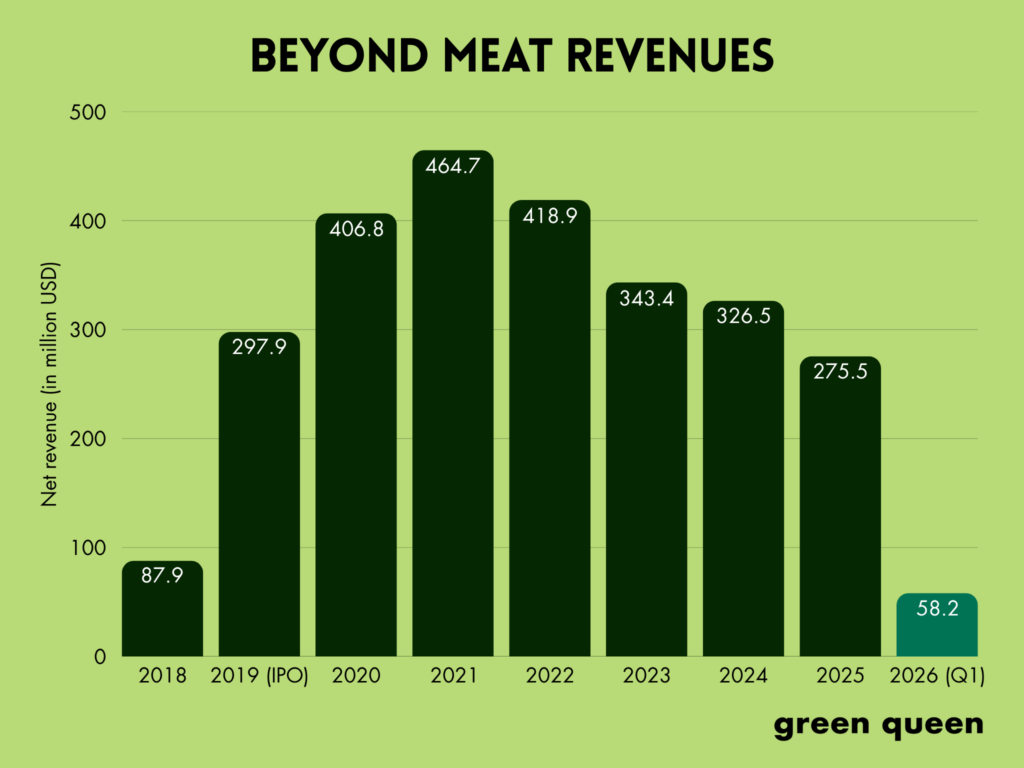
The Californian plant-based pioneer recorded revenues of just $58.2M in the first three months of 2026, a 15.3% year-on-year decline. This was its lowest quarterly total since 2019, in line with analysts’ forecast of $58.1M.
Its volumes fell by 19.5% from Q1 2025, and the company’s outlook for the second quarter has been limited to $60-65M, below analysts’ expectations of around $67M.
That said, the Beyond Burger maker’s gross profit totalled $2M in the January-to-March period, compared to a loss of $6.9M last year, while its net loss more than halved to reach $28.5M. Plus, its cash use for the quarter totalled $11.8M, its lowest in over two years.
Not for the first time, Beyond Meat’s earnings make for grim reading. Its revenues fell to an all-time low in 2025, a year when it saw its share price fall to an all-time low, became a meme stock, had to deny rumours of bankruptcy, and received a delisting warning from Nasdaq.
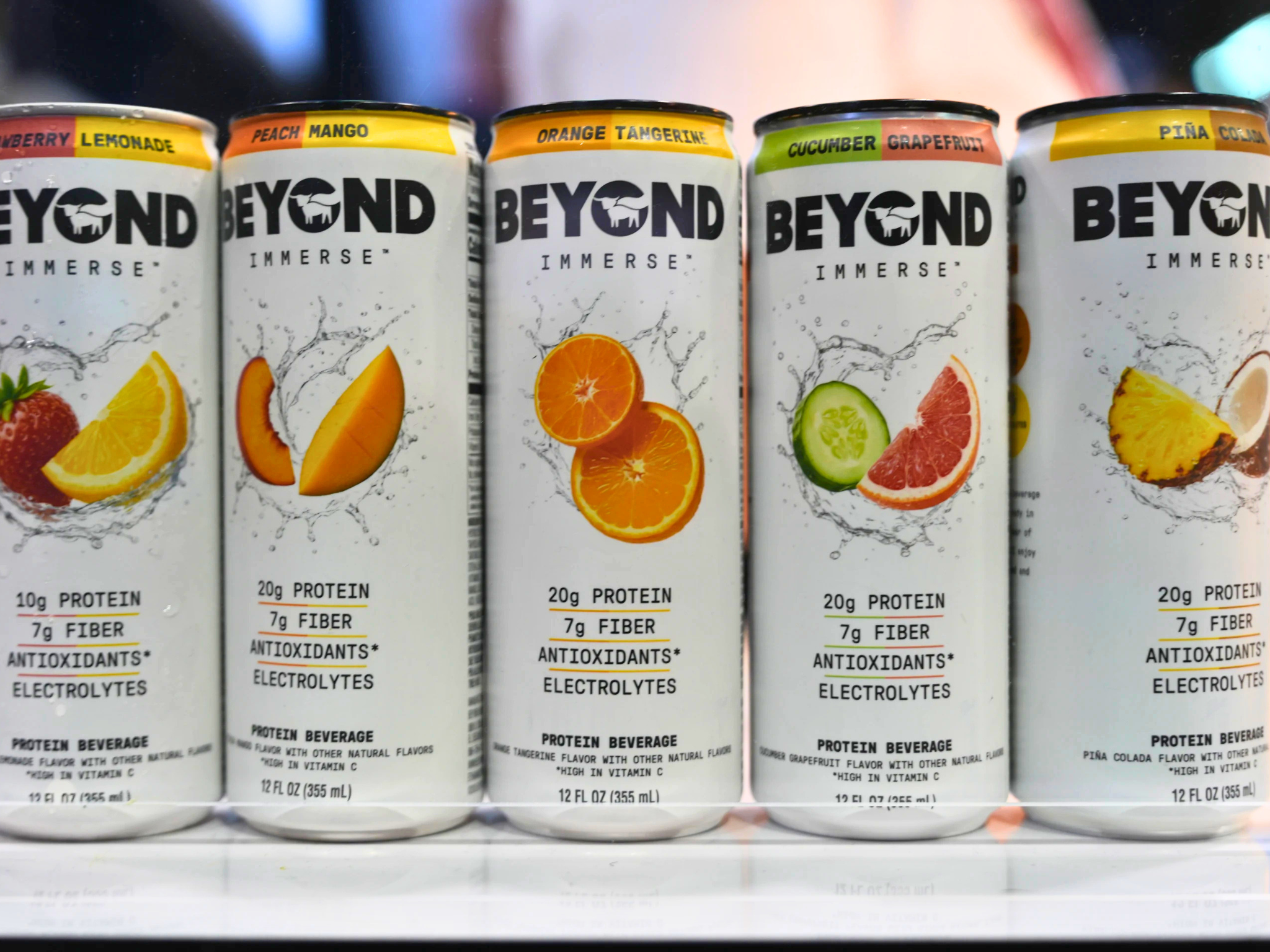
These woes led the company to diversify beyond meat alternatives, beginning with the Beyond Immerse line of drinks, which launched and ushered in a rebrand to Beyond The Plant Protein Company. Over the coming months, these protein beverages will form the centre of the firm’s efforts to stabilise its business – but they won’t be alone.
“Though we are entering the clear protein beverage category initially, our thesis is that we have the brand and capabilities to deliver the power of plants across multiple related categories within functional food and beverage,” said Beyond founder and CEO Ethan Brown.
International retail the only upside for Beyond Meat in Q1 2026
Beyond blamed slow volumes for the poor revenue performance in Q1 2026, primarily driven by lower sales of its vegan burger and chicken products to quick-service restaurants outside the US, as well as weak category demand and reduced distributions in its home country.
For instance, retail sales in the US contracted by 15.3% to $26.6M, mainly due to a near-15% decline in volumes. Things were even worse in the foodservice category, where revenues fell by 29.7%, totalling just $6.6M, the lowest among all of the company’s channels.
The foodservice picture internationally was similar, with sales narrowing by nearly 26% and volumes declining by 32.6% due to the aforementioned QSR struggles.
The only bright spot for Beyond in Q1 was the retail category outside the US, where its sales increased by over 8%. The company ascribed this to favourable changes in foreign currency exchange rates and price hikes for some of its products.
Internationally, retail volumes also rose by 7.8%, primarily due to improved demand and limited distribution gains in European markets. This was partially offset by certain distribution losses in Canada.
“We are starting to see some benefit as we execute across our distribution and portfolio strategy in our retail business,” said Brown. “These encouraging signs are not, however, present yet in our US or international food service businesses. To this end, we are applying significant emphasis to impactful portfolio modifications within certain foodservice distribution channels.”
He bet on the company’s transition to a wider plant protein portfolio to execute a turnaround, suggesting that it will bring the “strength of our brand, expertise, and technology” to adjacent categories.
“We believe that we are strongly positioned to compete and win based on what is now nearly two decades of work on the functionality, characteristics, cost, and presentation of plant-based inputs,” he told investors in an earnings call.
“Because we’ve chosen to confront challenges, criticism, and incumbent industry campaigns against us by innovating more intensely, taking perceived weakness and seeking to create strength from it, we’ve developed disciplines and capabilities that allow us to produce winning products in adjacent categories.”
Beyond Immerse set to enter New York stores this summer

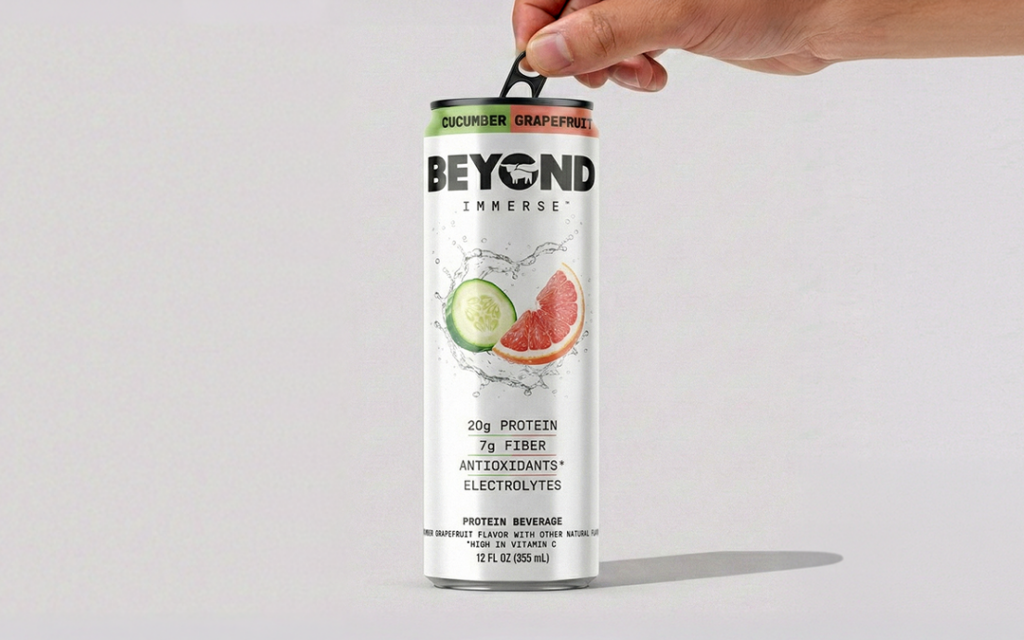
The monkfruit- and stevia-leaf-sweetened Beyond Immerse line contains 10-20g of protein, and 7g of fibre per 12oz can, vitamin C for immune support, as well as antioxidants and electrolytes – and it is now a critical cog in Beyond’s future business.
“One way to think about Beyond Immerse is to note that it is concurrently addressing four distinct beverage categories, each of which serves a specific need: protein drinks, fibre drinks, vitamin drinks, and electrolyte drinks,” noted Brown.
“The product delivers against each relevant need state within not four, but one beverage, and does so with a refreshing, enjoyable delivery. The consolidation of these nutrients in a single platform is intuitive, given the presence of each in the plant kingdom. It is this feature that gives the product its name, with the consumer immersing their body in the power of plants,” he explained.
“It’s not necessarily just a protein drink,” he added. “It’s a system for people who want to tap into the tremendous nutritional benefits of plants in a really convenient way.”
Available in seven flavours, the sparkling drinks have so far only been available on the Beyond Test Kitchen website. Last month, the company teamed up with Big Geyser, one of the country’s largest non-alcoholic beverage distributors, to launch the range in New York retail.
“We’ve developed many, many iterations since its initial conception, each more refined than the last. I’m confident that as we launch in earnest across New York this summer, we are bringing a compelling product to market,” Brown said.
‘A beverage company in hiding’: Beyond rolls back the years with marketing strategy
The CEO joked that Beyond was really just a “beverage company in hiding”, nodding to the presence of several industry veterans on its board of directors: former Coca-Cola CFO Kathy Waller, Boston Beer Company founder Jim Koch, and Honest Tea and Just Ice Tea founder Seth Goldman.
“That’s a lot of decades of combined expertise to make sure that we’re going about this in the smartest way possible,” said Brown, adding that Goldman was a catalyst in the Big Geyser deal, having worked with the distributor for “a very long time”.
Asked how the company planned to market Beyond Immerse, especially in light of the cash constraints, Brown reiterated the drinks’ multifaceted benefits and teased a return to a playbook that brought the company a lot of success previously.
He recalled a 2017 Sports Illustrated story titled ‘How Veggie Burgers Became the NBA’s New Gatorade’. “It had a bunch of NBA players who had invested in Beyond. You had Kyrie Irving, you had Chris Paul, you had JJ Redick. Others at the time were involved, [like] DeAndre Jordan, et cetera,” he said.
“The idea there was they were using Beyond products to help them basically recover more quickly, build muscle, so on and so forth,” Brown explained, noting that this is the strategy it will use for Beyond Immerse, too.
“You’ll see us using athletes, using active people, being very focused in terms of who in New York we’re going after – whether it’s run clubs, fitness studios, folks that are active in hiking and outdoor sports, competitive athletes, people that are really gonna benefit from that system. Then it’ll spread out to the general population from there.”
How Beyond plans to regain momentum in the plant-based meat category

Despite the company’s expansion into drinks, Brown does “not see a retreat” from the core category of meat alternatives that made Beyond famous.
“To the contrary, I believe that [by] introducing consumers to our brand and our foundational commitment to great taste, clean ingredients, and plant-based nutrition in less controversial applications, we will bring back many to the centre of the plate,” he said.
He outlined a three-pronged plan to stabilise the company’s meat alternatives business. “One, we continue to focus on gaining distribution and building out brand blocks in the frozen retail set,” he stated, referring to the launch of its Spicy Buffalo chicken pieces in over 2,000 Kroger stores last month.
“Like the original, it offers the same craveable, satisfying taste and strong nutritional profile, 21g of plant protein per serving and just 0.5g of saturated fat from heart-healthy avocado oil, no cholesterol, and only 130 calories,” the Beyond CEO said.
“As we move out from under the cloud of misinformation that has impeded our growth, I believe that it’s this type of value proposition that will resonate strongly with the consumer.”
Secondly, the company is rounding out its healthier Beyond IV portfolio, having rolled out its upgraded breakfast sausage lineup across major retailers. Moreover, it’s collecting health and environmental accreditation, such as those from the Clean Label Project and the Climate Solutions Framework.
Finally, Brown noted the company continues to “push the envelope” with new centre-of-the-plate protein offerings: “I encourage you to take a look at consumer reactions to Beyond Steak Filet, which is currently only offered through our direct-to-consumer platform, Beyond Test Kitchen.”
He added: “It is gaining an enthusiastic following. […] We expect to be able to bring this innovation to certain retail markets as production ramps up later this year.”