

Switzerland’s Capsule Hotel Sets ‘Protein Split’ Target in Favour of Plant-Based Food


Swiss chain Capsule Hotel has become the latest hospitality company to set a food sustainability target to increase the share of plant-based proteins on the menu.
Globally, hospitality groups are increasingly recognising the significant environmental benefits of tilting their menus in favour of plant-based proteins. Switzerland’s Capsule Hotel is now joining that list.
Operating five properties and serving over 150,000 guests annually, the company has committed to making 65% of its protein offerings plant-based by 2030, with the rest coming from animal sources.
The commitment applies to all of its properties across Switzerland and Denmark, and is part of its broader sustainability strategy. To support the implementation of the target, Capsule Hotel has teamed up with non-profit Scope Three Action, which helps businesses reduce emissions through protein diversification.
Why Capsule Hotel is increasing its plant protein share
“Sustainability shapes how we think about every part of our operation, and food is no exception,” said Valentina Rodoni, sustainability lead at Capsule Hotel.
“Setting a protein diversification target feels like a logical next step for us: it reflects our values, it responds to what our guests are telling us they want, and it gives us something concrete to work toward together with our teams and our partners,” she added.
If the hotel industry were a country, it would be in the top 25% of the biggest polluters. Scope 3 emissions account for over 90% of its carbon footprint, with food procurement one of the most significant contributors. Research shows that food sourcing is responsible for 62% of a hotel’s food-related emissions, far more than energy use or food waste management.
A typical hotel meal produces three times higher emissions than a home-cooked counterpart. And animal-derived ingredients alone contribute to 70% of these food sourcing emissions in this sector. That makes protein diversification crucial.
But doing it in a phased manner is important, too. Instead of eliminating animal proteins altogether, diversification involves gradually rebalancing food offerings through measures like introducing new plant-rich meals, adapting existing recipes, and enhanign the presentation of climate-friendly dishes.
Through its data-driven approach, Capsule Hotel plans to work towards the 65:35 goal via a combination of menu development, procurement practices and behavioural design techniques that make plant-rich choices more visible and appealing.
“By setting a clear, measurable protein target, Capsule Hotel is demonstrating that environmental leadership can go hand in hand with an excellent guest experience. We’re delighted to support them on this journey,” said Marian Milec, programme manager at Scope Three Action.
Hotel chains bet big on plant proteins globally

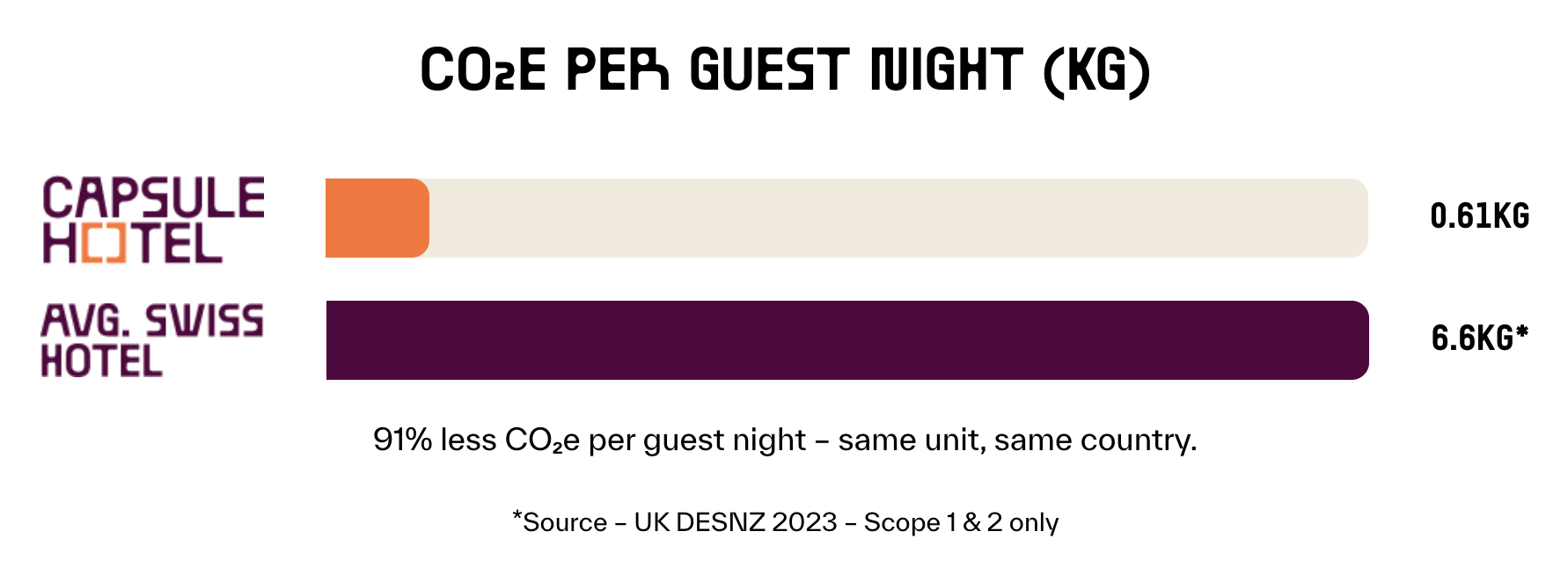
The announcement builds on Capsule Hotel’s existing sustainability initiatives, with the company’s nightly carbon emissions per guest already 91% below the Swiss average. This new target expands those efforts by addressing one of the largest sources of its greenhouse gas footprint.
A growing number of hotel groups are making similar commitments across the globe. IHG Hotels & Resorts, for instance, has committed to making 30% of its menus in the Philippines plant-based, spanning brands like Crowne Plaza and Holiday Inn. And Accor, the parent company of Novotel, Raffles, Pullman, and Ibis, has pledged to turn half its menu meatless globally by 2030.
Both operators are part of the World Sustainable Hospitality Alliance, which has recommended the hotel industry cut emissions by 30% by the end of the decade, down from the 185 million tonnes of CO2e it generates every year.
To help its members – spanning 35 leading chains and over 66,000 properties – achieve that objective, it partnered with US non-profit Vegan Hospitality last year, which works with industry members to expand plant-based dining solutions and meet evolving sustainability goals.
“We know that it’s a win-win for hotels and for their guests. Hotels will meet their sustainability targets and mandates; in the best-case scenarios, they will even save money while doing it, and guests will have more diverse menu choices, making the industry more inclusive,” Meredith Marin, executive director of Vegan Hospitality, told Green Queen at the time.
In China, too, at least a dozen leading hotels have made similar pledges to increase the share of plant-based proteins. That includes giants like Accor Hotels, Langham (both of which are aiming to turn 50% of their menu vegan by 2030), Orange Hotel, OctaveHotels (each promising 70% by the end of 2025), IHG, Marriott, and Dossen Group (30% by 2025), among others.
“More hospitality businesses are recognising that achieving their climate goals means addressing Scope 3 emissions, and the food they serve represents one of the biggest opportunities for meaningful reductions,” said Milec.