

This Hong Kong Future Lab Was Made Using Recycled Plastic Bottles
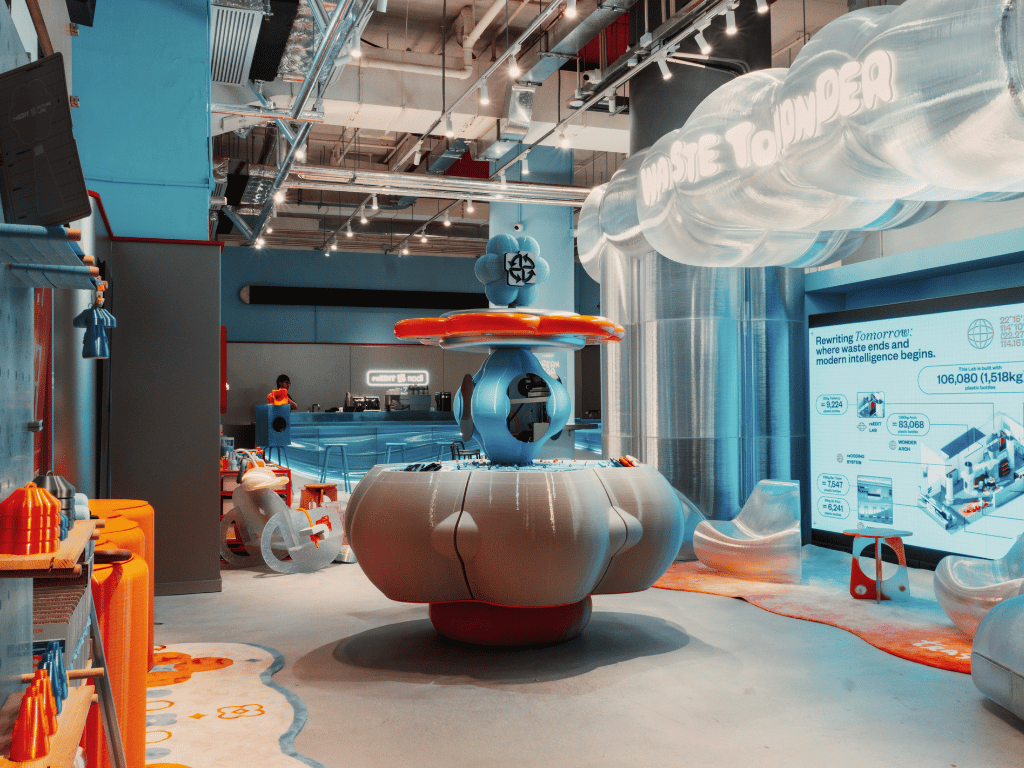
Hong Kong circular design studio ReEdit has opened a Future Lab built on waste materials like recycled plastic bottles, which also upcycles spent coffee grounds from its café into new objects.
In Hong Kong’s Wan Chai district, plastic bottles are the hottest construction material.
ReEdit, the circular design studio owned by Editecture, has opened a multipurpose Future Lab on Star Street, sprawling over 3,000 sq ft and built with 106,080 recycled plastic bottles.
The concept is part retail, part workshop, part café, and part event space, constructed entirely from materials discarded in Hong Kong. That includes every element, from the counters and installations to the products on the shelves.
“Our ambition is to run a material research lab in public and make it a habit rather than a spectacle,” Jacqueline Chak, co-founder of Editecture and ReEdit, tells Green Queen.
“A place where people can come back to for the coffee, workshops and community, and leave understanding that ‘waste’ is just a raw material we haven’t finished characterising. Doing that work behind glass is a first step in an attempt to make the circular economy tangible and part of everyday life in Hong Kong.”
How plastic is turned into building blocks for Future Lab
The hero installation at the Future Lab is built from 1,518kg of locally sourced rPET, with the full fitout saving around 246kg of CO2e compared to a conventional build.
“We work with trusted local waste partners in Hong Kong, who collect post-consumer plastic – sorting and cleaning it, characterising it (identifying the type of plastic, separating it into a single-polymer stream, and stripping out contaminants – labels, adhesives, food residue, mixed caps),” Chak explains.
“Different polymers don’t bond at a molecular level, so a mixed batch does not become stronger, but brittle and unpredictable. Purity of stream is an important quality decision we make.”
“From there, the material goes through our shredders for sampling, to be fed into our compression and sheet-press for panels and surfaces. Finer flakes are compounded into uniform pellets or filament to supply our extrusion and 3D-printing heads that need a clean, consistent feed in our lab factory.
“Before we commit a batch to a process, we read how it behaves when molten because that tells us where it belongs: free-flowing stock fills the fine detail of an injection mould, while stiffer, more viscous stock wants to be pressed or printed into larger forms. We match the right object to the right stage of the material’s life. Only then do we form it, through injection moulding, 3D printing or sheet pressing.”
ReEdit built its material library around the types of plastic that recycle predictably and stay “structurally honest through multiple lives”. “Post-consumer PET, HDPE, PP. PET from used bottles is our workhorse – it’s abundant in Hong Kong’s waste stream, it holds its properties well, and it carries a clarity and depth we can design with,” she notes.
“We channel this rPET mainly into 3D printing and sheet pressing; there’s 118kg of post-consumer rPET in the Future Lab café counter (sheetpress) alone. The polyolefins – HDPE and PP – are our structural materials, deployed primarily for sheet pressing and injection moulding. They are tough and forgiving enough to be shredded and reformed several times before their performance meaningfully drops.
“We qualify every intake batch rather than assuming, because two loads of the ‘same’ HDPE from different sources rarely behave identically. What we exclude is just as deliberate as what we accept.”
Spent coffee grounds are upcycled into new objects
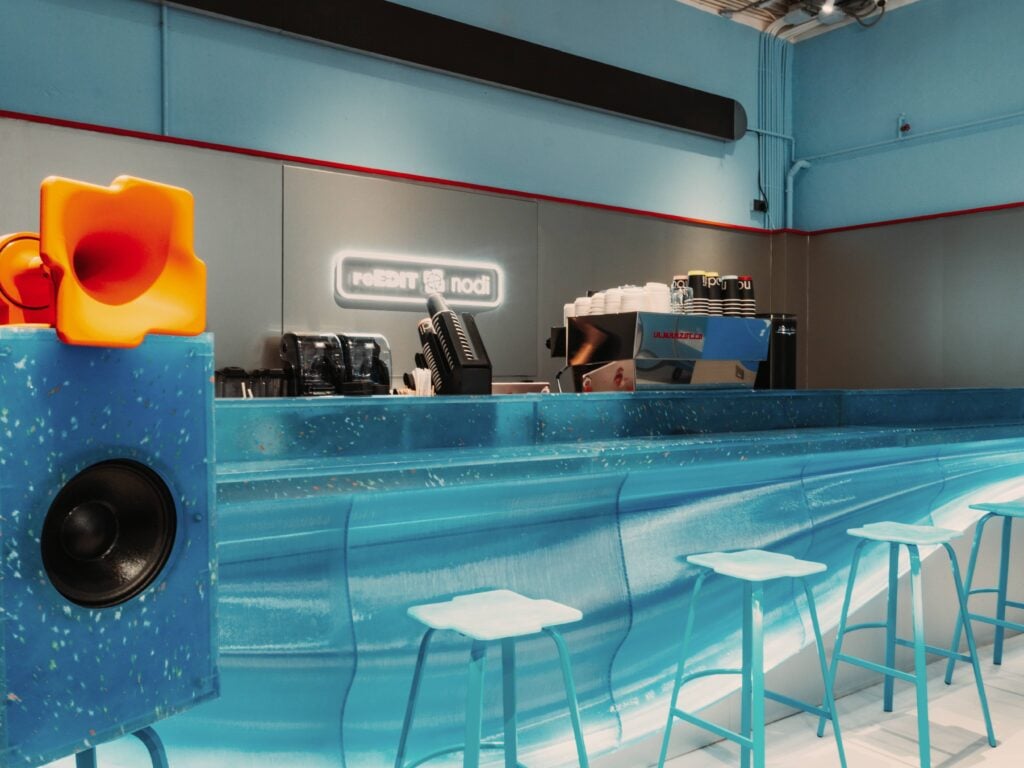
The lab floor features a vertical farm grown in partnership with Common Farm, which serves both as living décord and source for greens for the café’s smoothies. Behind the café is Nodi Coffee, the lab’s opening residency, which has launched a produce-driven smoothie line grown on the vertical farm.
To take the circularity concept further, the spent coffee grounds are collected and upcycled into new objects in the adjacent workshop, turning post-consumer waste back into raw materials.
“Every gram from the Nodi Coffee residency is collected, dried down to arrest the microbial activity, and milled to a consistent particle size so the grounds behave as a stable, predictable material rather than a variable,” explains Chak.
“Once it’s stable, we treat the grounds as a bio-aggregate, a natural filler we blend into a binder and cast or extrude into objects in the workshop directly beside the café. We deliberately let the material speak: the grain, the deep colour, even the faint aroma become part of the finished piece rather than something we sand away.
“It is a small, honest demonstration of the principle we apply to every by-product that comes through the lab, whether it’s coffee, construction debris, or industrial offcuts: a waste stream is just a material that hasn’t been characterised and given a next form yet.
“We are constructing workshops using this coffee waste for planters, candle making with wasted glass bottles, coffee waste pens and bowls. Coffee grounds can help plants by adding organic matter and a small amount of nitrogen to soil. We will also be using coffee waste as our fertilisers for our vertical planters [at a] later stage, to be collaborated with Common Farm.”
How does the Future Lab deal with food scraps? “Our first move with food is the same as with any material – design the waste out at the source before you’re left managing it at the end,” says Chak.
Shortening the distance from soil to cup through the vertical farm “cuts ingredient miles and, by design, strips out much of the trim, spoilage and packaging waste that long supply chains generate before food ever reaches a kitchen”. “For the organic waste that remains, we do what we can to collect, compost, and put it back into fertiliser that nurtures the vertical farm,” she notes.
‘We want to ensure sustainability can sit at the front’
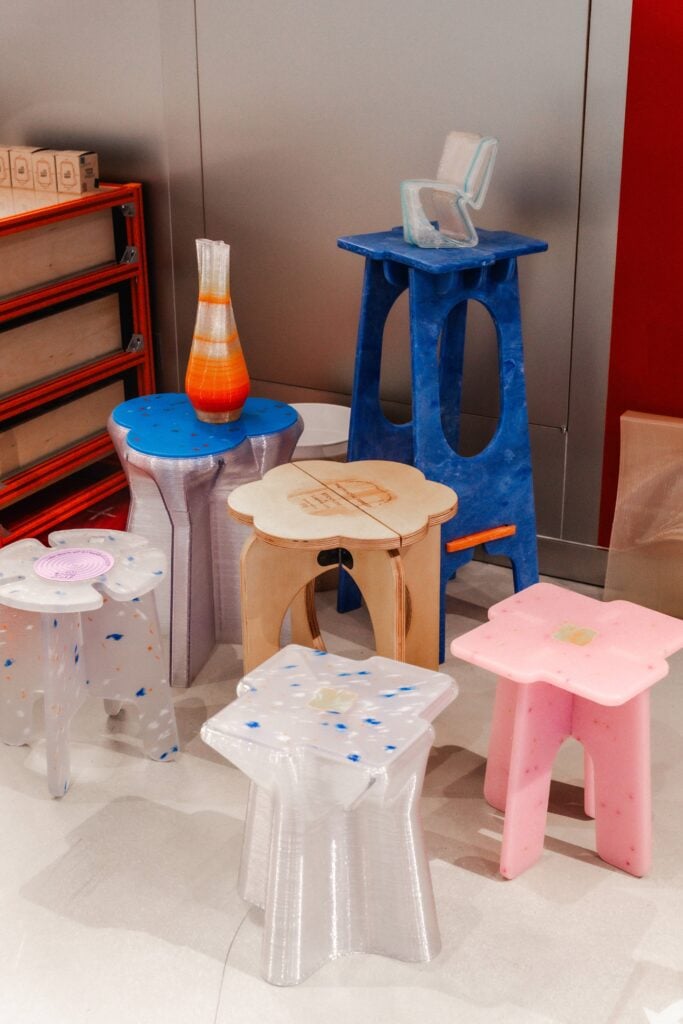
Future Lab is designed to foster community engagement – it will collaborate with fashion and lifestyle brands to host year-round events like wellness mornings and run club activations, alongside product drops and pop-ups.
It will further host hands-on workshop sessions to enable visitors to experience the circular economy firsthand through the in-house shredder and 3D printing machines to fabricate objects directly from recycled materials to take home.
In Hong Kong, around 2,120 tonnes of plastic waste ended up in landfill in 2023, accounting for nearly 20% of solid municipal waste. And while the quantity of plastic recycled locally rose from nearly 120,000 tonnes in 2022 to over 126,500 that year, it still represented just 6.5% of total waste.
The space offers a look into how the ReEdit studio operates, bringing the raw process and behind-the-scenes experimentation into full view. It is decidedly not a “one-and-done”, as the firm puts it.
“What we hope other businesses take from this is less a technique than a change in posture. For too long, sustainability has been treated as a cost to be managed quietly, or a claim to be printed on packaging,” says Chak.
“We want to make the case that it can sit at the front: as a source of design, of story, of real desirability. When a discarded material is treated with intent, it does not ask the customer to compromise but offers them something more meaningful, with history,” she adds.
“We also believe the circular future gets built through partnership. It isn’t something one studio or one brand can deliver on its own; it’s a shared standard that a whole community – makers, businesses, and the people who buy from them – has to raise together.
“Our hope is simply that Future Lab will serve as an open source and resource lab that moves more businesses to see their waste differently, and to bring people into that process rather than presenting a finished claim.”