

Irish Govt Urged to Create National Plant-Based Food Fund in Budget 2027


The Vegan Society of Ireland has called on the national government to take inspiration from Denmark and set up a national plant-based action plan and fund in the 2027 budget.
Ireland is being implored to take a leaf out of Denmark’s food sustainability playbook with the creation of a national action plan and fund for plant-based food.
The Vegan Society of Ireland is asking the national government to make these future-friendly food commitments in Budget 2027, which is set to be unveiled on October 6.
Part of the fund should be directed toward helping farmers move into fruit and vegetable growing, in light of the continued struggles of the Irish horticulture sector – the country now imports around 83% of its fruits and vegetables, and fewer than 70 commercial vegetable growers remain (down from over 600 in the 1990s).
Denmark, for context, introduced the world’s first national plant-based action plan in 2023, and has set aside one billion kronor (€168M at the time) in grants to strengthen this sector.
“Denmark is a major meat producer, yet its farmers, politicians and environmental groups kept talking until they agreed on a plan,” said James O’Donovan, chairperson of the Vegan Society of Ireland. “The measure was introduced by a right-leaning agriculture minister. There is no reason Ireland cannot do the same.”
Horticulture should be a diversification option
The vegan charity has made three main asks for the upcoming budget: the establishment of a fund on a scale comparable to Denmark, open to farmers, growers and food businesses; a commitment to publish a national strategy for plant-based food; and dedicated support for farmers moving into horticulture, including capital grants and advice from national agrifood development authority Teagasc.
These demands build on the Vegan Society of Ireland’s letter to Martin Heydon, the Irish food and agriculture minister, earlier this month. It called for horticulture to be named as a diversification option for farmers, alongside forestry, carbon farming and renewable energy.
“Irish people want to eat more fruit and vegetables, yet almost all of it is imported. Our farmers could be growing it. A fund like Denmark’s would give them the support to make the change,” said O’Donovan.
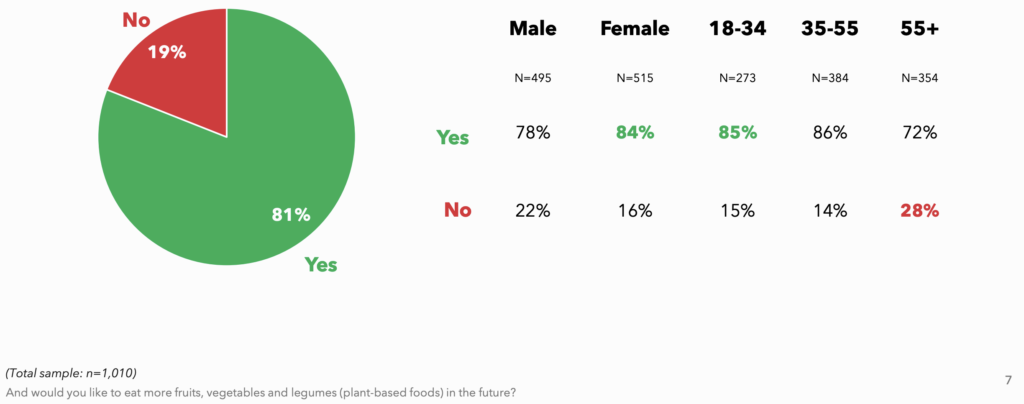
The non-profit notes that demand isn’t the problem. A nationally representative survey by Opinions Market Research in May found that more than four in five (81%) Irish adults would like to eat more fruits, vegetables, and legumes.
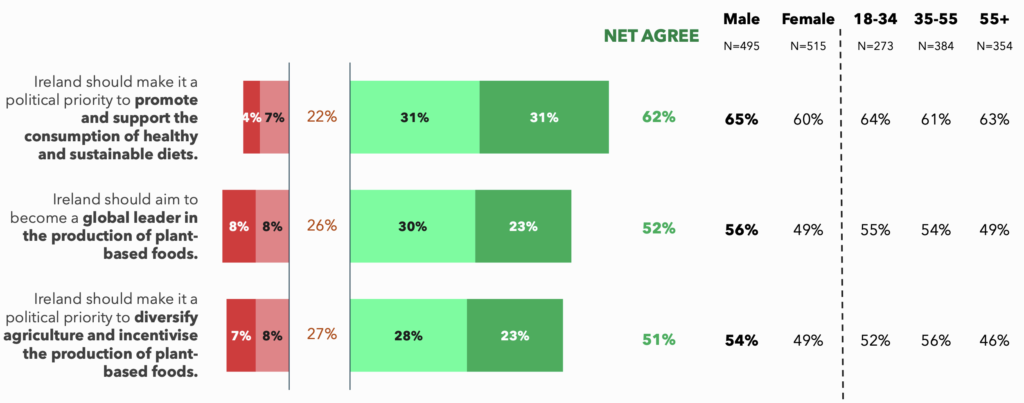
Moreover, 51% believe government policy should focus on diversifying the agricultural sector and incentivising the production of plant-based foods, a sentiment popular with people across all age demographics.
Irish citizens want their government to prioritise plant-based food
Denmark is widely viewed as a trailblazer in future food policy. In 2024, it announced a landmark Green Deal, which convened government and industry groups to impose the world’s first carbon tax on meat and dairy farming and devise a $6B plan to buy land from farmers and convert it into forest.
This effort was supported by the country’s major parties, farmers, trade unions, and climate groups, and the Vegan Society of Ireland – which calls itself “apolitical” – wants this cross-party support to materialise in its home country too.
“We will support any party that backs a move towards a food system that is kinder to animals, healthier for people and better for the planet. We believe Ireland’s future lies in relying less on animals and more on what we can grow,” O’Donovan said.
Public support for plant-based agriculture would help lower the cost of these products, which is the top barrier for wider adoption among Irish citizens. The aforementioned survey suggested that high prices prevent a third (32%) of people from eating more plant-based foods, and those who are financially stressed are 10 percentage points less likely to consume these.
Meanwhile, 62% of Irish adults believe Ireland should make healthy, sustainable diets a national political priority, and more than half (52%) want the country to become a global leader in plant-based food production.
The development comes shortly after the Dutch government faced a similar call by 46 organisations to create a national action plan for plant-based food, alongside a €65M annual acceleration fund. These demands align with the EU’s recently announced Protein Plan, which has set out a framework for scaling up plant protein production to boost the region’s self-sufficiency (although its focus is on animal feed, not human food).