

This AI Toolkit Helps Food Companies Prove GRAS Status Faster Ahead of FDA Overhaul


US scientific assessment company SciPinion has launched SciBridge, an AI-enabled toolkit that provides food producers with a method to prove their ingredients’ similarity to an FDA-cleared precedent in minutes.
With the US Food and Drug Administration (FDA) working on the biggest change to its food safety regulations in decades, companies and the agency itself are struggling to keep pace.
In August, the FDA published a proposal to scrap the Generally Recognized as Safe (GRAS) pathway, which allows companies to self-affirm their ingredients as safe and enter the market without formal review from the regulator. If passed, the new rule would mandate food producers to submit GRAS notices to the FDA and provide details on how they deemed their ingredients or additives safe,
This is set to create a colossal backlog, putting a strain on the FDA’s resources and delaying the entry of new ingredients into the food supply.
“The agency would need more resources in its human foods programme to properly be able to [review] all of those mandatory notifications,” Heidi Overton, President Donald Trump’s pick for the next FDA commissioner, told senators in a confirmation hearing last week.
Although the proposal is in its public consultation period, food firms are already bracing for what’s to come. One specialist in risk assessments and peer review, SciPinion, has launched a new toolkit called SciBridge Safety Suite, which leverages artificial intelligence (AI) to sidestep the potential hurdles.
“The FDA has acknowledged its own strain here, and the agency’s proposed rule specifically asks for comment on ways to make it easier for notifiers to draw on data from already-submitted GRAS notices, which is exactly what SciBridge is built to do,” said Vanessa Feher Castagna, SciPinion’s director of food safety and claims.
Ex-FDA official calls SciBridge a ‘clear value-add’
SciBridge is targeting a specific provision of the FDA proposal, which exempts companies from submitting a GRAS notice if a previous notification covered their ingredient under the same manufacturing process and conditions of intended use and the agency had issued a ‘no questions’ letter for it.
That said, these exemptions only apply if the manufacturing and intended applications are “substantially equivalent” to the conditions the FDA had already reviewed.
According to SciPinion, the scale of companies exposed to this exemption is far larger than previously thought, with potentially tens of thousands of “substitutional” ingredients where multiple manufacturers rely on equivalence to a single precedent notice.
“Demonstrating the identity, purity, and functionality among different preparations of similar substances requires expert scientific knowledge and experience. This can make GRAS reviews very time intensive, even for a substance that shares similarity to one that FDA has already reviewed,” said Dennis Keefe, former director of the FDA’s food additive safety office.
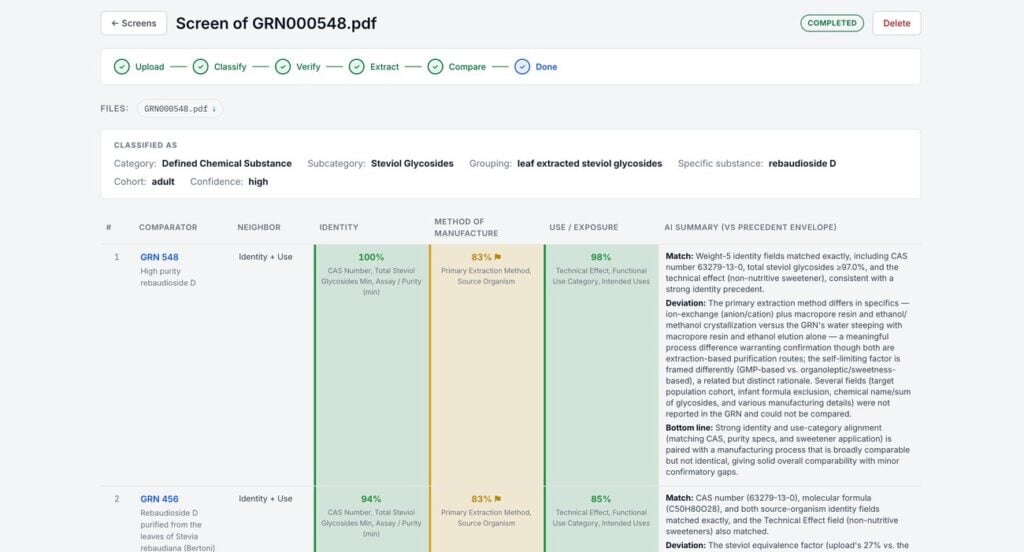
This is why SciPinion’s new suite pairs AI-led software with a menu of professional services to measure and document how closely a food ingreident matches a GRAS substance. It provides a “defensible, field-by-field method” for proving an ingredient’s substantial similarity to FDA-cleared precedent, turning months of manual comparison work into a similarity report in minutes.
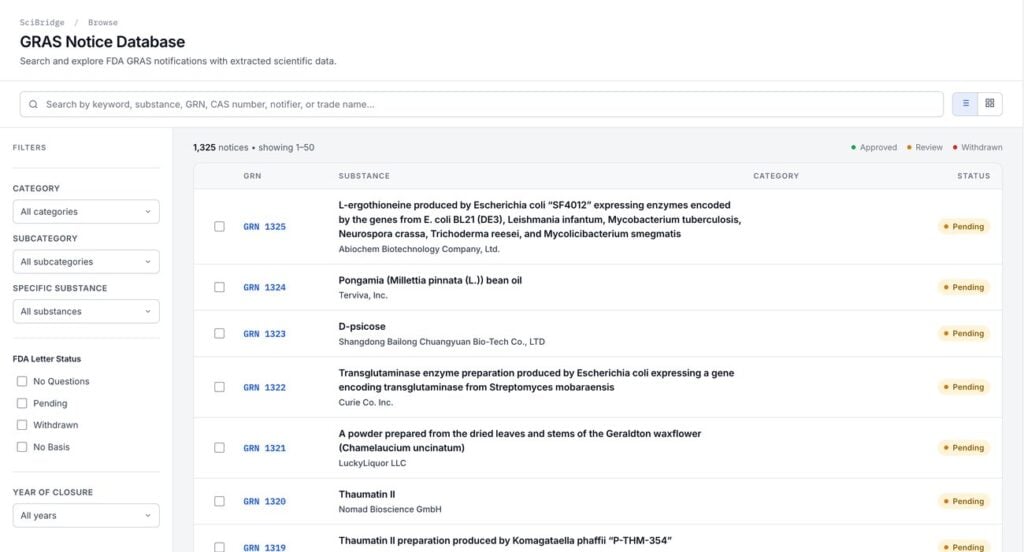
SciBridge offers three tools. Browse is a synced, structured index of the GRAS notice database with a side-by-side comaprison tool, Screen is a rapid similarity check that ranks a new substance against precedent notices, and Bridge is a field-by-field substantial similarity evaluation against up to three comparators, with a downloadable report and full audit trail.
“FDA’s food ingredient programmes, including the GRAS review staff, are severely resource constrained, and the proposed rule, if finalised, will only exacerbate the current review bottlenecks,” said Keefe.
“A streamlined, systematic, structured data review process is a clear value-add for industry to help organise their data in such a way [as] to make it easier for bridging evaluations and benefits FDA to further its public health protection mission.”
AI process includes human expert review
The GRAS rule was created by Congress in 1958, with the self-affirmation provision introduced in 1972. The latter is viewed as a cheaper and faster way to get to market, though it’s been labelled a “loophole” by US health secretary Robert F Kennedy Jr. However, the FDA only evaluates around 75 GRAS notices a year, and each approval takes up to 180 days.
There are questions over whether the agency has the legal authority to require companies to submit GRAS notices without congressional approval, but companies will nevertheless want to go through the full review to ensure transparency and consumer confidence and avoid any future uncertainty.
“SciBridge is the only tool on the market that can generate a full similarity report against an FDA-cleared precedent in about 10 minutes, which is work that can otherwise take months and run into hundreds of thousands of dollars for a ground-up GRAS review,” said SciPinion CEO Sean Hays.
“What makes SciBridge’s report something you can put in front of a regulator is the method: our platform fixes the comparison approach before it ever sees your ingredient.”
The SciBridge suite’s AI-assisted process includes human expert review, and the underlying tools themselves were shaped over nearly a year of “expert-led quality control and prompt refinement”. The programme has been built with data security at the core, so confidential ingredient information is kept safe.
The AI toolkit is built for startups, ingredient and finished goods manufacturers and distributors, trade associations, regulatory consultants, and law firms. Among these is TurtleTree, the Novonesis-backed firm that received a ‘no questions’ letter to sell precision-fermented lactoferrin last year.
“At the time when we achieved GRAS for our recombinant bovine lactoferrin, there was no template for proving substantial similarity to an existing ingredient. Our teams never lacked data. The entire GRAS record is public,” said TurtleTree CSO Aletta Schnitzler.
“What the industry lacked was a structured way to navigate the key information in the regulatory data. SciBridge is the only tool I’ve seen that uses the FDA record as the template itself.”