

Exclusive: Aleph Farms’s Cultivated Meat Matches Beef in Consumer Taste Tests


In a blind taste test, consumers rated Aleph Farms’s cultivated meat as just as good as beef on the flavour and texture scale, with half saying they’d order it in a restaurant.
To get meat-eaters to bite into a steak made from cultured animal cells, delivering taste and texture parity is a non-negotiable.
Aleph Farms, which makes cultivated Black Angus steak, seems to have done just that. The Rehovot-based startup partnered with New Sense Research to conduct a blind taste test at its facility last month, featuring 60 meat-eaters who regularly eat at chef-led restaurants.
It found some highly encouraging validation for its technology. For instance, 96% of participants accepted cultivated steak, a difference that was not statistically significant compared with the 98% who accepted the conventional version.
When asked whether they’d order the cut as part of a meal at a restaurant, 50% said yes for Aleph Farms’s product, and 51% for the beef steak. “The purchase intentions of the two cuts are similar, with no significant difference between the samples,” the researchers found.
Findings shared exclusively with Green Queen show that the texture of cultivated meat is on par with conventional beef and that health positioning is appealing, especially amongst the most engaged consumers.
“Parity is the prerequisite, not the ceiling,” Aleph Farms co-founder and CEO Didier Toubia tells Green Queen. “You cannot ask consumers to make a values-based choice if the product does not first meet their expectations on taste and texture. Our study shows we have cleared that bar on the attributes that matter most in a blind setting.”
Cultivated meat closer to ideal texture than conventional beef

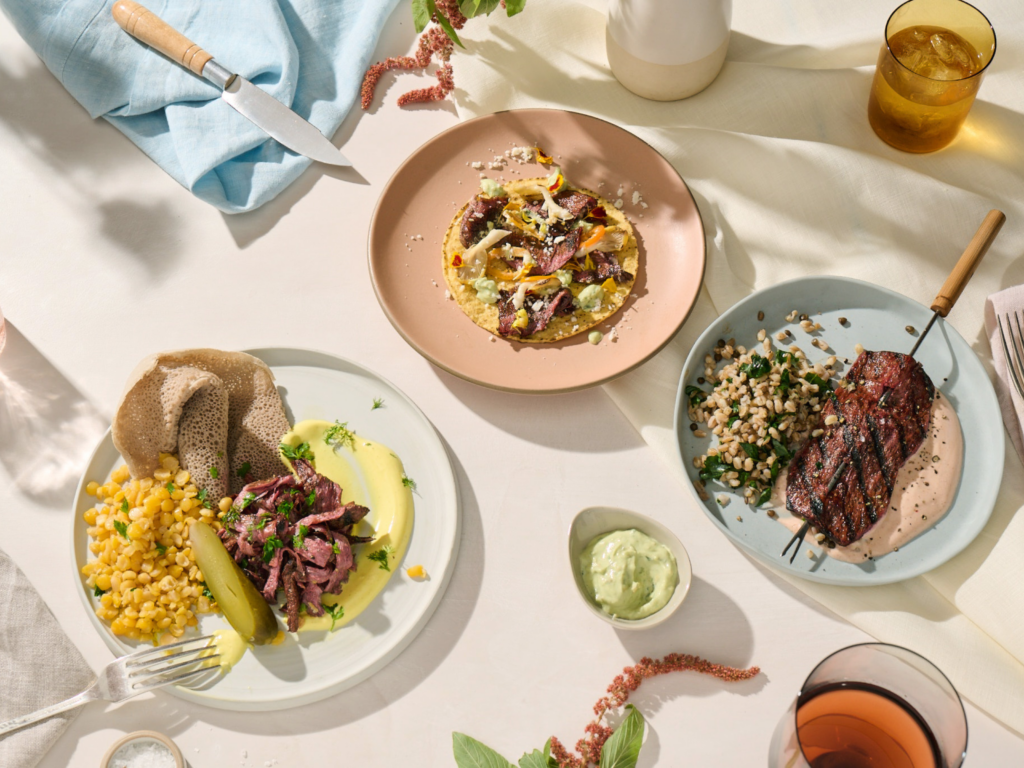
Aleph Farms’s signature offering is the Petit Steak, a hybrid meat product combining non-modified, non-immortalised cells from a Black Angus cow with a plant-protein matrix made of soy and wheat. It’s being marketed under the Aleph Cuts brand.
In the taste tests, Aleph Cuts scored 7.6 out of 10 on the tenderness scale, slightly higher than the 7.3 rating achieved by the conventional steak. On juiciness, the cultivated meat scored 7.4, versus 7.7 for the latter. Neither difference was statistically significant, denoting that the two products are on par.
When asked to assess each attribute using a just-about-right scale, the conventional steak cut was perceived as not tender or juicy enough and requiring too much chewing. The cell-cultured meat, however, sat closer to the ideal on all three metrics.
“Texture has been our primary focus for the past five years, and this study validated that work. On tenderness and juiciness, Aleph Cuts performed on par with conventional beef with no statistically significant difference. That is a significant milestone for us,” says Toubia.
“Our differentiation strategy has always been to lead with texture and build from there, and the data confirms we are on the right track. We will continue improving every dimension of the product, as any serious food company does.
“But the fact that consumers in a blind test said they would order Aleph Cuts at a restaurant at the same rate as conventional beef tells us the foundation is solid.”
Health claims drive up interest in cultivated meat

Aleph Farms also explored how nutrition and health play into consumer perceptions of cultivated meat. When presented with a product description that included the nutritional profile – lower fat, saturated fat, calories, and cholesterol than conventional steak – attractiveness held steady at 72% top-two-box. This was identical to the base description that had no nutritional claims.
“Top-two-box is a standard research metric used across the food industry to measure positive purchase intent. It captures everyone who said they would probably or definitely order the product,” explains Toubia.
“The most meaningful way to read our result is not in isolation but in comparison: Aleph Cuts and conventional beef scored within one percentage point of each other, with no statistically significant difference between them.
“These were regular beef-eating restaurant-goers who had no idea what they were tasting. Their willingness to order cultivated beef was indistinguishable from their willingness to order conventional beef.”
Participants were then shown the existing concept of Aleph Cuts, including the aforementioned nutritional benefits, as well as the presence of nutrients such as iron and vitamin B12, which are commonly associated with beef.
“Consumer response was strongly positive: 61% said that learning about these nutritional benefits increased their interest in the product, versus only 11% who said it decreased it. The health story adds appeal. It does not create friction,” said Toubia.
Nutritional superiority makes Aleph Cuts stand apart
Aside from the 65,000 sq ft plant in Rehovot (which has a capacity to initially produce 10 tonnes of cultivated steak annually), Aleph Farms is building a factory in Thailand with biotech firms BBGI and Fermbox Bio, and has teamed up with Switzerland’s The Cultured Hub and Malaysia’s Cell Agritech to produce cultivated meat for its European and Asia-Pacific operations, respectively.
The firm has secured $147M to date and is currently raising more capital. It has already been cleared to sell its cultivated steak in Israel, and is awaiting the green light in Singapore, the UK, and Switzerland. It further plans to pursue regulatory approval in the EU and the UAE, and is aiming to launch products with restaurant partners in Israel and Singapore by 2027.
“This study matters because it is independent, it is blind, and it uses the same methodology the food industry uses to evaluate any new product. For us, the findings validate our product strategy and confirm product market fit,” says Toubia.
“We set out to deliver the right product to the right consumer at the right price, and the data shows we are there. Consumers who had no idea what they were tasting chose cultivated beef at the same rate as conventional beef. That is not a theoretical result. It is evidence that our strategy works.
“For the wider category, it is proof that cultivated meat is ready to be evaluated on the same terms as any other food. Not as a concept. As a product.”
He adds that, aside from taste, what makes Aleph Cuts “genuinely different” is that it’s nutritionally superior to beef. “80% less cholesterol, nine times more polyunsaturated fat, comparable protein, and fewer calories. All with the same beef-eating experience. When the product is priced right, performs right, and is nutritionally better than what it replaces, consumers do not need to make a sacrifice,” says Toubia.
“On the [contrary], they buy Aleph Cuts because it is meeting an unmet need for high-quality, indulgent and healthy proteins. That changes the conversation entirely.”