

Circulose Debuts New Platform, H&M + Mango Collabs to Scale Up Circular Textiles


Swedish eco-materials innovator Circulose has launched a scale-up platform and notched partnerships with H&M and Mango to advance circularity in the fashion industry.
Circulose, the Swedish materials firm known for its textile-waste-derived pulp fibres, is looking to become a “full solution provider” with a new scale-up initiative and partnerships with two industry giants.
The startup recovers cellulose from worn-out clothes and production scraps to make a “dissolving pulp” that can form the base of viscose, lyocell, modal, acetate, and other regenerated fibres. These can be spun into yarns, woven or knitted into fabrics, and cut and sewn into textile products, replacing virgin materials like cotton and wood pulp.
To accelerate circularity in the fashion and textile sectors, it has teamed up with sustainability non-profit Canopy to launch Circulose Forward, a platform of tools to help brands seamlessly integrate Circulose’s materials into their supply chains and products.
“Scaling up next-gen materials is not straightforward,” said Circulose CEO Jonatan Janmark. “To enable adoption at scale and at pace, we need to make integration into brands’ supply chains seamless. Circulose Forward is a key initiative to make that happen.”
Circulose has further enlisted European fast-fashion giants H&M and Mango as its first scale-up partners, the latest example of the firm’s Big Fashion collaborations.
Pricing is a key focus of Circulose Forward
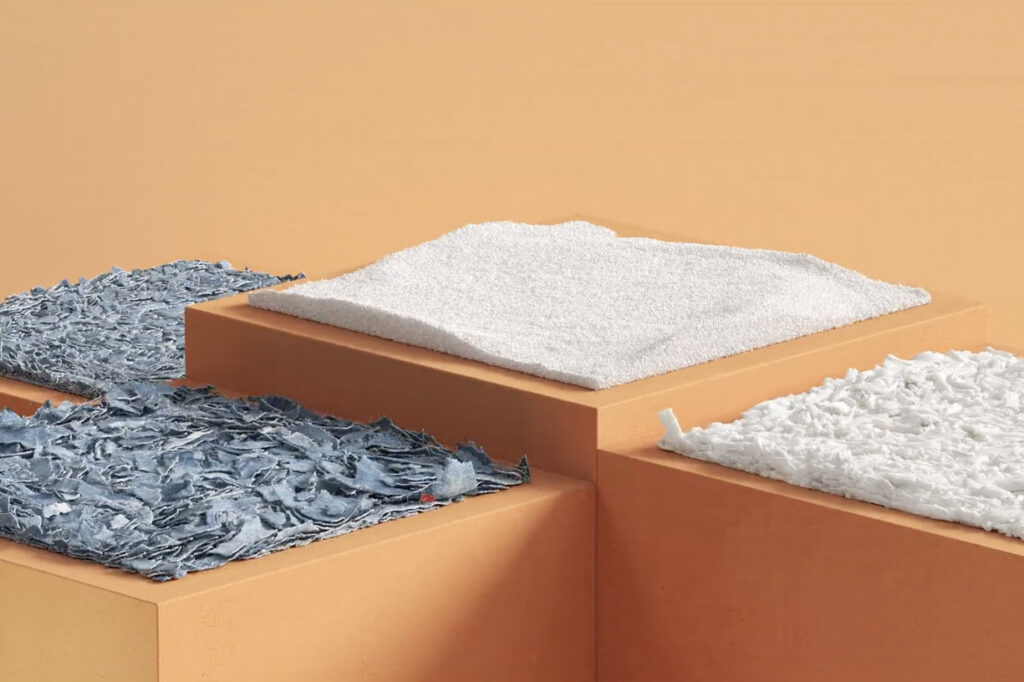
To make its materials, Circulose takes discarded textiles and industry byproducts (particularly cellulose-rich cotton fabrics), shreds and de-colours them, and turns them into a slurry. Here, contaminants like polyester are taken out, leaving behind cellulose, a biodegradable polymer that most cotton and green plants are made out of.
The slurry is dried to produce sheets of material, which are packaged into bales and shipped to be made back into virgin-quality textile fibre by producers. Brands then design and produce new clothes using Circulose fibres, thus closing the loop.
The Circulose Forward platform comprises several verticles. The first rollout is a Material Library, which serves as a digital showcase for 36 commercially available materials using Circulose.
Some of these qualify as Circulose Forward Priced Materials, following the firm’s logic that there should be no unwarranted price hike through value chain steps. Speaking of cost, the platform also hosts a Price Calculator built on this philosophy to help brands estimate the expected financial impact of adopting Circulose in their materials or garments.
Finally, the Stockholm-based company has unveiled the Circulose Supplier Network as part of the new platform. This is a group of supply chain partners experienced in producing materials with Circulose and committed to supporting a smooth transition away from virgin fibres.
“This platform provides practical, scalable solutions that align with both climate science and market needs,” said Nicole Rycroft, founder and executive director of Canopy. “It’s the kind of innovation that helps the industry leave deforestation in the past and move decisively toward a resilient, low-carbon, next-gen future.”
In addition to the platform, Circulose has worked with Canopy and Fashion for Good to develop a new pricing model that requires brands to license Circulose to access its offerings. This is designed to reduce pricing friction and scale up its use, shifting from capsule collections to large-scale adoption.
“This is just the beginning,” said Janmark. “Circulose Forward will continue to grow, giving our partners access to a robust portfolio of tools that make circularity not a distant vision – but a reality today.”
H&M, Mango team up with Circulose with an eye to 2030

The collaborations with H&M and Mango are part of its scale-up strategy, with both companies looking to replace a significant share of their man-made cellulosic fibre (MMCF) use with fibre made with Circulose. Mainly derived from wood, MMCFs face considerable sustainability challenges – sourcing wood requires deforestation, while chemically processing its pulp into fibres causes pollution.
H&M and Circulose go way back. The former is an investor in the startup and was the first retailer to use Cellulose, as part of its Conscious Exclusive spring collection in 2020. Now, they’re extending their relationship with a multi-year deal.
“Investing in next-generation materials is essential to achieving our goal: ensuring that 100% of our materials are recycled or sustainably sourced by 2030,” said Cecilia Strömblad Brännsten, H&M Group’s head of circularity. “Scaling access to these solutions is key to accelerating the shift towards a circular economy for fashion.”
Andrés Fernández, sustainability and sourcing director at Mango, added: “This collaboration marks a significant step on our sustainability roadmap as we strive to exclusively use fibres with lower environmental impact by 2030 and reflects our commitment to fostering a more circular and responsible fashion ecosystem, where innovation and environmental stewardship go hand in hand.”
Founded in 2012 by scientists at Stockholm’s KTH Royal Institute of Technology, Circulose was formerly called Renewcell. Over the years, it has worked with the likes of Levi’s, Ganni, Tommy Hilfiger, Zara, and Calvin Klein. But the company filed for bankruptcy in February 2024 and was acquired by Altor three months later, with Janmark appointed as CEO and former H&M Group CEO Helena Helmersson as president.
It is among a large wave of startups looking to decarbonise cotton and the broader textile industry. Cotton cultivation accounts for 2.5% of the world’s arable land and emits 220 million tonnes of CO2e annually. The amount of water required to make a single cotton T-shirt could sustain a human being for two-and-a-half years (although some industry groups say these figures need some more nuance).
Industrial agriculture is worsening the situation. H&M itself has been linked to Brazilian cotton farms accused of illegal deforestation, land grabbing, violent conflicts and corruption.
Meanwhile, every second, the equivalent of one dumper truck of textiles is either landfilled or incinerated around the world. To make matters worse, textile waste has been estimated to increase by about 60% between 2015 and 2030.
It’s what drives innovators like Circulose to come up with sustainable alternatives. Others in this space include Galy, Natural Fiber Welding, Evrnu, BioFluff, Ponda, Alt Tex, and Spiber.