

Is Cultivated Meat Better for the Planet? This New Study Confirms Climate Impact


Cultivated meat is significantly more environmentally friendly than conventional animal proteins like beef or pork, according to a new peer-reviewed study.
The argument for cultivated meat is undeniable on the animal rights front, but some have often cast doubt on its true environmental costs.
Take this 2019 study from the University of Oxford, which suggested that while some forms of cultivated meat could indeed be better for the planet, others could, in the long run, lead to higher global temperatures if they depend on fossil-derived energy.
Even last year, analysis by cultivated beef pioneer Aleph Farms placed cultivated meat fifth on a list of protein systems with the most positive impacts on the planet, behind practices like regenerative and organic farming.
Yet several life-cycle assessments (LCAs) have shown that cultivated meat is significantly more climate-friendly than the existing livestock system, and a new peer-reviewed study adds to this body of literature.
Czech startup Bene Meat Technologies, which produces cultivated meat for pets and humans, teamed up with the Czech Technical University (CTU) in Prague to conduct an LCA of its proteins, which has now been published in the International Journal of Life Cycle Assessment.
The research shows that all of Bene Meat’s cultivated meat production scenarios “achieve significantly better results” than previously published baselines, and exhibit lower product environment footprints than even the most ambitious benchmarks for conventional beef and pork.
“These metrics are calculated based on our proprietary platform and processes. As such, they are tied to our technology rather than to any specific cell type,” Kateřina Dvořák Vašová, Bene Meat’s communications coordinator, told Green Queen.
“This means the values are generally applicable across different applications, with variations depending on the specific use case. At the time of the study, the data were based on our pet food application; however, today they are comparable across all of our cell lines.”
Raw materials and energy mix crucial to cultivated meat’s climate impact
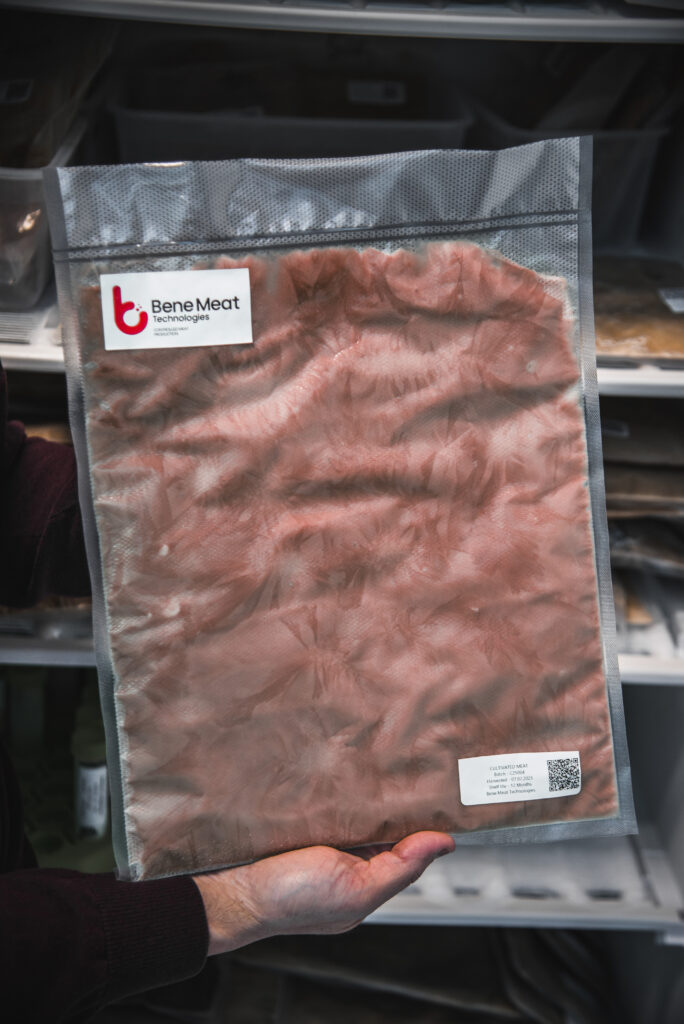
Unlike other studies, this LCA was not based on lab data and rough estimates, but rather primary data from Bene Meat’s pilot process and detailed models of its upcoming industrial-scale facility.
“The goal was to align the environmental impact assessment with the real conditions of future production,” said Miroslav Žilka, head of the department of management and economics at CTU, and co-author of the study.
“Using primary data from the industrial process allows us to significantly refine previous estimates and provides a vital reference framework for further development in the field of cultivated meat,” he explained.
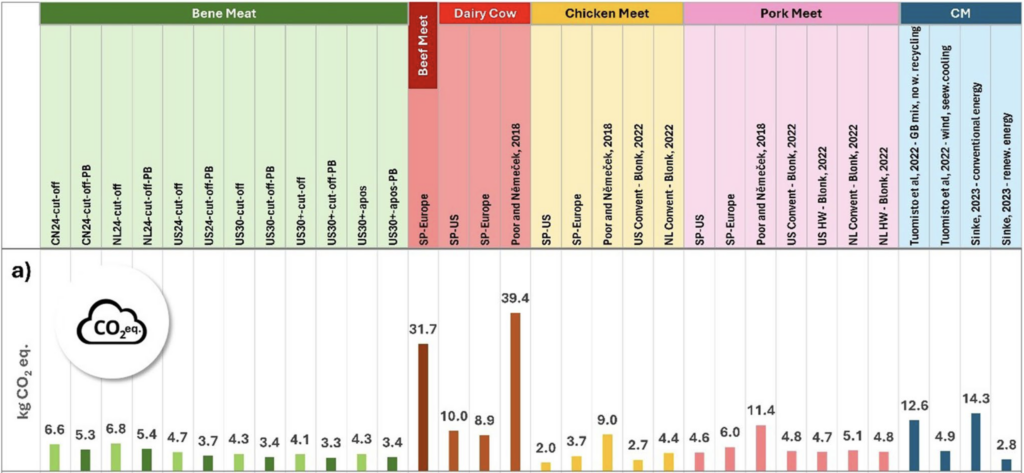
The analysis, based on technology designed for a production capacity of 400-600kg of cultivated meat per day, revealed that the current carbon footprint is 5.3kg of CO2e per kg of product. Depending on the choice of raw materials and the energy mix, it can range from 3.3kg to 6.6kg of CO2e.
Bene Meat’s production process involves a culture medium derived from soy protein isolate, and the origin of the soybeans has the most significant impact on its overall product footprint (between 35% and 45%), followed by glucose. Electricity, heat, and water demineralisation collectively account for 21-26% of the impact.
Its current soy protein isolate supplier is based in China, whose production mix includes a high proportion of Brazilian soybeans, which have a larger environmental footprint due to land-use change effects such as deforestation and natural habitat conversion.
Replacing this with a US-based soybean supplier can reduce Bene Meat’s climate impact by 20%, since land-use change is negligible.
The study assessed the impact of different electricity sources too, finding that a greener energy mix with 30% solar power can lower Bene Meat’s cultivated meat emissions by 12%.
Bene Meat’s cultivated meat outperforms beef, pork and chicken
Bene Meat’s product fares far better than animal proteins like beef and pork. Beef is the most emissions-intensive food on the planet, with a global average of 98.6 kg of CO2e – 95% higher than the startup’s cultivated meat. Even the most ambitious scenario for beef production is 34.9kg of CO2e per kg.
On the other hand, pork production has an average footprint of 11.4kg of CO2e per kg, which is more than twice that of Bene Meat’s cell-cultured protein. And in each protein’s most ambitious forecasts, the latter is still 55% lower than the 5.1kg of CO2e attributed to pork.
The most promising scenario for cultivated meat, which involves US soybeans, a 30% solar energy mix, an allocation to the byproduct, and reflects the potential for reducing environmental impacts, achieves “35% lower impacts than the best meat equivalent – European chicken”, the authors noted. It would also be 63% lower than beef from dairy cows.
To further lower the climate impact of Bene Meat’s cultivated protein, it’s crucial to minimise the effects of key raw material inputs like soy protein isolate and glucose. “This can be achieved by optimising reaction yield through adjustments in process conditions and times, or by selecting suppliers that prioritise sustainable production methods – or ideally, both approaches,” the study read.
“Another strategy could involve adopting an energy mix with a significant share of renewable sources, such as installing photovoltaic panels at the production facility. Additionally, future opportunities for decarbonising heat and background processes should be explored, even though they were not included in this study.”
The research echoes findings from a 2025 LCA by fellow cultivated pet food startup, BioCraft Pet Nutrition, which found that its protein had 92% lower emissions than the beef byproducts used by manufacturers.
Bene Meat, which has already registered its cultivated meat as a feed material in the EU (allowing it to sell it as a pet food ingredient), is now planning a follow-up analysis based on data from full-scale operations. This will provide a more definitive verification of the results in practice, offering the “most precise view yet” of the climate impact of full-scale cultivated meat production.
“For Bene Meat, it is essential to work with real data,” said Jan Luprich, the startup’s business development head. “This study clearly demonstrates that our technology has the potential to succeed in industrial production from both a technological and environmental standpoint.”