

Herbalife & IIT Madras Launch Accelerator to Advance India’s Plant Biotechnology Sector

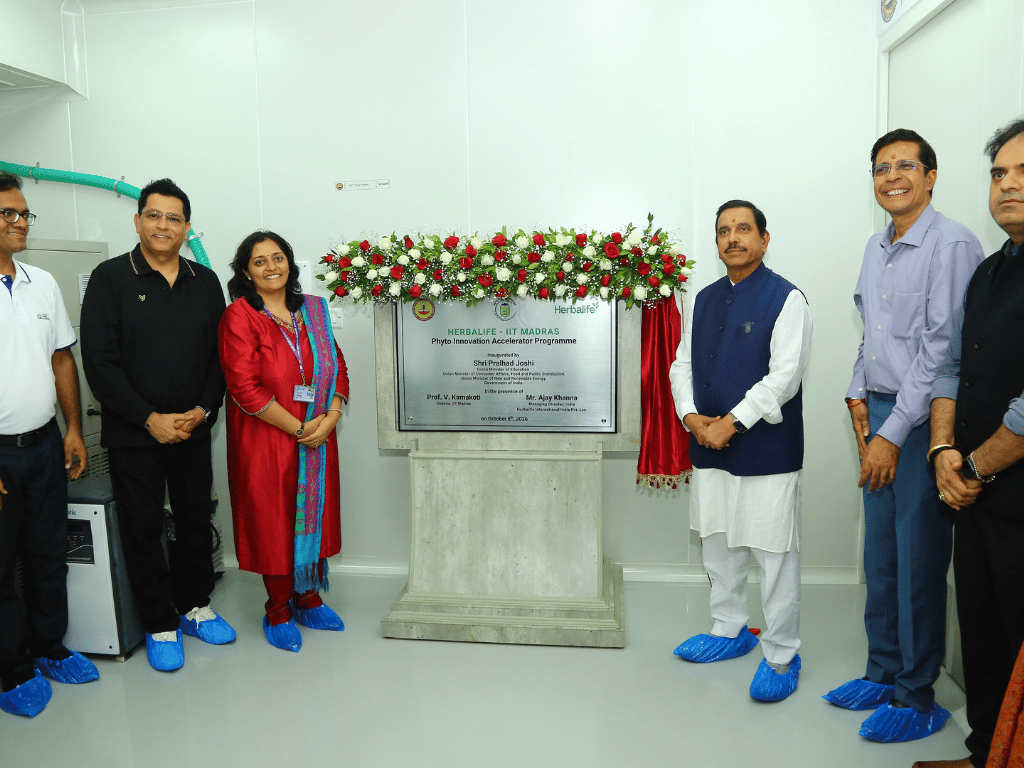
US supplements giant Herbalife and the Indian Institute of Technology Madras have established a Phyto Innovation accelerator programme to translate plant biotechnology research into scalable solutions.
Months after opening a plant cell fermentation centre, US dietary supplements corporation Herbalife and the Indian Institute of Technology (IIT) Madras are building on their collaboration with a new biotech accelerator.
They have launched an industry-academia Phyto Innovation accelerator scheme to help companies translate plant biotechnology research into scalable solutions for the health, wellness, and sustainable biomanufacturing industries.
“Innovation in health and wellness increasingly depends on strong collaboration between academia and industry. Through the Herbalife–IIT Madras Phyto Innovation accelerator programme, we aim to create an environment where promising scientific ideas can access the expertise, infrastructure and industry perspectives needed to progress beyond the laboratory,” said Ajay Khanna, managing director of Herbalife India.
“We hope the programme will help nurture the next generation of innovators while contributing to India’s growing leadership in biotechnology, sustainable innovation and health-focused research.”
Three-year accelerator to run via two verticals

The accelerator programme fuses India’s botanical heritage with modern science and deep tech, aiming to build a nationally recognised innovation ecosystem that translates plant biotech solutions into market-ready technologies while fostering research, innovation and capacity building across the health, nutrition and biomanufacturing spheres.
It will operate through two verticals over three years. Under the Phytothon phase, Herbalife and IIT Madras will conduct innovation challenges and hackathons every six months to identify promising innovations in plant biotechnology, nutraceuticals, functional foods, botanicals, and biomanufacturing.
Up to three startups will be supported through access to scientific infrastructure and specialised lab facilities at the IIT Madras Bioincubator and its Centre of Excellence on Plant Cell Fermentation. These include customised bioreactors for plant cell cultivation and analytical and computational systems, alongside technical mentorship, pre-incubation support, and proof-of-concept development.
The second vertical, Global University Innovation Network, aims to facilitate international collaborations through student and faculty exchanges, collaborative research, webinars, seminars, workshops, short-term courses, publications and co-organised conferences.
Bringing together different stakeholders, including students, researchers and entrepreneurs, will strengthen India’s scientific capabilities in the plant cell fermentation sector and allied domains like plant biotechnology AI-enabled multi-omics analysis, bioinformatics, and process modelling.
It will also drive innovation, capacity building, and ecosystem development via stronger academic-industry collaboration and global knowledge exchange.
“At IIT Madras, we believe that translating research into real-world impact requires strong collaboration across academia, industry, and [the] entrepreneurial ecosystem,” said Prof Smita Srivastava, head of the plant cell fermentation hub.
“The Phyto Innovation Accelerator Programme represents an important step towards creating a platform that enables scientific discoveries to evolve into real-world applications. By bringing together talent, technology, infrastructure and mentorship, this initiative will help foster innovation and strengthen India’s capabilities in plant-based biomanufacturing.”
India ramps up biomanufacturing ecosystem

The accelerator follows the establishment of the aforementioned Centre of Excellence in July, which seeks to advance plant cell fermentation – which involves growing plant cells in suspension within bioreactors, rather than soil – and enable the scalable production of herbal biomass, enriched herbal extracts and high-value phytochemicals.
This hub combines advanced upstream cultivation systems with state-of-the-art downstream processing and metabolomics platforms, and is equipped with customised plant cell bioreactors, advanced analytical platforms, and pilot-scale processing facilities to foster the development of future-friendly plant-derived ingredients and health and wellness products.
The centre will provide incubatees with access to these bioreactors, analytical equipment, cryogenic storage, and a high-performance GPU workstation for bioinformatics and AI-enabled research.
Indeed, India has been stepping up its efforts to become a biotech leader. For instance, this accelerator aligns with the national BioE3 strategy, which focuses on accelerating tech development and commercialisation by setting up biomanufacturing hubs and biofoundries across the country.
The government has also published a roadmap to boost the national bioeconomy sector, with a target value of $2.6T by 2047. Within this, it plans to more than triple the value of the biotech sector, from $195B today to $691B in 2035, underlining bioindustrials – which include alternative proteins, enzymes, food-grade media, and more – as the segment with the largest potential.
It’s why biomanufacturing facilities and research hubs are cropping up all over India. In 2024, Bengaluru saw the launch of the Centre for Smart Protein and Sustainable Material Innovation (an incubation hub) and the Alternative Proteins Innovation Center (a scale-up facility). And last year, the government opened the National Institute of Animal Biotechnology, an animal stem cell biobank, in Hyderabad.
In March, India formally launched the BIRAC-BioNest Incubation Centre in Mysore to help startups advance their research and achieve commercial viability for technologies like precision fermentation and CRISPR. A month later, the foundation stone was laid for an upcoming ₹42 crore ($4.5M) BioFoundry Centre to bridge the gap between lab research and industrial application of alternative proteins.