

Oatly Widens Oat Milk Emissions Gap to 67% with British Dairy

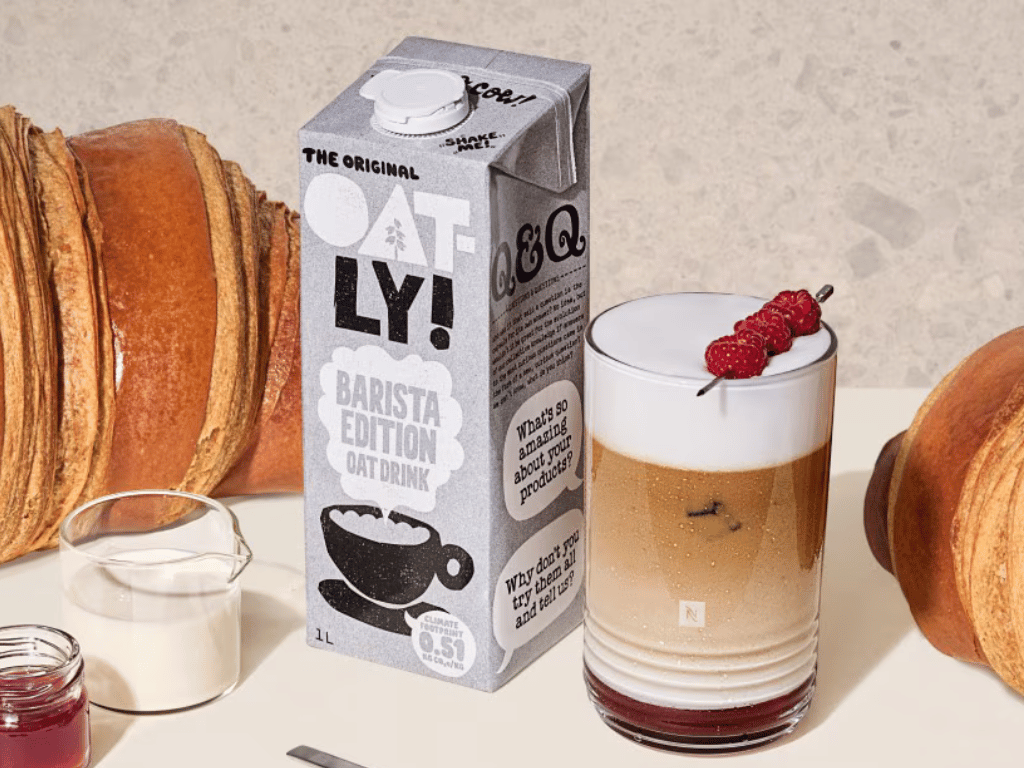
Oatly’s oat milk now has a 67% lower climate impact than chilled cow’s milk in the UK, up from 55% in 2021, highlighting the company’s shifts in ingredient and energy sources.
In late 2025, Swedish oat milk pioneer Oatly announced that eight of its best-selling barista milks in the UK were now made with 100% local oats, a move it said would help lower its climate footprint by 7-13%.
Now, a new independent life-cycle analysis (LCA) by Mérieux NutriSciences | Blonk has proven the efficacy of the shift in raw material sourcing, alongside efficiencies in energy use and transportation.
Oatly’s ambient barista oat milk was always significantly more climate-friendly than dairy, and that gap has now widened in the UK, from 58% in 2021 to 67% in 2025. It was a jump even the company didn’t see coming.
“Yes, we’ve been reducing our climate footprint through improved energy efficiency in our factories, more optimised transport routes, HVO fuel and sourcing British oats. Even though we’re taking action, I knew our own reductions would not result in a nine-percentage-point increase,” Oatly’s senior sustainability director, Caroline Reid, said in a LinkedIn post. “I was surprised.”
The gap in climate impact also widened in Germany and the Netherlands for shelf-stable oat milk, while remaining significantly high in Sweden and Finland. Overall, the company’s barista products are 58-71% more planet-friendly than chilled cow’s milk.
On its own, the emissions associated with Oatly’s barista products decreased by 5-13% in the UK, Germany and the Netherlands, but increased by 0.4-5% in Finland. In its home country, the ambient version saw a 3% decline in its climate footprint, and the chilled oat milk was associated with a 1% uptick.
Dramatic differences in land and water use between Oatly and dairy
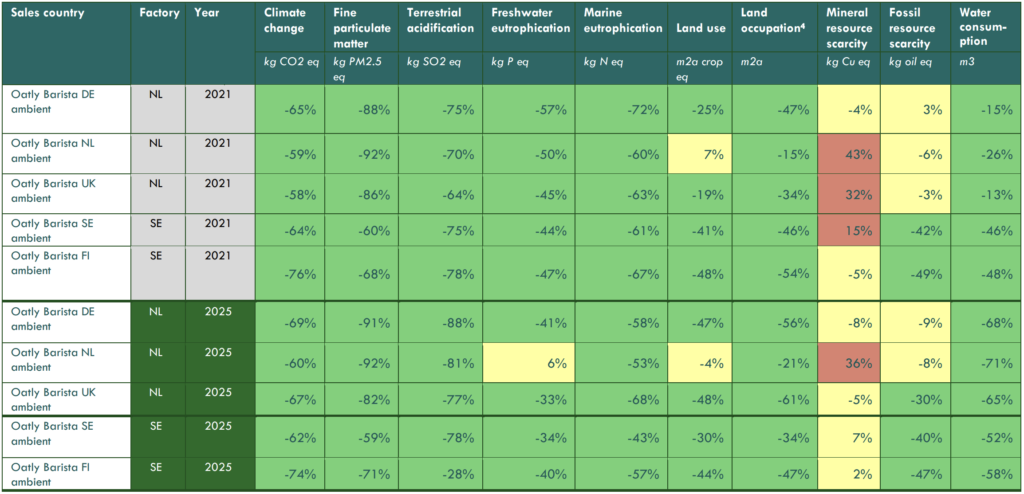
In the UK, the gap between Oatly’s ambient oat milk and dairy expanded by 29 percentage points in land use and by a whopping 52 points in water consumption. The results were similar for the analysis on Oatly’s chilled barista oat milk, too.
The difference in emissions grew by 4 points in Germany and by 1 point in the Netherlands (for shelf-stable oat milk), with both markets witnessing major improvements in land use and water consumption. In fact, in the latter country, Oatly’s ambient oat milk consumes 71% less water than cow’s milk.
“The decrease in climate change impacts is due to improvements in the efficiency of the factory and to smaller distribution distances,” the LCA states. “The higher climate change impacts of background datasets for refrigerated transportation of chilled products in Finland and Sweden lead to an increase in the product’s climate change impacts.”
An update to the input data also led to a decrease in absolute cow’s milk emissions in the latter two countries. In contrast, dairy emissions in the UK and Germany ticked up, thanks to a change in the biophysical allocation by the International Dairy Federation (IDF), which now allocates more impact to milk production and its associated energy needs.
Another reason the gap has widened in these countries is the use of updated emissions calculations based on the Intergovernmental Panel on Climate Change’s (IPCC) 2021 AR6 global warming potential values.
“In addition to the IDF allocating more of the cow’s impact to milk compared to meat, the IPCC AR6 new global warming potential gives more weight to methane emissions, which [have] a higher short-term global warming potential than carbon dioxide,” explained Reid.
Oatly calls on companies to ‘raise their voices’ for climate-friendly policies
The updated LCA comes amid Oatly’s turnaround strategy. After a rocky couple of years, changes in its manufacturing network and product strategy led the company to its first full year of profitable growth in 2025.
Oatly has gone from strength to strength this year, with revenues up by 15.4% in the first half of 2026, prompting the business to lift its constant currency revenue forecast from 3-5% to 8-10% for the full year.
With many plant-based manufacturers struggling to keep up with an evolving consumer landscape, some have abandoned their climate-first messaging to instead home in on taste and/or health. Oatly remains an outlier here – it leads with taste, but environmental stewardship is quite literally a front-of-pack priority.
Last year, it was named the world’s first climate solutions company in the food and beverage category. To be certified, it had to prove that 90% of its revenue comes from climate solution products, have a near-term emissions target and a net-zero goal covering scopes 1, 2 and 3, disclose its progress annually, and be working more broadly to transform its sector.
It attained the certification following the launch of its updated global sustainability strategy, which outlines measures to reduce its emissions by 89% by 2050 (from a 2020 baseline), and counterbalance its remaining emissions with permanent removals moving forward to contribute to a net-zero society.
Its plan involves a shift to regenerative agricultural practices, reducing food waste and avoiding landfill disposal, rolling out pay transparency initiatives for employees, investing in farmers’ access to technical assistance, and sourcing fully renewable or recycled materials for its packaging.
“If we want a food system that operates within planetary boundaries and meets our nutritional needs, we need to shift to more plant-centric production and consumption, reducing dependence on foods linked to high methane emissions,” Reid said.
“As a consumer, one easy swap is cow’s milk to Oatly in your morning latte or afternoon matcha,” she added. “For the food industry, my hope is that more companies raise their voices asking for policies and food environments that support planetary health diets.”