

Solar Panel Companies Are Paying Farmers to Quit Growing Crops, And It’s Risking India’s Food Security

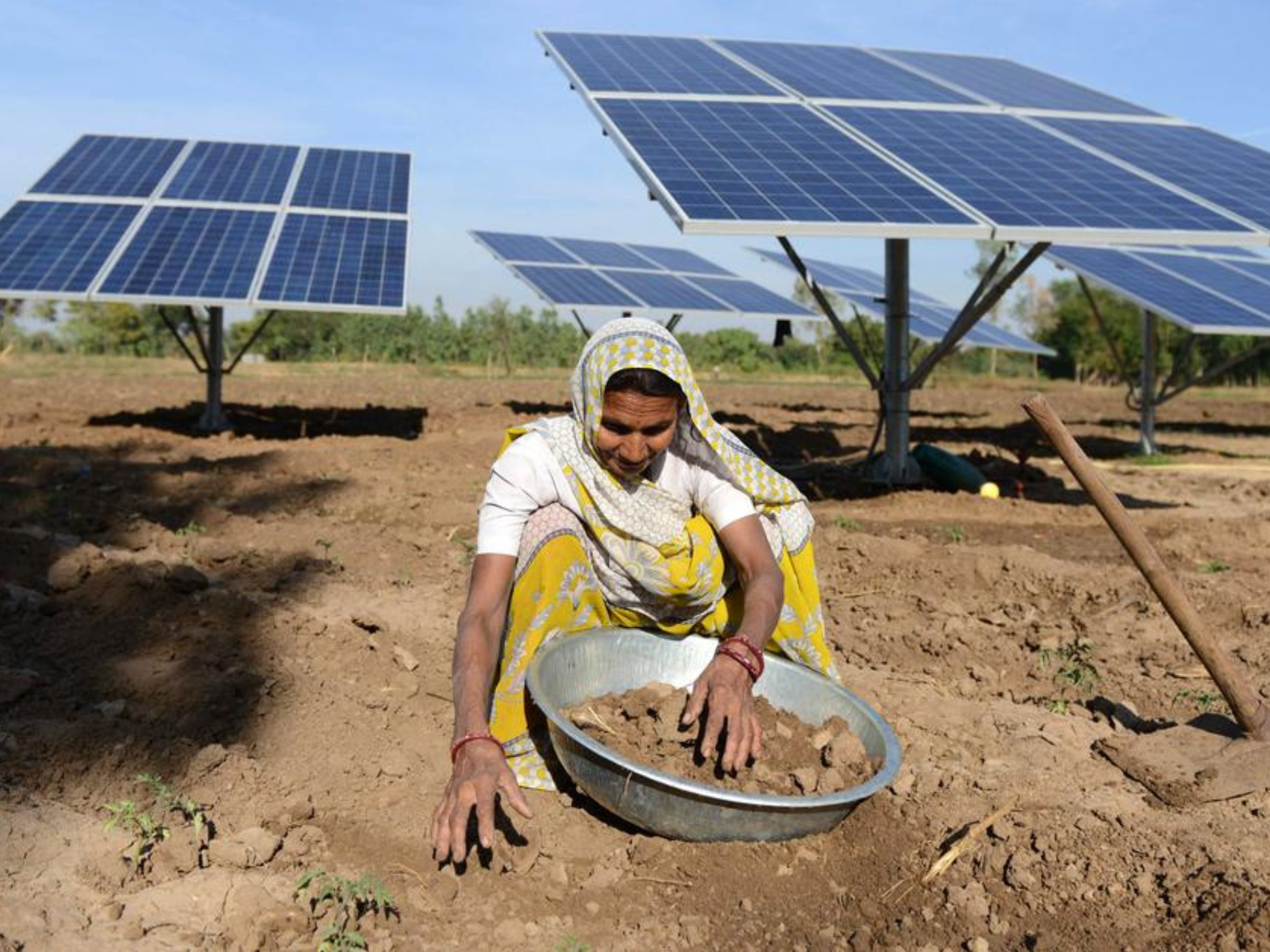
The conversion of fertile farmland in Punjab, dubbed India’s “breadbasket”, into solar energy projects offers farmers a stable income, but is raising critical concerns about the long-term impact on the country’s food security and the region’s agrarian identity.
The Mansa district in the northern Indian state of Punjab was once known for its self-sufficient farming communities. Today, it is better recognised for the vast solar fields that dominate its landscape. As solar parks spread across former farmlands, the village of Mirpur Kalan offers a glimpse of what has been left behind.
37-year-old Ram Kumar Singh remembers a time when his family never had to buy food. Almost everything they consumed, wheat, rice, mustard, bajra, millets, and seasonal vegetables, came from their own fields. For generations, the land was the only family’s lifeline, shaping both their sustenance and their identity.
Now, he purchases his wheat, rice, and other vegetables from the market. Nearly 69 hectares (170 acres) of his once-productive farmland is now covered in solar panels. In return, he receives a fixed annual income from a private renewable-energy developer, an income far more dependable than what agriculture has offered in a decade marked by climate change, especially depleting groundwater, erratic weather, and upsurging cultivation costs.
He is not alone. More than 100 villagers in his area have leased out land to solar companies, marking a paradigm shift from agri-farms to solar farms. Farmland that once yielded thousands of tonnes of food grain is now carpeted with solar modules stretching across the horizon.
From growers to buyers: the evolution of a Punjabi farmer’s reality
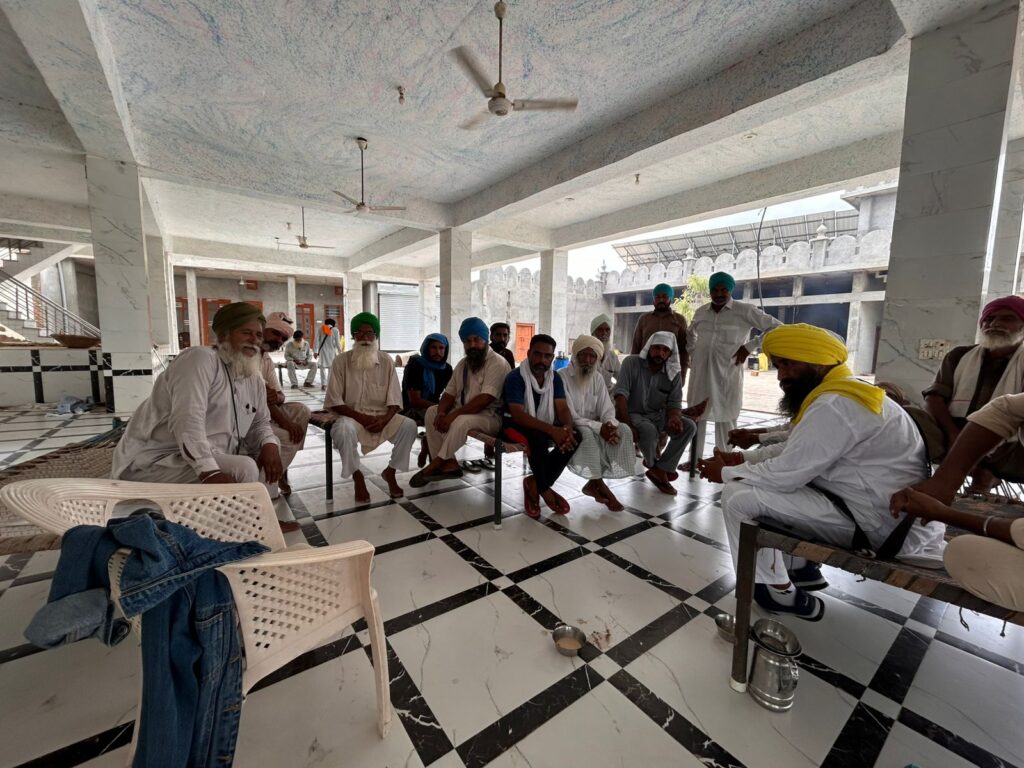
The transition to solar parks did not happen overnight, nor was it accepted without question, says Kuldeep Singh, a member of the Kissan union in Mansa. Years of declining incomes, deteriorating water quality, and a lack of government support made it easy for the farming community to choose solar, according to him.
Ram Kumar Singh, a well-educated farmer with a degree from Punjab Agricultural University in Ludhiana, played a key role in this shift. He introduced the idea of solar parks to the village, explaining how they could provide a stable, predictable income. Under his guidance, farmers agreed to lease their land to solar companies, who promised ₹50,000 per acre (approximately US$560) with a 5% annual increase, far more reliable than what the fruits of their agricultural harvests could offer.
Ram says he had watched his family struggle on farm wages for years. Despite owning a large and very fertile piece of land, the income was never enough to meet their needs. He says his situation was not unusual; many families in Mirpur Kalan and nearby areas owned large plots of farmland, yet low crop prices, rising expenses, and the absence of government support left them with little to survive on. These pressures pushed villagers to look for a more stable source of income.
“What choice do we have?” says Bhutta Singh, another farmer from the area. “The land has no water, the crops fail, but the [solar] company gives us guaranteed money. Earlier, our wheat harvest could feed us for a year. Now we buy everything – wheat, rice, and vegetables – from the market. We have become buyers instead of growers, now, but with stable income.”
The importance of Punjab’s farmland for India’s food-grain ecosystem
Punjab is one of the most fertile parts of the country, long been known as the “breadbasket of India”. Though the state occupies a small share (1.53%) of India’s geographic area, it contributes much more than its share to the nation’s food security. According to the Punjab Economic Survey 2023-24, Punjab provides around 46% of all wheat and 31% of rice procured for the central foodgrain pool, evidence of its critical role in feeding millions across the country.
Moreover, Punjab is also a key player in India’s agricultural exports, especially rice (including premium varieties), helping to meet both domestic demand and international needs. Because of this dual role as a major supplier for India’s central food buffer, and as a contributor to international grain markets, Punjab’s farmland is more than just real estate: it is a strategic asset in India’s food-grain ecosystem, linking rural livelihoods to national food security and global trade.
The Mansa district of Punjab is not alone in seeing solar energy emerge as a source of stable income. Districts such as Ludhiana, Gurdaspur, Fazilka, Amritsar, Tarn Taran, and many others are also witnessing a growing shift toward solar leasing.
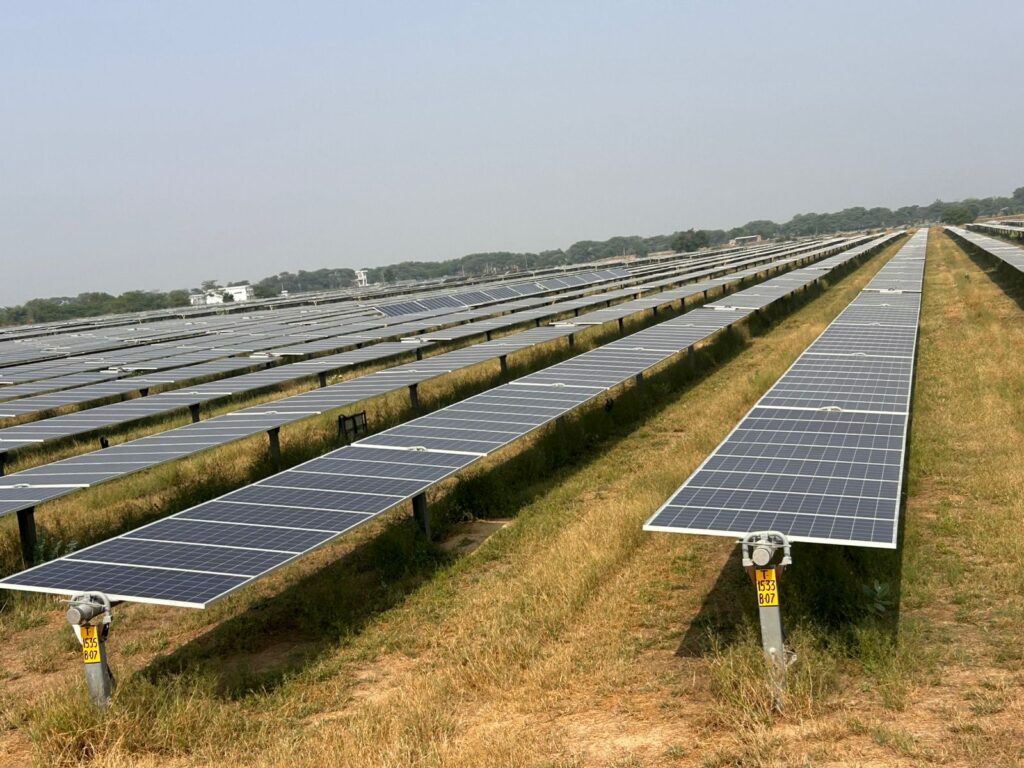
In the neighbouring Bathinda district, the villages of Sardargarh and Chughe Kalan host one of the largest solar projects in the regional 100+ megawatt plant, spread across nearly 700 acres (the equivalent of about 565 hockey fields). Farmers in these villages have leased their land for 30 years. Seeing the promise of stable income, many young farmers nearby are now considering converting their fertile fields into solar landscapes.
Anil Makkar, the coordinator responsible for leasing out land to the solar companies in the Sardargarh and Chughe Kalan villages, says many farmers are approaching him to make the switch. More than 100 farmers from different parts of Punjab have asked him about the process of leasing out their fields so they can benefit from the stable income.
Food security maths: watts vs wheat
According to the Punjab Energy Development, Punjab has 805 MW of solar power projects installed as of 2025, with an additional 110 MW currently under construction and several more awaiting approval. Based on figures from the Ministry of New and Renewable Energy Guidelines, one megawatt of solar power requires approximately four to five acres of land.
At this rate, the 815 megawatts of operational and upcoming projects would require roughly 1,640 hectares of land – the equivalent of about 1,312 standard cricket fields.
For comparison, if this land were used to cultivate wheat instead of for solar panels, it could produce around 7,786 tonnes of wheat annually. This estimate uses Punjab’s average yield of 4.748 tonnes per hectare, as per CEIC data.
7,786 tonnes is enough wheat to meet the annual cereal requirements of nearly 38,900 people, assuming an average consumption of 200 kilograms per person per year.
How soil fertility can change over time
To understand the long-term fertility of soil and the impact of leaving large stretches of farmland uncultivated for more than 30 years, Green Queen Media reached out to Dr Sagar Jadhav, a scientist at the Bharatiya Agro Industries Foundation (BAIF).
Dr Jadhav explained that leaving land fallow for a short period – typically a year – is a common agricultural practice. Fallowing allows nutrients to return to the soil and helps improve overall soil health. However, he says that abandoning farmland for up to 30 years would require a dedicated scientific study to assess the full impact on soil quality.
He also raised concerns about groundwater degradation in Punjab, noting that extended periods without cultivation may increase the land’s ability to recharge groundwater levels over time.
Speaking about alternatives, Dr Jadhav mentioned that agri-voltaics could be a potential option. However, most ground-mounted solar projects rely on deep concrete foundations for levelling and installing pillars, and he says that the long-term effects of these concrete layers – such as whether they hinder water absorption into the soil – remain unclear and could influence both soil quality and groundwater recharge over several decades.
He also wonders about the rapid leasing of farmland for solar at a time when agriculture already offers low returns. “We still have people to feed,” he says. “The government should create a policy to limit the leasing of agricultural land.”
Punjab’s land leasing system: policy without safeguards
The Ministry of New and Renewable Energy has been advising all States and Union Territories to prioritise barren and non-agricultural land for solar development. The Ministry also cited the 2017 Solar Park Scheme, which encourages States to use government wasteland, non-agricultural land, canal bunds, and even water surfaces in large reservoirs for solar installations.
But according to Manik Goyal, a Right to Information (RTI) activist in the state of Punjab, stated that, “Punjab has no specific land policy defining where solar farms can or cannot be set up and without zoning, fertile land is the easiest target.”
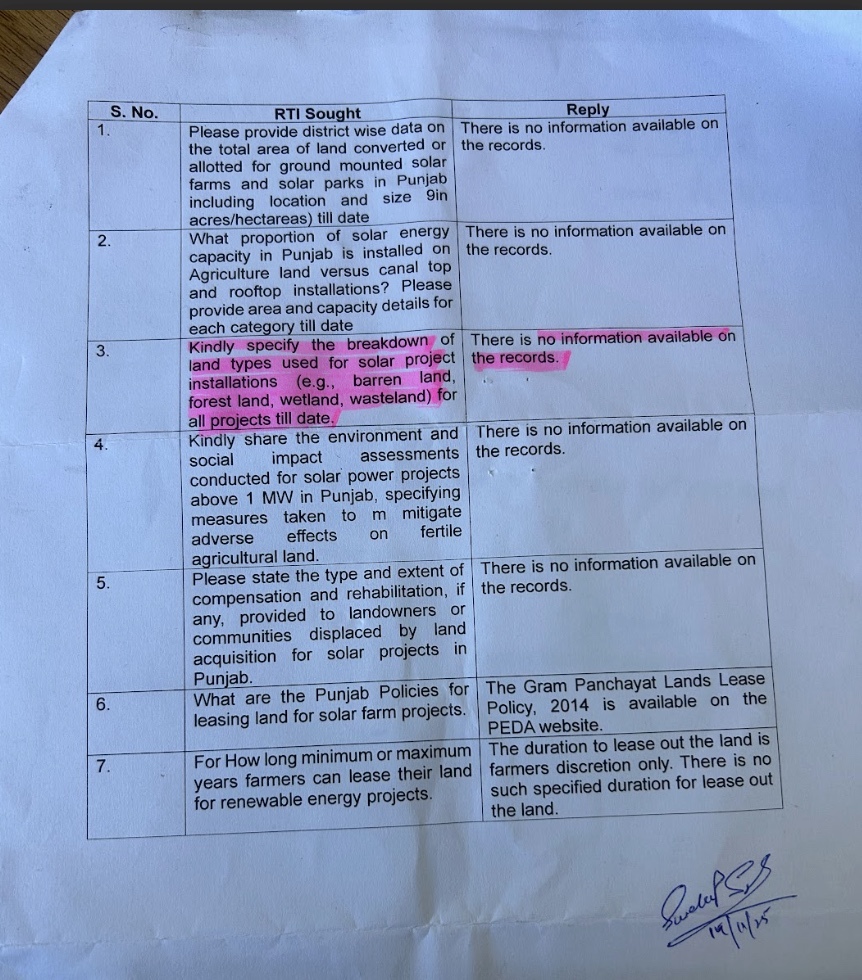
Green Queen filed a Right to Information (RTI) to get a breakdown of land use/land cover for solar projects on barren land, forest land, and wasteland. The department replied that no such information was available on record. The state government appears to have no effective checks and balances for land use, allowing land to be leased out in any proportion and without clear limits.
Farmers whose land lies adjacent to solar farms pay a hefty price, too
While the farmers who leased their land to solar companies continue to receive a stable income, many others whose land lies adjacent to farms face new, unaddressed challenges. In Mansa, Bahadur Singh said that the solar farms did not maintain the vegetation or the wild grass under the panels, leading to a rat infestation that damaged crops and reduced yields. Despite repeatedly raising the issue with the Deputy Commissioner many times, the farmer’s concerns have largely gone unheard.
Another farmer, whose fields are sandwiched between two solar farms, said the solar company had placed iron rod pillars outward, making it difficult for him to bring tractors into his fields. If the pillars were positioned inward, then there would be no hassle for the tractor to come directly into the field; however, the company ignored this simple request.
During the monsoon, waterlogging of the solar panels spilt into adjacent fields and homes, further damaging crops. Fellow farmers have expressed sympathy and even approached the company, but no action has been taken. These cases highlight the lack of environmental safeguards, agricultural planning, and accountability, issues that are growing and have largely gone unreported.
Does solar energy benefit local villages?
One of the biggest unanswered questions is whether the villagers hosting these large solar plants actually benefit from the power generated. Despite large installations nearby, farmers see no improvement in the local power supply. They still have continuous power cuts during peak hours and have no provision for discounted or priority electricity. The electricity generated by the solar panels feeds into the state grid, but power distribution remains uneven.
In another instance, villagers such as Kulwant Singh, 52, from Chugeykalan, claimed that when the company asked for their land, it promised local employment. However, no one from the village was retained. Bhupinder Singh, 50, from Saradargarh in Bhatinda, made similar claims, adding that the plant has a “no women policy” that prevents local women from performing minor jobs like panel cleaning or grass cutting.
Additionally, the company draws water from local canals, reducing supply for other farmers. Although Bhupinder Singh has filed complaints with Punjab’s Mandi Karan Board and the Jal Shakti Department, and even though the company has faced penalties, he questions how many times a farmer can repeatedly lodge complaints.
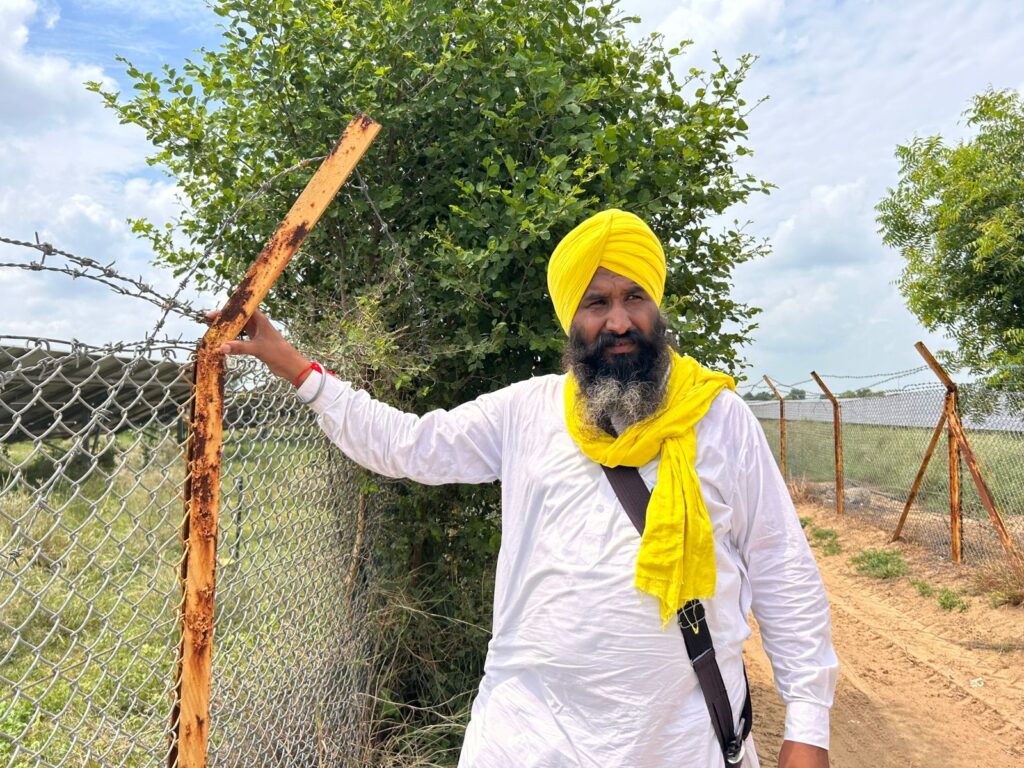
Economic pressure is pushing Punjabi farmers to lease their land to solar companies
No farmer wants to lease their farmland. The block head of Bharati Kisan Ekta Manch, Kuldeep Singh, said that farmers avoid leasing out their fields unless they have no other option. In well-irrigated areas, even a single acre can cost around ₹80,000 to ₹85,000 (approximately US$888 to US$943) for just one crop cycle. Poor agricultural policies and unstable incomes are pushing many young people to look for more secure livelihoods outside farming, he added.
Aman Sikka, 28, a young farmer who recently leased his land to a solar company, said he does not want to do so any longer because farming is not only an occupation for him, it is a cultural identity. But economic pressure often leaves farmers with no choice.
“Shifting to solar is an economic decision, not my preference,” he says. “If groundwater recharge improves and we receive a fair minimum support price, I would happily remain a farmer for life.”
As Punjab’s farmlands quietly turn into solar estates, the state is grappling with a shift that goes far beyond income patterns. For many families, solar leasing has brought a kind of stability that farming no longer guarantees. Yet the same transformation is raising difficult questions about soil health, land use, local equity, and the future of food production in a state that feeds much of India.
What is unfolding in places like Mansa, Bathinda, Fazlika, Ludhiana, and Gurdaspur is not merely an economic choice but a deeper trade-off – between energy security and food security, between steady earnings and a fading agrarian identity.
Whether Punjab can create policies that allow farming and solar power to coexist rather than compete for the same land will ultimately determine whether this transition strengthens rural livelihoods or slowly weakens the nation’s most reliable food bowl.