

US Declares Agriculture A National Security Priority – Can Food Tech Capitalise?

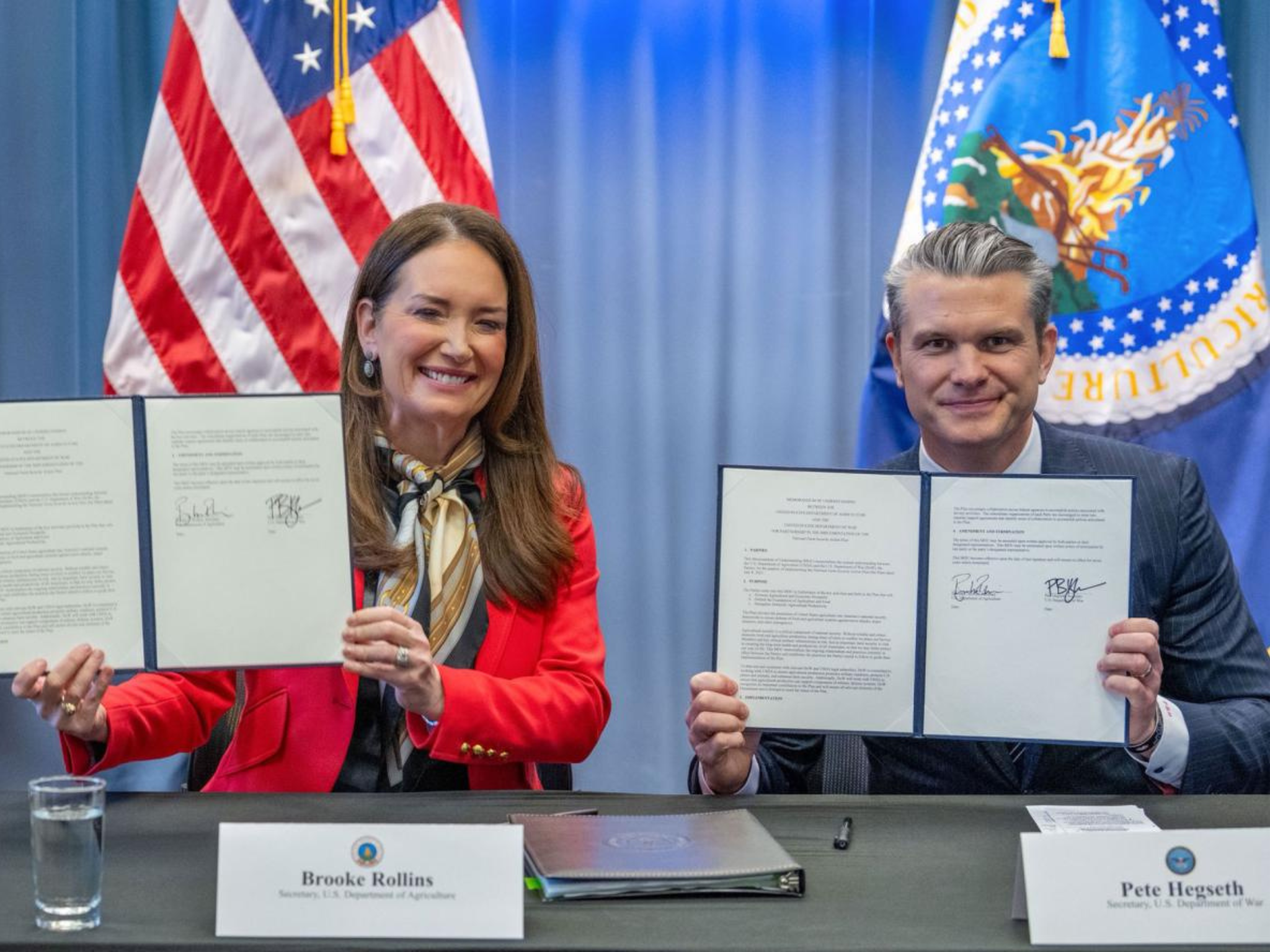
The US Departments of Agriculture and War have signed an MoU to elevate agriculture into the national security framework, with a focus on advancing novel technologies to address vulnerabilities.
Food security is critical to national security, the US government has announced.
The Department of Agriculture (USDA) has signed an MOU with the Department of War (DoW) to make agriculture a key element of national security, as an extension of the National Farm Security Action Plan.
The move has led to a new research partnership between the Defense Advanced Research Projects Agency (DARPA) and the USDA’s Office of the Chief Scientist, as well as the creation of an Office of Research, Economic, and Science Security under the latter.
Together, the USDA and DoW will work to develop novel technologies and exchange personnel to accelerate innovation to protect the domestic agricultural supply chain, which could prove to be a major opportunity for local food tech players.
“We’re going to promote agricultural and economic prosperity, defend the foundations of agriculture and food… and strengthen domestic and agricultural productivity,” said Pete Hegseth, the secretary of war. “We’re ensuring that American agriculture remains resilient, productive, and a cornerstone of our nation’s strength.”
USDA and Pentagon spotlight ‘novel technologies’ to promote national security

The partnership between the two departments is designed to further implement the farm security action plan announced in July, which aims to enhance agrifood research security, address supply chain gaps, and boost domestic productivity by safeguarding animal and plant health and protecting critical infrastructure.
One of its provisions prioritises USDA funding for American-made technology, research and innovation, including biotechnology and biomanufacturing.
The National Farm Security Action Plan further seeks to support the development of a “21st-century agro-defence workforce” by promoting higher education programmes that prepare young Americans to tackle emerging agrifood security challenges.
Now, the USDA and DoW are building on this foundation to work more closely together to “defend the nation’s food and agricultural systems, strengthen domestic productivity, and address emerging security threats to American agriculture”.
By giving USDA agencies access to DARPA, the MOU seeks to enhance agricultural security and defence by accelerating the adoption and integration of novel technologies and ensuring the US’s capability to lead agricultural technology innovation.
The two bodies will exchange information on the security threats to the American food system, its technological requirements and economic trends, and fostering public and private sector adoption of novel agriculture innovations.
The partnership may leverage USDA testbeds to “accelerate scientific discoveries, development, commercialisation, and adoption of novel technologies”. This could include the development of an “expedited but bounded pathway” to rapidly test, validate, and deploy agricultural biosecurity and other technologies to counter emerging threats “without sacrificing safety, oversight, or trust”.
Could this be a win for American food tech?

The partnership’s focus on “novel technologies” will pique the interest of food tech companies across the US, especially those setting up local manufacturing hubs to develop innovations that can safeguard food security.
While the government has stayed ambiguous on what these new food technologies could be, it’s worth looking at a letter sent by 11 Republican Congress members to the director of national intelligence and the USDA’s director of homeland security in November 2024.
The letter was a response to the national intelligence director’s annual threat assessment, which labelled China’s strategic advancements in “synthetic biology and agricultural biotechnology” as an attempt to “lead the broader biotechnological landscape”.
The lawmakers implored the US intelligence community to “conduct a focused analysis” on the potential impact of China’s advancements in alternative proteins: “We cannot allow China to control more of the world’s food supply than it already does. To cede American leadership in the global innovative protein market to foreign adversaries like China is to forfeit the food security of the United States and its allies.”
Although that letter was sent under the Biden administration, nine of the 11 signatories are still serving in the House of Representatives, and one is President Donald Trump’s labour secretary now.
So even though many Republican-led states have banned novel foods like cultivated meat (or are trying to), there’s a recognition from members of the same party that such technologies can secure the US’s food supply. And the new USDA-DoW partnership could, in theory, advance this sector.
The move also aligns with a new alternative protein bill by Senator Adam Schiff, which seeks to create a national protein security programme under the USDA’s Agriculture Research Service with $10M in annual biotech funding, and calls for a national protein security plan that considers the best available science about protein diversification and its strategic benefits.
Other alternative protein companies that are doubling down on US manufacturing stand to win too. This includes precision fermentation specialist Liberation Bioindustries, duckweed protein firm Plantible, mycoprotein startup The Better Meat Co, and cocoa-free chocolate maker Voyage Foods.
“The signal is loud and clear: concentrated supply chains are a vulnerability. Diversified production is a strategic asset,” Heather Courtney, founding general partner at VC firm Alwyn Capital, said in a LinkedIn post. “For food tech and alt protein, the narrative just shifted. You aren’t just ‘ahead of the market’ anymore. You’re essential to national security.”