

Prioritising Plant-Based Food in Public Institutions Can Save the EU €11.6B Each Year


A new study shows that the EU stands to save €11.6B in budget, healthcare and environmental costs by shifting a majority of public food procurement spending towards plant-forward menus.
The EU could save billions every year if it shifted public food procurement to plant-forward menus, according to a new analysis.
Currently, 43% of the bloc’s food spending for schools, hospitals, and other public institutions goes towards animal proteins, with the rest directed to plant-based foods. This is despite the former making up just 32% of the region’s calorie intake and up to 86% of its food-related emissions.
Reprioritising budgets even more in favour of plant-sourced foods could bring about €11.6B in economic savings, the study from Bryant Research shows. It would significantly reduce greenhouse gas emissions and improve long-term public health, both of which are key goals for the EU.
“This is not a lifestyle debate, it is a fiscal and strategic one,” said Jasmijn de Boo, global CEO at ProVeg International, which commissioned the research.
“Public procurement is one of Europe’s most overlooked climate and health tools. By shifting spending to 85% plant-based, the EU could save €3.16 billion directly from food budgets, and over €11 billion annually when environmental and health impacts are included,” she added.
Plant-rich public procurement offers savings across multiple cost streams
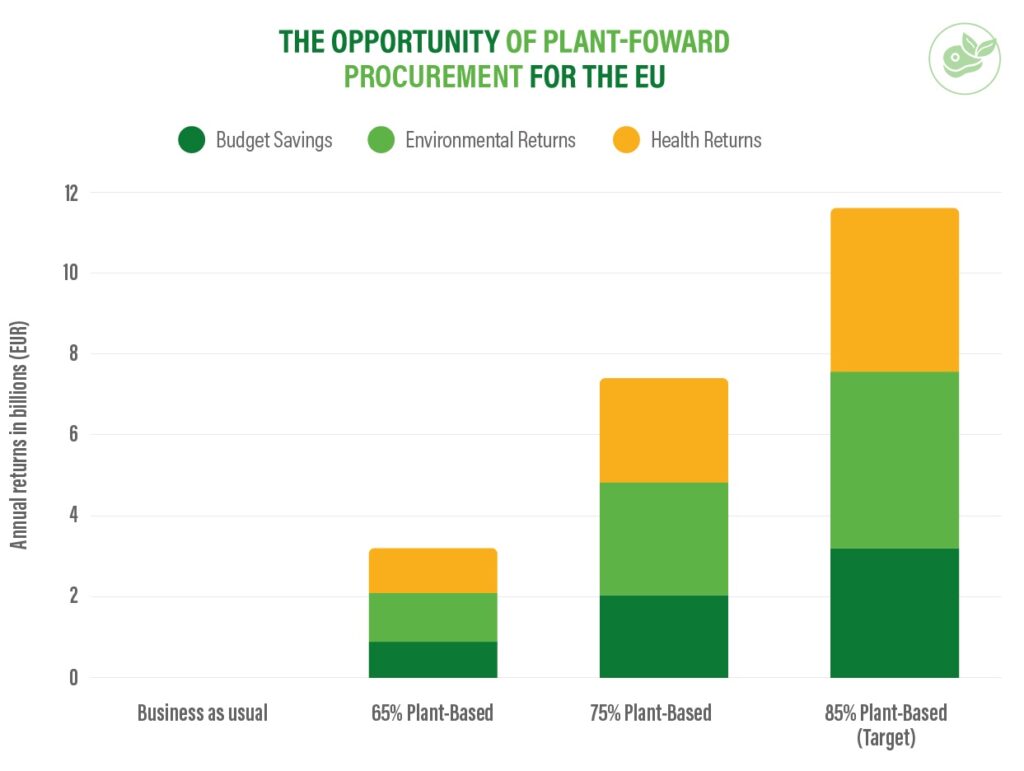
The researchers explored the impact of increasing spending on food served in schools, universities, hospitals, the military, and other public institutions, presenting scenario modelling at 65%, 75% and 85% plant-based procurement levels. The latter is informed by the Eat-Lancet Planetary Health Diet, which derives around 87% of its calories from plants.
They quantified three cost streams: direct budget savings from the lower ingredient costs of plant-rich meals, environmental externalities, and the health burden of dietary disease.
Previous research has shown that the cost of air and water pollution from animal protein production totalled €181B in 2022, while diet-related diseases linked to meat and dairy consumption cost the EU around €452B in healthcare costs the same year.
Currently, the EU spends €45B on public food annually, and existing procurement patterns generate €8.4B in climate-related externalities. These are costs borne by taxpayers through healthcare and environmental damage.
This new analysis suggests that spending 85% of public procurement funds on plant-based foods would save €3.16B in direct public food budgets, €4.37B in avoided environmental externalities, and €4.08B in costs related to social health and cardiovascular disease.
This equates to returns of €215 per person served by these institutions. Conversely, if the current system remains unchanged, the EU would miss €1.3M in returns per hour.
The 85% scenario would lead to a reduction of 8.9 million tonnes of CO2e per year, equivalent to removing 4.44 million cars from the region’s roads. Plus, it would help prevent nearly 400,000 cases of long-term obesity.
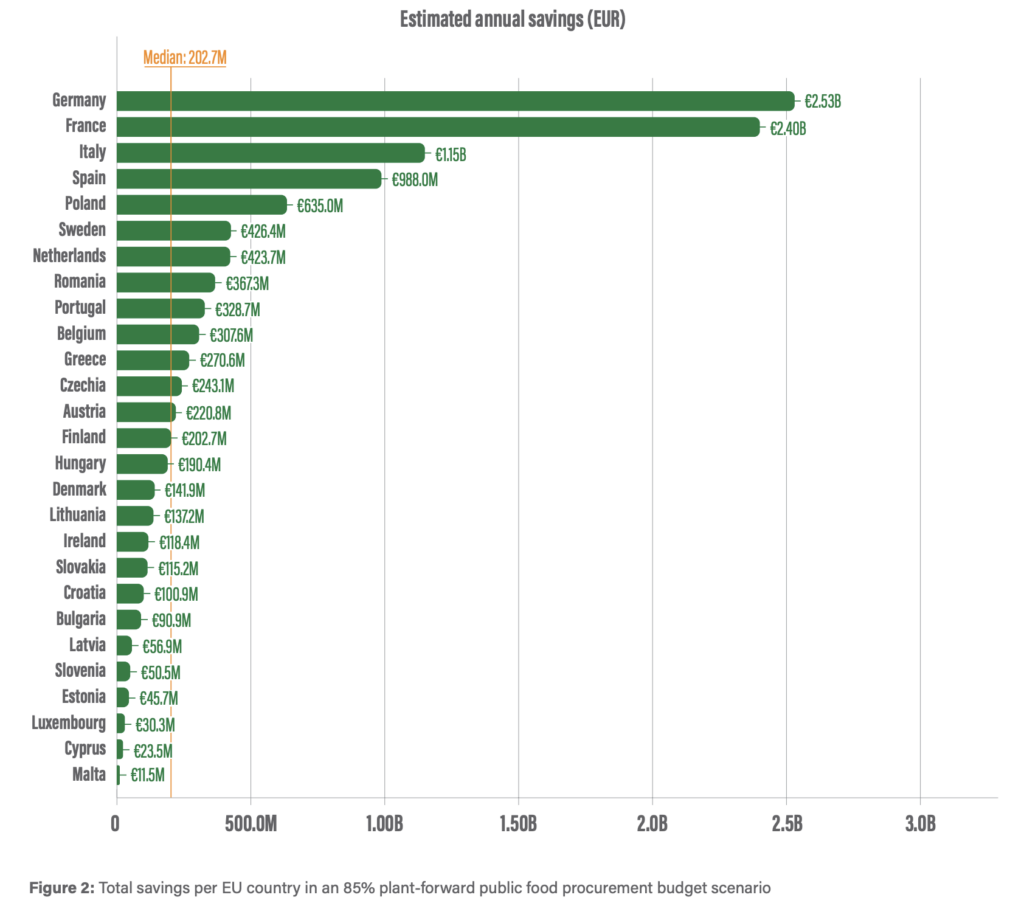
Bryant Research’s analysis maps the impact on each of the EU’s 27 member states. Germany would be the biggest beneficiary, with the shift delivering €2.53B in combined returns each year, followed closely by France (€2.53B). Italy is the other country with over a billion to be made in savings (€1.15B).
Crucially, schools are at the centre of the impact, since they account for 39% of institutional animal product consumption across the region. Reforming school meals alone could lower future adult obesity rates.
How the EU can ramp up spending on plant-based food in public institutions
Beyond these savings, plant-forward procurement better protects the EU from volatile agricultural input costs, supply chain instability, and environmental risks, boosting its long-term food security. It also supports farmer diversification, in line with the 2028-34 proposals for the Common Agriculture Policy.
So, how can the EU effect these shifts? For starters, policymakers must amend the EU Public Procurement Directive to replace lowest-cost bidding with sustainability-weighted evaluation that incorporates environmental and health impacts, and to introduce a minimum 25% organic sourcing target.
The EU School Scheme needs reform, too. Legumes, pulses and nuts should be reclassified as a core category, as should fortified unsweetened plant-based milks.
Policymakers should direct European Social Fund Plus funding towards training chefs and upskilling the catering workforce to deliver nutritionally complete plant-forward menus, and support farmers by establishing conditional supply contracts and a dedicated transition grant fund to derisk seeking to transition to food-grade plant proteins.
Moreover, the EU should implement science-based behavioural nudges that preserve freedom of choice, including by introducing a ‘plant-based by default’ approach, strategic menu placement, and sensory-focused labelling.
The research follows Systemiq’s earlier analysis this year, which suggests that if alternative proteins are treated as a strategic priority, they could generate €111B in annual gross value added to the EU and support 414,000 high-quality jobs across arable agriculture, R&D, manufacturing, logistics, and marketing.
As the 2026 review of the EU Public Procurement Directive approaches, the new research provides policymakers with a “politically deliverable” path to align public spending with the Strategic Dialogue on the Future of EU Agriculture report, according to ProVeg.
It would also support the European Commission’s commitment to create a protein diversification strategy to address supply challenges and meet its net-zero target for 2050.
“Public food purchasing is preventative fiscal policy hiding in plain sight,” said de Boo. “Adjusting menu composition is one of the fastest ways governments can influence emissions, healthcare costs, and public spending at scale.”