

Blended Meat Had A Breakout Year in 2025. These Factors Will Define Its Next Growth Stage


At least 65 companies and brands now offer blended meat products amid fast-growing interest from retailers and foodservice operators. Can the category now scale past its proof-of-concept stage?
From Disney to the Dutch Grand Prix, blended meat proliferated in 2025.
These products, which combine meat with plant-based ingredients or mycoprotein, offer companies a way to lower their emissions and costs, and consumers a way to eat less saturated fat and more fibre while maintaining the meaty taste of burgers and the like.
According to a State of the Category report by protein transition platform Food System Innovations (FSI), these ‘balanced protein’ products are now entering their next stage in the market.
Globally, 65 companies and private-label brands now sell blended proteins. And in the US alone, the serviceable obtainable market for these products is worth $5.3B, as calculated by FSI and research agency Schaefer. That equates to 2% of the total US meat market, but doesn’t account for the full foodservice and retail opportunity.
Since 2023, more than $60M has flowed into this sector from a mix of private investors and government funding (including the US Department of Defense). That may be a modest total, but FSI argues that “early commercial wins” suggest the category is “meaningfully under-capitalised and poised for outsized impact with additional funding”.
How blended meat emerged as a winner in both retail and foodservice
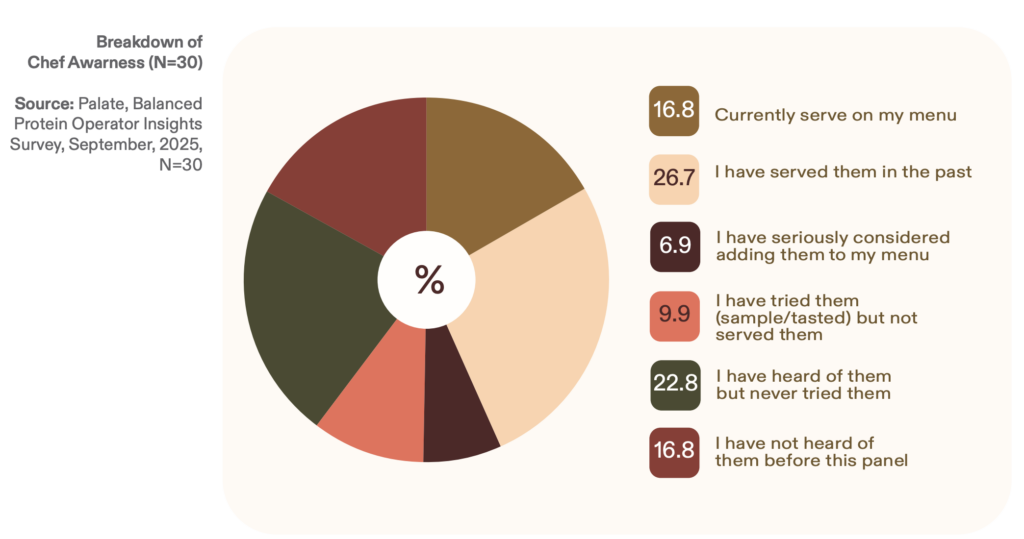
FSI suggests that the foodservice momentum for blended meat is “tangible” and is built on a decade of culinary advocacy. In a small-scale operator study, it found that 83% of chefs were either aware of balanced proteins, had tasted or seriously considered adding them to the menu, or had direct experience serving them.
The bulk of this momentum comes from non-commercial foodservice. New York’s Pat LaFrieda sells a burger with 50% mycelium meat from 50Cut at a lower price point than its 100% beef patties. Disneyland has swapped all kids’ meal burgers for 50/50 Foods’s Both Burger. And the Dutch Grand Prix quietly transitioned all hamburgers to Olijck Foods’s Halfway Burger, selling 29,000 of the in three days.
Commercial foodservice appears to have underutilised blended meat, with marquee launches in restaurant chains contained to limited-time offerings. First Bite, a foodservice intelligence company with access to a database of over 200 million menu items, estimates that less than 500 restaurants (0.1% of the US total) serve blended burgers on their menu.
Retail adoption, on the other hand, is “uneven but promising”, driven chiefly by European supermarkets. In the Netherlands, for instance, Albert Heijn has introduced 13 private-label blended meat options, and Lidl’s blended beef mince is 33% cheaper than the beef-only option. And one in four burgers sold at the latter’s Belgian stores contains plant-based ingredients.
The importance of value propositions
When it comes to consumers, the leading motivator for blended meat adoption is curiosity, and the top barrier is people having no clear reason to buy it. This points to the same underlying issue: value proposition confusion.
“Curiosity drives initial awareness but rarely sustains repeat purchase. At the same time, the fact that only 8% of category rejectors cite unfamiliarity reinforces that consumers recognise these products, but they don’t know why they should choose them,” the report states.
“Many consumers still struggle to understand why Balanced Proteins exist or how they fit into their routines. This underscores the need for clearer, more tangible benefits anchored in taste, health, affordability and practicality.”
This is why FSI believes the category’s biggest opportunity and challenge is definition, suggesting that “stronger framing around purpose and composition will turn curiosity into conviction”.
Aside from curiosity, health is also a key driver, as cited by 50% of respondents. But among those who find blended meat unappealing, 30% remain hesitant about the ingredients in these products, and 27% are concerned about how they’re processed.
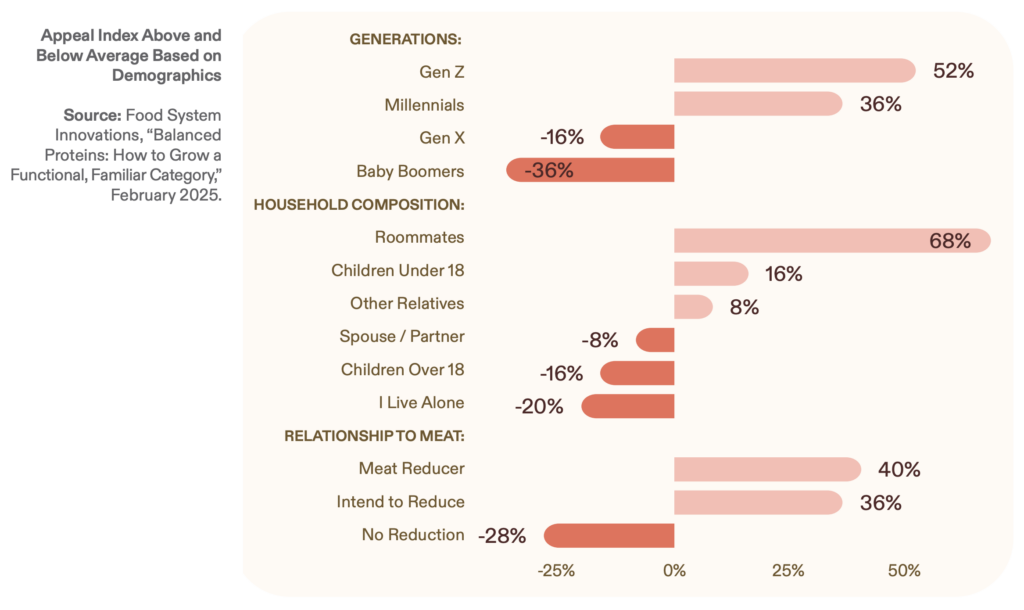
Proprietary research by Schaefer reveals that Gen Zers, millennials, and households with children are more likely to be open to balanced proteins. In fact, Gen Z’s appeal rating is 52% higher than the average.
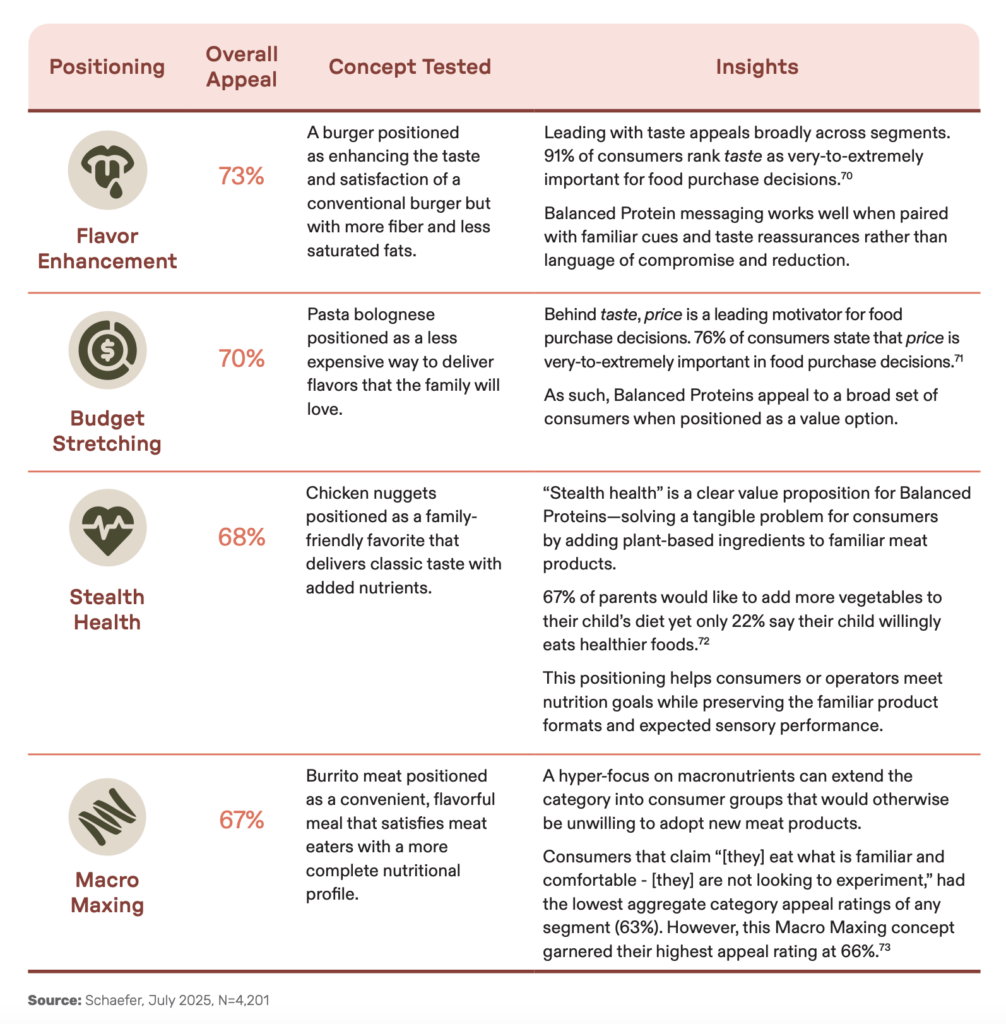
Schaefer identified four value propositions around blended meat that resonate most with consumers. These include flavour enhancement (73%), budget stretching (70%), stealth health (68%), and macro-maxing (67%). “Balanced Proteins perform best when framed as enhancements to foods people already love, not as a new category to learn or a habit to change,” FSI notes.
The factors that will define blended meat’s growth
The report highlights how the next phase of growth for blended meat depends on addressing a range of interconnected system-level challenges.
The first is to ensure sustained improvements in sensory performance (several balanced proteins already outperform 100% meat on taste) and operational excellence to boost consumer trust and loyalty.
Building buy-in from consumers and industry is critical, too. Companies must create excitement through sharp, compelling narratives and clear value propositions to drive trial, and cultivate strong engagement from chefs, operators, retailers, and brands to normalise balanced proteins across menus.
Even when products are ready, distribution bottlenecks slow growth for blended meat, which is why operators must secure broadline distribution access to ensure consistent, reliable supply across foodservice channels. This is the bridge between pilot success and mainstream adoption.
Investment is critical here, since capital deployment in balanced proteins remains limited. Catalytic and impact funding are necessary to close infrastructure and R&D gaps to battle the familiar headwinds of the food industry: unclear demand, modest margins, and uncertain exits.
Looking ahead, FSI predicts blended meat will be defined by four priorities in 2026. Companies would need to generate measurable performance data to establish credibility and benchmarks for future growth.
They must expand awareness across channel buyers with category-level marketing, trade presence, and case studies. Plus, they need to strengthen co-manufacturing and ingredient supply partnerships to lower costs and improve access.
Finally, it is essential for blended meat purveyors to attract more investment to move from pilot to scaled programmes in both institutional and commercial settings.
“The year ahead will be pivotal in determining whether Balanced Proteins progress from proof-of-concept to proof-of-category, emerging as a defined, organised segment of the meat industry with broad market participation,” FSI says.