

Plant-Based Just Egg Lands in the UK Via Vegan Food Group


Eat Just’s market-leading vegan egg, Just Egg, has finally debuted in the UK, with the distribution being handled by VFC parent Vegan Food Group.
Just Egg, the mung-bean-based vegan liquid egg from US company Eat Just, has debuted in the UK market.
The product is being offered to taste-testers near King’s Cross station in London on Thursday (August 7), and will be available to consumers in the coming weeks, starting with online retailer Ocado. Each 340ml carton is priced at £3.99 and is equivalent to six eggs.
The rollout marks the product’s European debut, as well as its first foray outside North America. It will be manufactured and distributed by Vegan Food Group (VFG), the holding company behind plant-based brands like VFC and Meatless Farm, as part of an exclusive deal announced in April.
“People have been waiting for so long to bring this to the UK, and me and the team have just had such an incredible journey working with the US team, understanding the brand and… how we bring that to the UK consumer is very different to the US consumer,” says Abigail Nelson-Ehoff, head of marketing at VFG.
“The consumers who have been waiting for this product, a lot of the vegan community, [will go]: ‘Finally, it’s here,'” she adds. “But it’s also as many people, if not more people, who have never heard of the product – this is an amazing product for them. So it’s how we can bring it to both.”
Matthew Glover, co-founder and chairman of VFG, says: “We think there’s a huge pent-up demand for it. There’s not been anything like this on the market so far. So we’re very excited to launch it into the UK.”
Echoing Nelson-Ehoff, he says this product is “really for everybody, not just vegans”: “It’s for anybody that’s plant-curious. There’s a lot of people that are allergic to eggs, so it’s perfect for those individuals.”
How Just Egg made it to the UK

Just Egg is made from a base of mung bean protein and contains nearly 13g of protein per serving (5.9g per egg equivalent, versus 6.3g for a chicken egg). It has less than a third of the saturated fat found in conventional eggs, as well as zero cholesterol. Producing the vegan liquid egg uses 98% less water and 83% less land, and generates 93% fewer greenhouse gases.
The European launch of Just Egg has been a years-long endeavour. Eat Just had signed several partnerships to bring the product across the Atlantic, while receiving novel food regulatory approval by the European Food Safety Authority and authorisation from the EU Commission.
The efforts finally came to fruition in April this year, after the Californian food tech unicorn struck a deal with VFG. The latter invested £11.5M ($15.2M) to build a fully automated line to produce Just Egg at its facility in Lüneburg, Germany (Europe’s largest dedicated plant-based factory), enabling it to produce the equivalent of 500 million eggs per year.
“Proprietary mung bean production will be led by Eat Just, supplying this directly to VFG from its Minnesota facility,” Glover told Green Queen at the time. “From that point, VFG is installing a fully automated downstream production system in Lüneburg to produce Just Egg. Other ingredients and packaging will be sourced locally.”
He added: “The brand positioning and proposition sits perfectly alongside the existing VFG portfolio of brands, products and eating occasions. Our strategy is consolidating a portfolio of exciting products and brands, to which Just Egg sits perfectly.”
Through its investment, VFG sought to enhance automation, extend shelf life, cut waste, and improve product quality at its facilities in the UK and Germany. It will also support retailers and foodservice partners with “next-gen innovation and operational excellence”.
“VFG will be making the majority of the upfront investments in capital expenditure and marketing to launch the brand in Europe,” Glover said.
Eat Just and VFG look to build plant-based momentum amid egg crisis
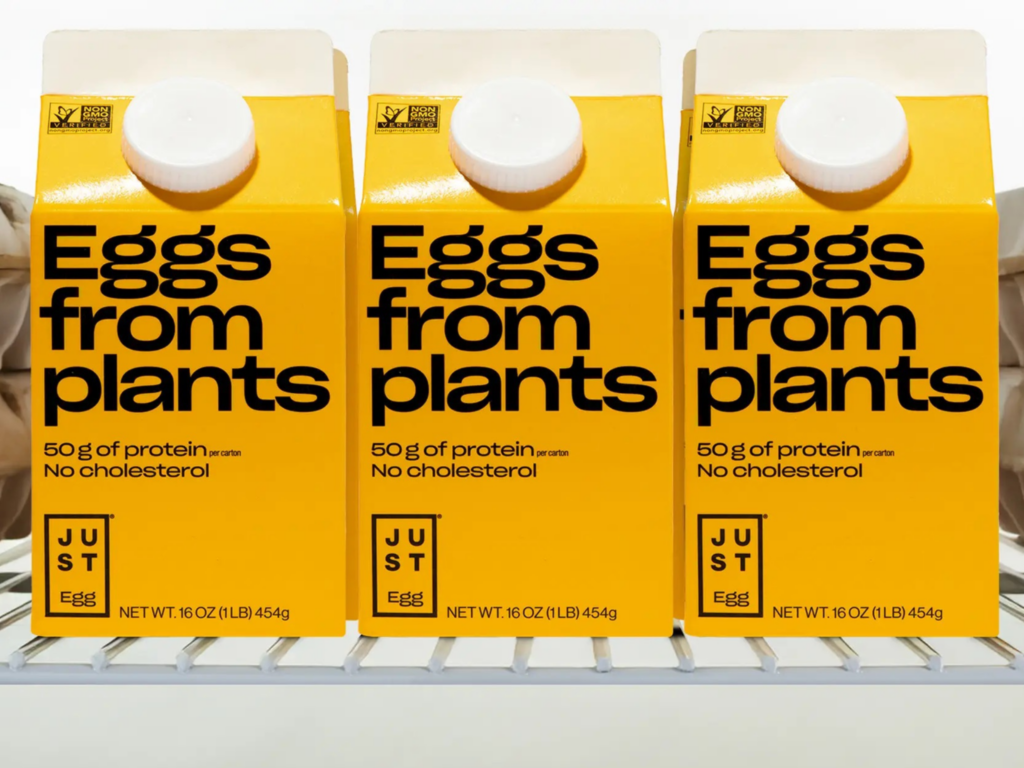
Eat Just’s UK entry comes on the back of skyrocketing success in the US, with 174 million birds culled in the current three-year wave of avian flu. Retail egg prices reached a record high of $6.23 per dozen in March. In some cities, each egg costs $1 now.
The company had already sold the equivalent of 500 million chicken eggs and captured 99% of the market for alternatives in the US. Then, in January alone, Just Egg’s sales grew five times faster than in the past year; 56% of shoppers returned to buy more (a three-point increase from 2024). Most shoppers (91%) who put it in their basket, meanwhile, are neither vegan nor vegetarian.
With egg shelves often empty, there are very few choices for Americans who wants eggs. “One, don’t eat them. Two, you know, have applesauce. Or three, have Just Egg,” co-founder and CEO Josh Tetrick told Green Queen in February. “This is a real moment in time for the plant-based industry to prove that it’s up to the challenge.”
The egg crisis isn’t just restricted to the US – in Europe, the cost of eggs has reached its highest in at least a decade, reaching €268.5 ($292) per 100kg in March.
In the UK, it will compete with the Crackd vegan liquid egg, which is made from pea protein. Aquafaba brand Oggs previously marketed a liquid whole egg alternative, though it hasn’t been in stock in supermarkets for several months now. “There are other egg replacements on the market, but quality-wise, there’s nothing that can stack up against Eat Just,” VFG CEO Dave Sparrow said in April.
“The UK and Germany are the immediate priority given our extensive distribution, which is already in place, and then we’ll roll out across other key markets,” Glover said at the time.
“The food system is broken. Most eggs are produced in factory farms. There’s about 37 million eggs currently trapped inside [them], both caged and cage-free. And these are real squalid, overcrowded, unhealthy places to produce food,” he says now.
“So this plant-based egg that we’re producing is much cleaner and healthier, and certainly much better for the environment and the animals and people.”