

Higher Protein, Higher Yield: Ever After Foods, Roslin Technologies Make Cultivated Meat Breakthrough

Food tech startups Ever After Foods and Roslin Technologies have worked together to produce structured cultivated meat tissue with dramatically higher protein concentration and record levels of productivity.
Two cultivated meat startups have combined their technologies to achieve a breakthrough in yields, protein content, and scalability, with “significant implications” for the cost of these innovations.
Israeli firm Ever After Foods (EAF) paired its tissue production system with Scottish player Roslin Technologies’s advanced cell platform to achieve breakthrough results in cell productivity and protein content.
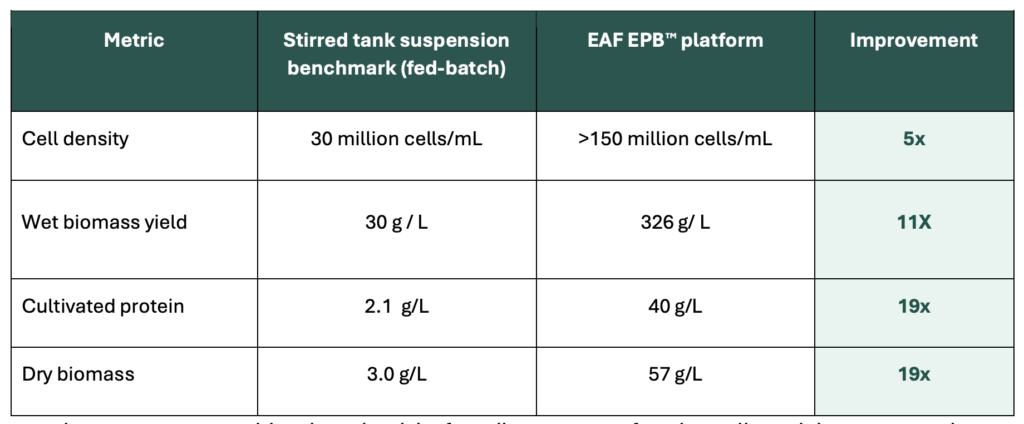
The companies produced structured cultivated tissue directly on EAF’s edible scaffold, a process that yielded 19 times higher cultivated protein and dry biomass productivity, and 11 times higher wet biomass productivity, compared to a stirred-tank suspension benchmark.
“Manufacturing productivity is one of the biggest factors determining whether cultivated meat can become economically viable,” EAF CEO Eyal Rosenthal tells Green Queen. “This has significant implications for production economics.
“Higher output from the same cultivation volume means potentially less equipment, infrastructure and operating cost per kilogram of product. Our technology also produces structured biomass directly on an edible scaffold, reducing the need for separate cell-harvesting and downstream processing steps.”
Combined technologies increase cell density fivefold
Formed as a joint venture between cellular agriculture firm Pluri and the Tnuva Group (Israel’s largest food company), EAF operates a species-agnostic platform that integrates advanced bioprocess engineering, a proprietary edible scaffold technology called PlantriX, and its Edible Packed-Bed (EPB) production system, which comprises a patented 3D cell expansion environment to mimic the cells’ natural environment.
Roslin, meanwhile, is a spinout from the University of Edinburgh developing advanced cell technologies for cultivated meat companies. Its pluripotent stem cells have indefinite replication potential, can naturally differentiate into any tissue, and are genetically stable. They can grow fast and efficiently to high densities in low-cost, food-safe media.
The two companies note that the cultivated meat sector has primarily been focused on increasing cell density for over a decade, but cell expansion is only one part of the challenge – commercial production depends on how efficiently these cells can produce edible protein, biomass and structured tissue.
Their partnership combined a host of technologies and processes, including suspension propagation of cell aggregates, serum-free and animal-component-free media, mechanical dissociation before seeding, direct seeding into a tissue-producing bioreactor, plant-based edible scaffolds, and animal-free attachment material, coatings and microcarriers.
They expanded Roslin’s porcine cells in suspension as multicellular aggregates in serum-free media. These aggregates were then mechanically dissociated and directly inoculated into EAF’s EPB bioreactor, where cells attached directly to its PlantriX scaffold. The process achieved a cell density of 150 million cells per ml in nine days, a 62-fold increase.
The platform resulted in volumetric productivities of 326g of wet biomass, 57g of dry biomass, and 40g of cultivated protein per litre. This came from achieving a cell density five times higher than a stirred-tank suspension benchmark, as well as boosting the per-cell protein and dry biomass yield fourfold. In other words, the tech enables cells to produce more cultivated meat.
All reported productivity and composition metrics were achieved with an edible scaffold making up less than 2% of the final product by weight, and all biomass and protein values were calculated after excluding the scaffold and media contribution.
Higher outputs can help lower cultivated meat costs
The companies noted that higher productivity per unit of bioreactor volume and greater output per cell can potentially improve the economics of cultivated meat manufacturing, a key bottleneck for its commercialisation. They’re now doing additional development and scale-up work to advance the combined cell and tissue production platform.
“These results demonstrate the versatility of our porcine pluripotent stem cells across suspension expansion and EAF’s tissue-production environment, while achieving substantial gains in productivity,” says Roslin CEO Ernst van Orsouw. “The collaboration provides an encouraging example of how complementary technologies can be integrated to address key scale-up challenges.”
“Our techno-economic modelling indicates the potential for substantial reductions in both capital and production costs compared with conventional stirred-tank approaches,” says Rosenthal. “These projections still need to be validated at commercial scale, but the productivity results provide strong evidence for a more economically viable manufacturing pathway.”
He notes that EAF is primarily a manufacturing tech company, with a commercialisation strategy centred around supplying its EPB platform and working with cultivated meat companies to enable industrial-scale production.
“Together with Bühler, we have developed a 200-litre modular production system, with industrial-scale validation as our next major milestone. In parallel, we are advancing collaborations with industry partners toward commercial deployment. The timing of initial commercial production will depend on successful validation and our partners’ development plans,” outlines Rosenthal.
“We are also exploring cultivated seafood and pet food opportunities, particularly following our acquisition of Fishway, which expanded our capabilities in aquatic cell biology. Pet food remains an attractive potential early application, but it is not our sole route to market.”
EAF has not yet filed an application for regulatory approval. “As a manufacturing technology provider, we work with partners developing different cultivated animal products, and regulatory requirements depend on the specific product, cell line and target market,” he says.
“We are advancing regulatory preparations for priority markets, including Singapore, Israel and the US. Approvals will depend on the relevant regulatory processes and the specific products being developed.”