

Future Food-Tech San Francisco 2026: MAHA, Fermentation, AI & Regulation

At this year’s Future Food-Tech conference in San Francisco, the policy spotlight shone bright, with artificial intelligence set to play a big role in the sustainable food industry.
The swashbuckling policy shifts from the Trump administration are driving how companies and investors are thinking about the future of food. And many are less than impressed with the MAHA-heavy, science-light decision-making in the US food industry.
That much has been apparent at the Future Food-Tech conference in San Francisco (March 19-20), where food tech stakeholders from across the world have convened to chew over the future of the industry.
Several startups unveiled new innovations to give attendees a glimpse at what they’ve been up to behind the scenes. This includes Savor, the maker of carbon-derived butter, which teamed up with local establishment Jane The Bakery to offer vegan scones, cookies and croissants.
The conference also saw Kokomodo and Cellva showcase their chocolate alternatives – the former’s version is made via plant cell culture, and the latter from coffee waste. Bettani Farms, months after making a string of acquisitions, exhibited its non-dairy cheese, Maia Farms displayed its dried mycelium proteins, and Michroma demonstrated its precision-fermented alternative to Red Dye No. 3.
Among these future food innovations, the influence of policy and regulation – whether it’s the debate around ultra-processed food or the proposed elimination of a key regulatory pathway – couldn’t be understated. And artificial intelligence (AI) seemed to be on top of investors’ minds, too.
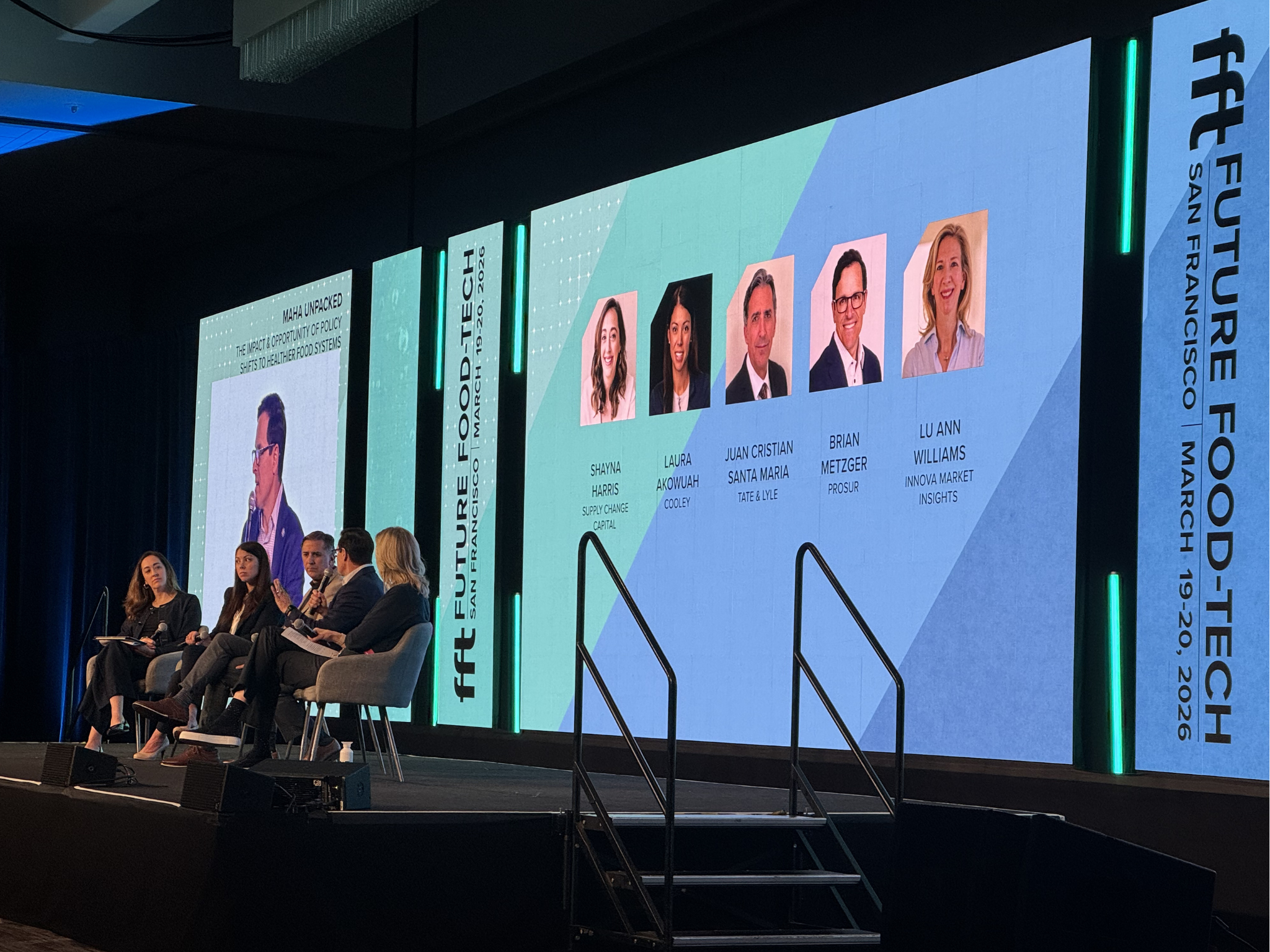
Laura Akowuah, special counsel at Cooley LLP, spent a decade working at the Food and Drug Administration (FDA), including months at the start of President Donald Trump’s second term.
She outlined the main things to keep watch on over the coming year. First, the future of the self-affirmed Generally Recognized as Safe (GRAS) pathway. “That has the ability to impact so many things,” she said, suggesting that companies should carefully monitor this.
“Number two, I think you need to think about marketing and transparency with consumers. Number three: what’s going to happen with ultra-processed food and the government-wide definition? How is that going to roll out? And then, I think, added sugars,” Akowuah said in a panel discussion on the MAHA era.
Here are some of the biggest talking points from the 2026 Future Food-Tech summit.
1) MAHA is dictating food formulations

According to data collected by Innova Markets Insights, 23% of all product launches contain an ingredient targeted by the Make America Healthy Again movement, including artificial dyes, high-fructose corn syrup, certain preservatives, or over 10g of added sugar per 100g.
Big Food faces more than twice the MAHA exposure rate as indie brands, with 40%of their products containing at least one of these ingredients. This outlines the need for food giants to reformulate their offerings, which could boost the prospects of B2B food tech startups producing clean-label functional ingredients or targeting sugar reduction.
The latter is a major opportunity, given that 65% of consumers say they’re now looking to limit sugar intake, the highest of any ingredient. So sweet protein startups like Oobli and Amai Proteins could win big.
2) The removal of self-GRAS is an affordability issue
For decades, food companies have relied on the self-determined GRAS pathway to bring their ingredients to market. It’s a cheaper and faster way to commercialise, but since it doesn’t require formal FDA review, many raise concerns about the true safety of products launched this way.
It’s why health secretary Robert F Kennedy Jr is looking to eliminate this provision, which would extend the path-to-market and the associated costs for food companies.
Lu Ann Williams, co-founder and president of Innova, suggested that it costs between $150,000-300,000 and takes up to three years to get novel food approval in the EU, where the regulatory framework is strict and, some argue, overly complex. If you change the self-GRAS provision, this could have a big financial impact on businesses.
But it isn’t just companies that will suffer on the monetary front. “Having worked at the FDA for a long time and knowing the resource constraint issues pre-2025, thinking about how that’s gonna happen now, I’ll be very interested to see how that rolls out,” said Akowuah, who called the self-GRAS decision a “big question mark for everyone this year”.
She encouraged businesses to submit comments to the FDA’s forthcoming proposal on how it will eliminate this rule, outlining how it could stifle innovation, development, and affordability.
“[The] FDA cares about affordability. So I think in those comments, you also want to include how this is gonna impact consumers and impact their pocketbook,” she said.
And affordability is top of mind for consumers. When Innova Markets Insights asked people what matters when they’re planning a healthy meal, 38% of them said taste and 36% cited budget – only 30% said they factor their health goals into account.
“So, the massive issue now is affordability,” Williams said during the panel discussion. “You can be as aspirational as you want, but we’re in a unique period coming out of the last five years. Making all this affordable is a big challenge, especially when it all has to happen so fast.”

3) GLP-1 drugs are now mainstream, and converging with MAHA
The booming popularity of Ozempic and other GLP-1 drugs has already shaken up the food industry on a massive scale, with some of the largest companies either introducing new products aligned with GLP-1 users or reformulating their current offerings.
Innova’s research has found that the share of Americans using GLP-1 drugs increased from 10% in 2024 to 18% in 2025. In fact, over a third (34%) are now planning to adopt these medications, proof that they’re no longer a niche category.
Williams believes the GLP-1 movement directly converges with the MAHA drive, calling it the “only true consumer-driven topic” in the RFK Jr era. And the data shows that dietary shifts are already happening. In the US, 45% of GLP-1 users eat more vegetables, 40% consume more protein, and 30% ingest more fibre. Overall, 71% of these consumers are eating more healthy.
Innova’s research further indicates that the axis between GLP-1s and MAHA is driving people to eat less ultra-processed foods (UPFs), and instead focus on more nutrient-dense products that are rich in protein and fibre.
Only 0.17% of products address what Innova calls the “ultra-processed middle” – encompassing foods that blend convenience, clean labels, and affordability alike – making it the “biggest white space” in the future food industry.
4) Plant-based proteins need to move beyond meat
Among the categories most affected by the UPF backlash is plant-based meat, which has seen a continued decline in sales in the US, where people are choosing to eat more animal protein instead.
The new (heavily criticised) Dietary Guidelines for Americans (DGA) has accentuated this shift, flipping the food pyramid to encourage red meat consumption. At the same time, it was the first time plant-based proteins and fermented foods were prominently highlighted in the recommendations. That’s a big deal, according to Williams.
“When plant-based really took off, it was overhyped. The hype cycle around plant-based meats – they just didn’t deliver against consumer expectations,” she told Green Queen.
“So now… consumers tell us pretty much all over the world that they would like to see less mimicry, but they would like plants to be used in kind of a standalone food product. So there’s other things that you can do to use the plant proteins in a different way. And now you have a big incentive in the US, especially because of the changes in the dietary guidelines.”
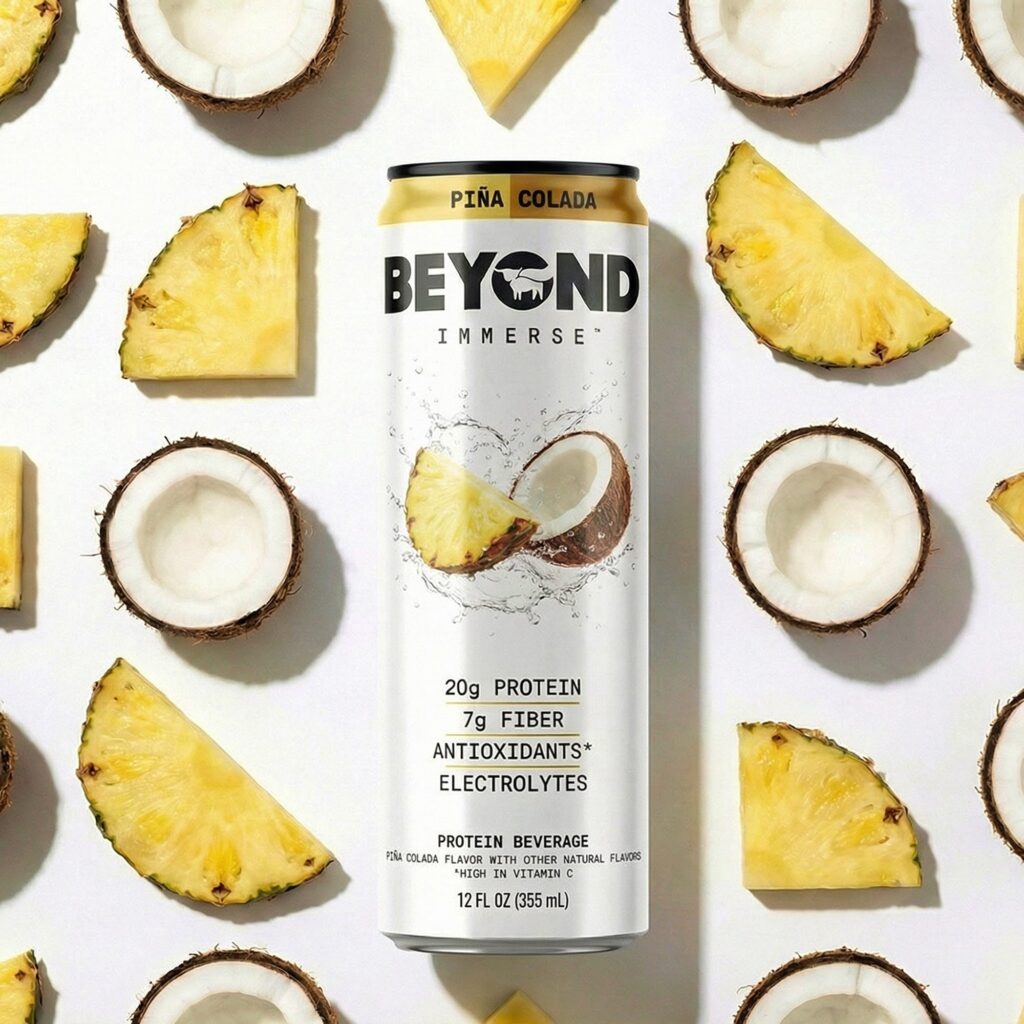
She added that companies “have to make it taste good”. This is exactly the philosophy that has driven Beyond Meat to diversify its product portfolio and offer a wide range of plant protein products, including its latest line of sparkling drinks.
“I think it’s very smart. It’s reality,” said Williams. “I don’t know if it’s going to work because it comes down to the execution. What’s the price? How do they communicate to consumers? What’s the nutrition?”
She added: “But in terms of a total pivot, I think they were going to have a hard time trying to just do a pure meat mimic.”
5) Blended meat will truly ‘move the needle’
The one area where plant-based proteins can shine is actually not vegan at all. Blended meat products have been proliferating across Europe and the US, with retailers like Lidl and Ahold Delhaize taking charge of this approach.
For Williams, blended meat is what would really make alternative proteins go more mainstream. “That’s what will move the needle,” she told Green Queen.
“If you’re going to really be serious about making this go mainstream, it’s going to be up to something like that. But also, when you add those plant proteins to the other meats, you get a bit of fibre, you get less saturated fat, you get a juicier product, [and] the taste stays the same. And if you could reduce the price by a bit, it would fly off the shelves.”
Doubling down on her belief, she added: “If I had to put money in something myself, it would be on a hybrid product with a retailer, on a ground beef and with a milk and stretching it with a plant-based product.”
6) AI can drive the food industry forward, but only with the right approach
AI is being increasingly embedded into alternative protein and future food production, from protein discovery platforms to process optimisation. And if you ask some investors, the technology is very much here to stay.
“I’m talking to other investors about how AI has changed the industry, so that we can understand, like, if you put money into alternative protein and cultivated meat, there’s something that’s different now in the industry,” Steve Simitzis, managing partner at Replicator VC, told Green Queen.
“Before, we had to invest a lot of money into doing a lot of science for the first time, and AI has made it so you can essentially just get through a ton of data faster than any human can and reach those breakthroughs faster.”
Alternative proteins endured a 20% decrease in funding in 2024, with the total sum failing to surpass the $1B mark for the first time since 2018. The decline is reflective of the wider investment landscape, which has seen VCs back away from climate tech and double down instead on AI.
“AI is eating up a lot of oxygen for funding and LPs. A lot of money is going into a small number of funds that are writing massive checks. To me, that looks like bubble behaviour on the AI side. And because of that, we don’t have the generalist capital going into food,” Simitzis said.
However, he doesn’t think it matters all that much. “There’s a lot of activity still happening at pre-seed and seed [levels], so naturally, the numbers are going to be smaller,” he said. “And that’s kind of where we do need to. We did need to retrench as an industry and focus on what’s actually going to scale, and that means making smaller dollar bets into smaller, more simple teams.
“And since a lot of them are AI-powered now, they can kind of do more with less… It’s a nice to have… [But] it’s more like, are they using it for something that makes sense or are they just trying to put AI on a slide?”
This is echoed by Matteo Leonardi, investment manager at Grey Silo Ventures, whose food portfolio is focused on upstream solutions. This is an area only a small number of businesses can effectively apply AI to, he said.
For him, a successful instance of AI use is more likely to come from the agtech sector – one of his firm’s latest investments is in a voice-to-text company that uses AI to make it easier for farmers to log their work at the end of the day.
“I’m very bullish on AI when it kind of comes to saving, optimising current workflows. And that’s for ag,” Leonardi told Green Queen. “But in food, I don’t know if that’s possible.”
7) Fermentation can be effective beyond protein, but not across all streams
Interest in one of the oldest forms of food technology is brewing fast. But for a long time, the focus on fermentation in the future food industry has been from the perspective of protein. That is changing now.
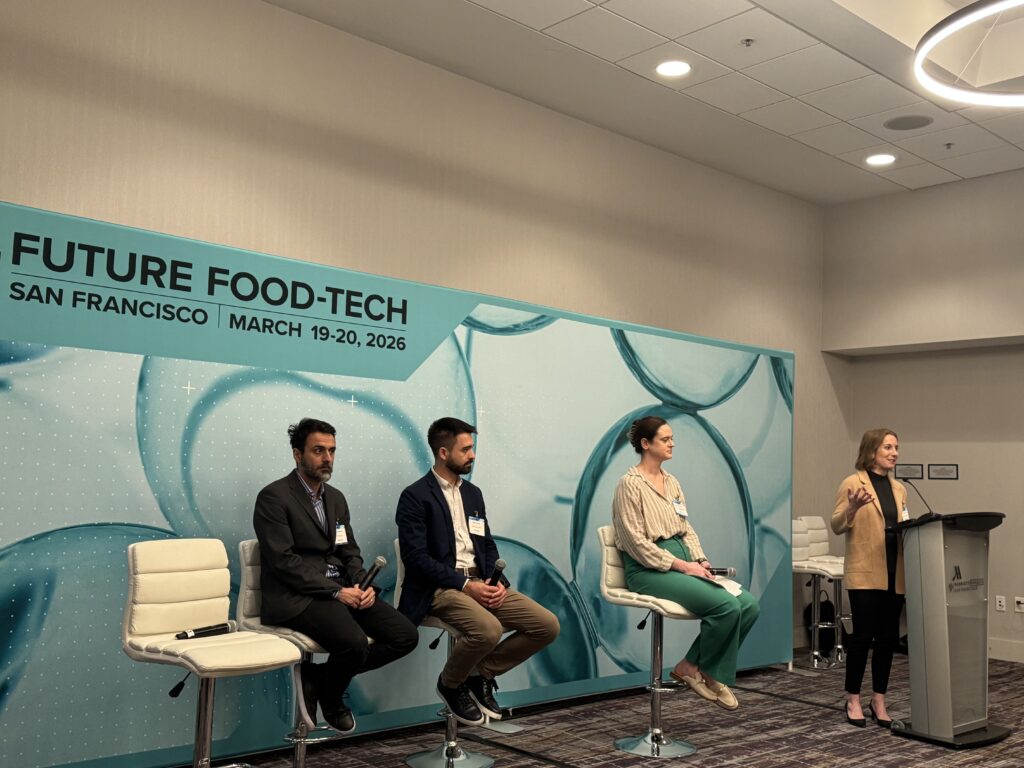
“The cost drivers are different now that maybe they were a couple of years ago. The cost drivers for protein are just insane. You have to compete with the meat industry? That is a challenge,” said Beth Conerty, regional innovation officer at the iFab Tech Hub.
“We really wanted to go after ingredients… where all of a sudden, the cost drivers make a little bit more sense, where the final percentage of a formulation is smaller. You need smaller quantities rather than trying to replace the whole beef industry. Then it’s also a higher-margin product.”
This technology seems more viable with ingredients like bio-based colourants, especially with the current policy environments.
“When protein was the target, all of the regulatory [effort] was to oppose protein. There have been states who have banned cultivated meat… so that doesn’t help cost factors at all,” said Conerty. “On the flip side, we’re seeing such a push from regulatory [bodies] to reduce and eliminate synthetic ingredients.”
For Leonardi, the egg industry is another viable target for precision fermentation, since animal-free replacements can target multiple functionalities. What’s less of a draw, as an investor, are companies using this tech to take on tropical fats like palm oil.
“That’s a beautiful mission, I get it,” he said. But the unit economics don’t make sense. “Try and replace palm oil with mechanical fractionation of other vegetable fats. That’s fine. But precision fermentation trying to replace a product that sells for $1.80 per kilo. It’s tough,” he explained.
“In those cases, you are solving something that, on a philanthropic point of view, is fantastic. But at the same time, you need to be aware that, probably, in terms of financial viability, economic viability, you’re never going to be able to do that. And companies would not be able to pay for a product that is just so expensive.”
8) Food polices need to be in step with science

At the MAHA discussion, panellists bemoaned the US government’s current policy approach to food. “Consumer demand – and rightfully so – for healthier foods, less processed foods was already latent. And then MAHA came on top of that,” said Juan Cristian Santa Maria, VP and head of regulatory and scientific affairs at Tate & Lyle.
“What MAHA has augmented is consumer confusion, precisely because the policy is moving too fast, and not necessarily science-driven, and often incongruent and inconsistent, where we’re taking one step forward, two steps back.”
He referred to the “complete 180-degree change of direction” in the initial recommendations for the national dietary guidelines, to the eventual publication (which was based on advice from an entirely new set of handpicked stakeholders).
“The perfect graphical example is the new DGA – and the food pyramid, literally flipped upside down. That’s exactly what is happening, and now consumers are confused,” said Santa Maria.
“I think we really need policies that, rather than demonising science and innovation, incentivise and promote science and innovation, that [are] targeted towards developing health benefits and health solutions, and that is what will really have an impact on society and the public health,” he added.
He noted that while food policy has deviated away from science, consumers will ultimately drive change to bring out the real benefits of innovation.
Science is not an enemy of the health outcomes, or affordability. Actually, it’s a conduit to being able to get to those endpoints that we’re looking at, both the health benefits as well as affordability to consumers,” he said. “So we cannot abandon science.”