

Livestock Farmers Could Earn More Money by Producing Less Meat: Study

As meat production shrinks in the UK, livestock farmers could be more profitable if they work on improving the environment and produce less meat.
The best way for meat farmers to make more money could be to produce less meat, according to new research by British think tank Green Alliance.
In the UK, 58% of people have made some effort to eat less meat, and the intake of red meat has fallen by 8% over the last two decades. Though beef and lamb production have made a loss since 2000, farms have still been profitable thanks to payments under the EU’s legacy farm support mechanism.
This provision, called the Basic Payment Scheme, is set to end in 2027, when it will be replaced by the UK’s Environmental Land Management (ELM) schemes, which reward farms for public goods.
“Reducing livestock numbers can help to create more space and time for farmers to increase other lucrative income streams,” the report said. “Therefore, aligning the level of production with reduced beef and lamb consumption could, in fact, increase the profitability of these farms.”
To realise these benefits, though, the government must give farms more opportunities to earn money by delivering public goods under its agri-environment support schemes.
Reducing meat production could make space for more profitable activities
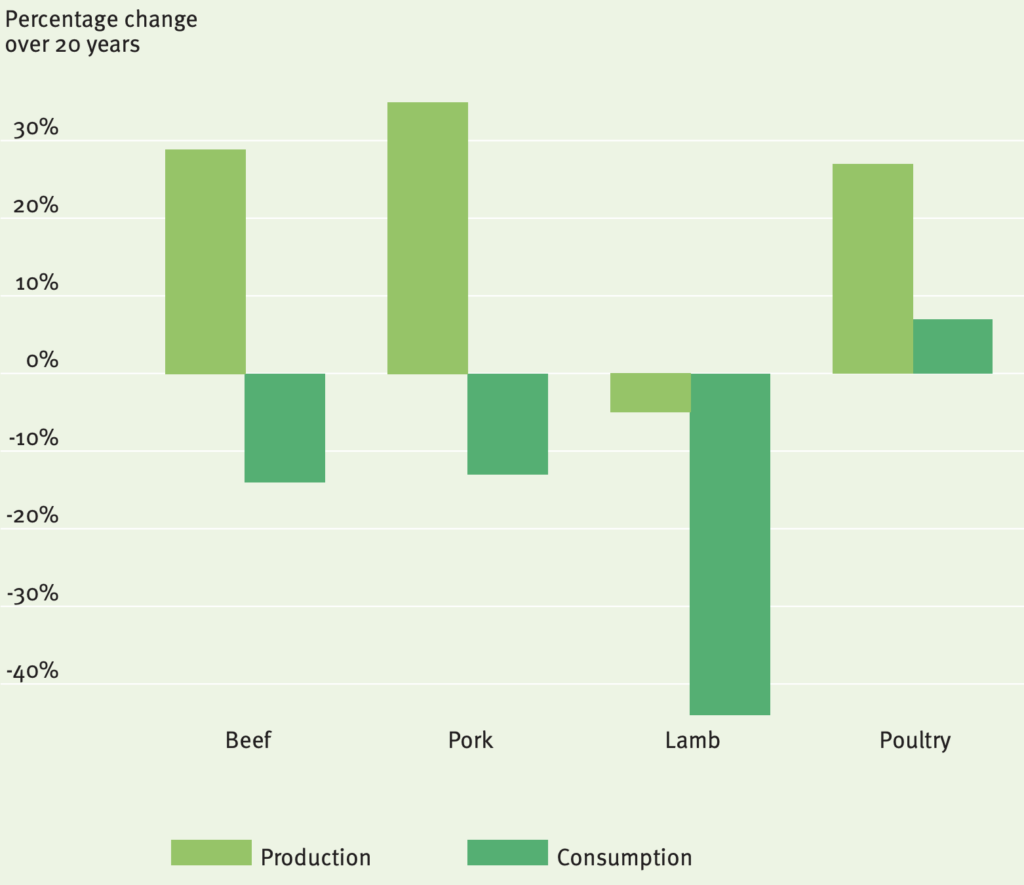
Green Alliance’s analysis revealed that Brits are eating 14% less beef and 13% less pork than they did 20 years ago, although the production of these proteins has continued to increase. Lamb consumption has fallen by 44%, eight times faster than production. And chicken is the outlier as the only meat people are eating more of (a 7% rise), with production exceeding consumption.
Grazing farms, which mainly produce beef and lamb, are struggling to make a profit, since they are under pressure from a combination of rising input costs and the growing impacts of climate change. It leaves these producers to rely on government schemes to survive.
Pork and poultry production, which tends to take place in specialist units, is generally profitable; as the most commonly consumed processed meats, both have a substantially larger climate impact than plant-based proteins, so “some reduction is necessary”.
Green Alliance said regulation will be needed to reduce the health and environmental harms of these proteins, since these farms are driven by profit to keep expanding. These policies must be accompanied by lower consumption to avoid higher imports and offshoring the climate impact of food production.
The think tank said reducing meat production to make more space and time for other activities (such as creating habitats or restoring peatlands) could help these farms become more profitable, driven by farming policy rewarding public goods.
“Our research suggests that if some British beef and lamb farmers produce a bit less meat and do more to improve the environment instead, they could actually increase the profitability of their farms,” said Lydia Collas, head of environment at Green Alliance. “Meanwhile, we’d all benefit as farmers would help wildlife recover, improve water quality and prevent flooding.”
Government support crucial to support farm transition
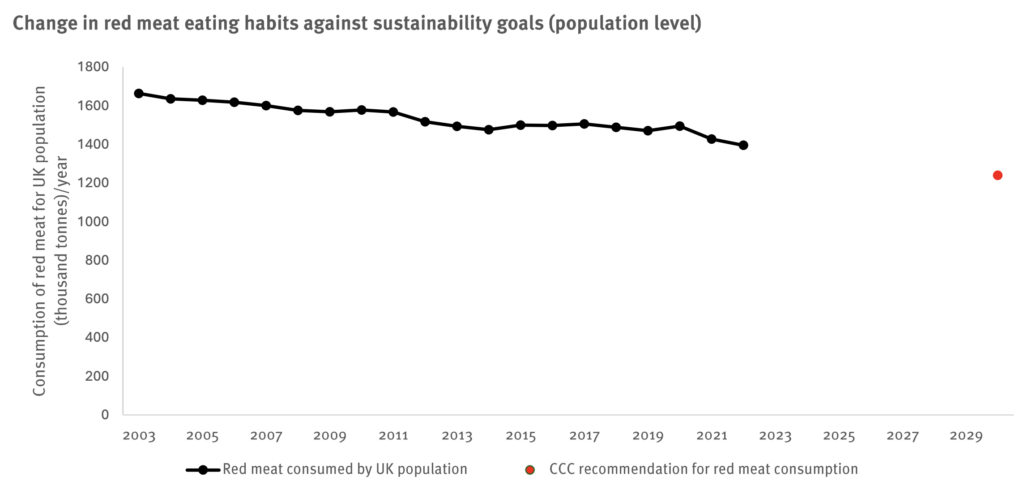
The UK’s National Health Service recommends limiting red and processed meat intake to lower the risk of cancer and heart disease, and its Climate Change Committee has called for a 50% reduction in meat and dairy consumption by 2050 to meet the country’s net-zero goals.
Green Alliance suggested that food and farming policies should be aligned to support people in eating healthier, plant-rich diets, reduce meat production, and lower the UK’s environmental impact (instead of shifting it overseas).
“British people are eating less meat than they were 20 years ago, which is good for their health and the planet’s,” said Collas. “If this trend continues, people will rightly question how this will affect farmers.”
To support a fair transition for farmers, the think tank recommends using the national food strategy to lower meat consumption to healthier and more sustainable levels. These modest reductions, which are already occurring, are unlikely to dramatically threaten farm profitability in the short term.
The food strategy should therefore expand access to affordable, plant-rich diets and ensure that meat consumption falls faster than domestic production.
Further, the UK government should develop its ELM schemes to create more business opportunities for grazing farms, alongside a significant expansion of “higher-tier” and landscape recovery funding schemes. The Sustainable Farming Incentive, which will reopen for applications in June, pays farmers for nature-friendly activities, and will be crucial to this shift.
Green Alliance also urged the government to implement a land use framework to guide ELM spending towards areas where food production and farm profitability are low, and the potential to generate public goods is high.
“We need policies that will drive competitiveness and profitability, which are critical elements of thriving and resilient farming businesses, meet environmental goals and are crucial to achieving the government’s own targets for economic growth,” said David Exwood, deputy president of the National Farmers’ Union.