

Tasty Awards: Maïzly is Taking on Plant-Based Dairy with A One-Size-Fits-All Corn Milk

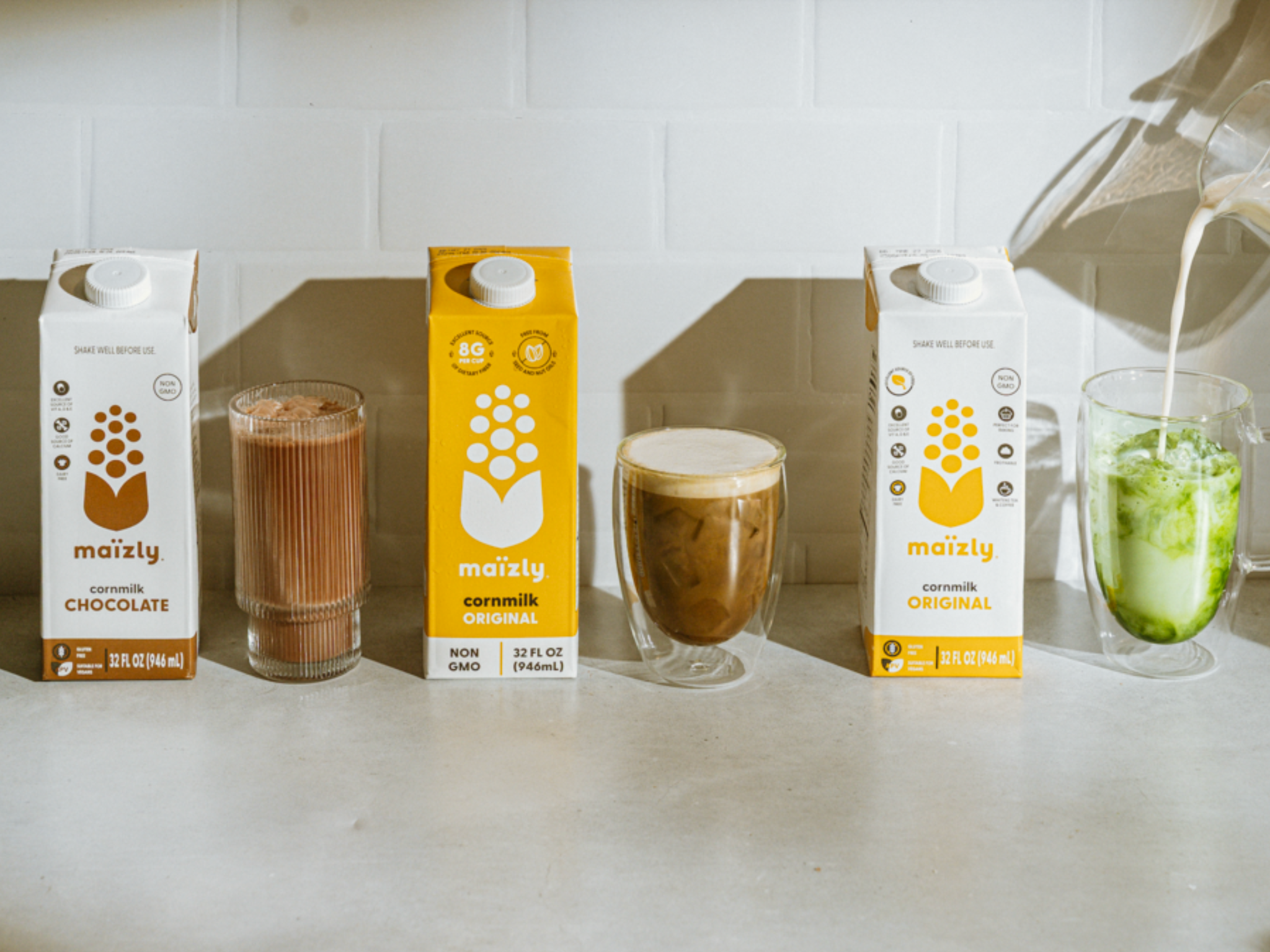
With a fibre-packed alternative promising to rival dairy in the coffee industry, Maïzly CEO Tim Leclercq explains why corn milk could be the next big non-dairy innovation.
Four years and 120 iterations. That’s what it took for Tim Leclercq and his team to create a corn milk that does it all.
Speaking to Green Queen on the sidelines of Nectar’s Tasty Awards in San Francisco, the co-founder of Maïzly recalls the “extremely challenging project” to combat the off-notes that plague many plant-based milks, and strike a balancing act between everyday use, coffee functionality, and dairy-like flavour.
“When we developed the product, we decided we wanted to develop one SKU that does everything, so you don’t need to have a whole lot of different SKUs in your fridge. Just like dairy,” he says.
“We didn’t want to develop a product that had all the same features and characteristics of the current set. So we set about dealing with and focusing on the problems that we found with the set that existed,” Leclercq explains.
Maïzly’s corn milk, which debuted in the US last year, has a “complementary taste profile”, so you don’t taste the base ingredient when you have your cappuccino. “It lets the coffee shine,” says Leclerq.
“And because our product has no sediment, it’s got the complementary taste profile, it steams so well, and it’s allergen-free, it works really well in the coffee industry. So it’s certainly a big target of ours, that coffee channel, and we’ve got some good traction already. It works extremely well in all these specialty coffees, because it allows flavours to rise up. You don’t have any competing flavour from our product.
“It’s also fully functional, so you can do absolutely everything with it. You bake with it, cook with it, it steams like a normal dairy milk for your cappuccinos, you can do all the barista art. So those were the key features that we wanted to bring to the table with our product.”
Cold foam, fibre, and seed oils: Maïzly eyes multiple trends
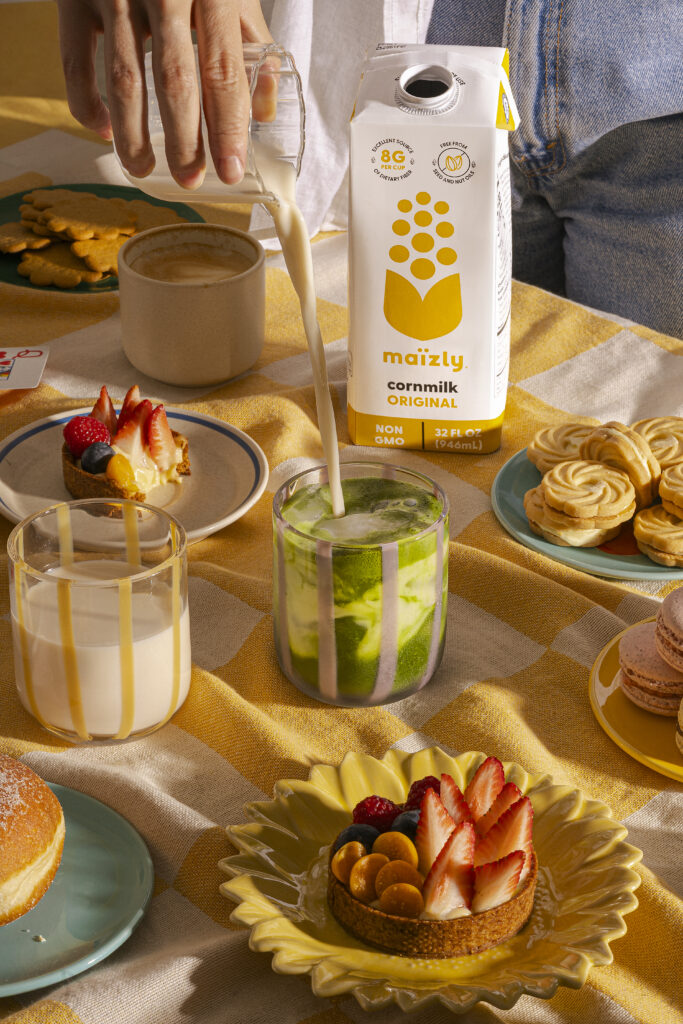
Maïzly’s barista-friendly functionality can help it meet one of the coffee industry’s most exciting trends: cold foam. Interest in this format rose by 73% year-on-year in 2025, with TikTok driving the craze, posting even higher 105% growth. It’s expected to see another 25% increase this year.
“We work well with cold foam as well. That is definitely an area where we can fill that opportunity. We find the specialty coffee space very interesting with all these different flavours that are being created in the creativity in that space, and how our product just merges into that lane very seamlessly,” says Leclercq.
Aside from the coffee space, the company is looking to appeal to health-conscious consumers, especially through fibre, one of the most in-demand macronutrients.
“Another feature of our product, which we feel has huge value, but on the grocery side, is that it’s got 8g of fibre – so it’s a third of your daily fibre requirements. And it’s corn fibre, which is one of the best forms of fibre you can consume because it goes further and lasts longer,” he says.
This will appeal to America’s fibermaxxers – 95% of the country doesn’t meet its daily recommended fibre intake, and most people consume less than half of what they should. “For one cup, you’re getting a third of your daily requirement without even noticing it. So it’s an easy way to consume fibre,” says Leclercq.
The one white space for Maïzly is the protein content: it only contains 1g of chickpea protein per cup. That’s the same as established brands like Almond Breeze or Silk oat milk, though it operates in a market that is obsessed with protein.
“It’s not a big feature of our product, but it is there,” says Leclercq. “The reason we chose chickpea was because it’s actually one of the best forms of plant-based protein you can get. It’s got all but one of the amino acid chains, and it’s also one of the most easily absorbed plant-based proteins.
“Even though we’ve got the same as the others, it’s much more efficient. You’re getting more out of that protein that you’re consuming. We would like to increase it. We’ve always looked at ways of increasing it, but it is a very expensive ingredient. So you’ve got to balance affordability with health as well. You want to get into the mainstream, right? So that’s probably the biggest reason why we’ve kept it where it’s at.”
Where it lacks in protein, Maïzly’s corn milk makes up for in micronutrients. It’s fortified with vitamins A, D and E, as well as calcium. Plus, it’s got half the sugar content of oat milk and a third of dairy.
“We also use coconut oil, so no seed or nut oils. We [found] in a lot of our research, part of the reason people are moving away from oat milk, for example, back to dairy, is because of the seed oil issue, which has become quite, you know, out there. So the fact that we don’t have seed oils is also a really positive health trend for our product.”
Maïzly sets sights on flexitarians to grow market share
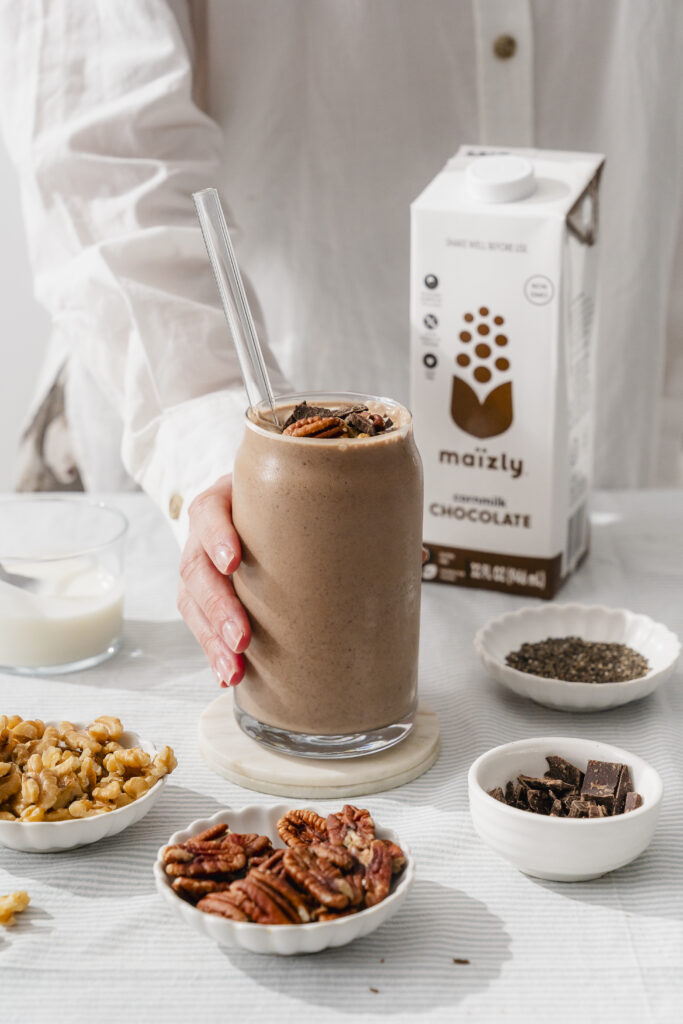
It’s the blend of coffee-like functionality, seed-oil-free formulation, and fibre-packed benefits that has won consumers over, with Maïzly’s original corn milk winning a Tasty Award this month. It suggests that 50% of taste-testers found it to be on par with or better than conventional milk.
“We’re just starting out on our journey. So for us, it’s really exciting to get onto the shelf amongst the Oatlys and the Califias of this world, and we feel quite proud that we’re there,” says Leclercq.
Still, the gap between the average non-dairy milk and the benchmark dairy option remains sizable, according to Nectar’s 2026 Taste of the Industry report.
“Obviously, there’s been quite a big fight between dairy and plant-based. Especially, Oatly took that on its shoulders, which was a brave route to go. And we’re thankful for that, because it did open up the category, and it made it mainstream. So there’s no criticism that I’ve got for the existing set of plant-based milks,” Leclerq says when asked what the industry could do better.
Dairy-free milk has still only made it into 40% of US households – while that is, by no means, a small share, it hasn’t increased much in recent years. “We’re hoping to solve that. Our focus is really on the flexitarian market, hence why our product is so similar to dairy,” the Maïzly CEO outlines.
“It’s got the same mouthfeel as dairy. It’s got the opacity of a dairy milk, and the taste profile is most similar to dairy. So that 33% of the population that considers themselves flexitarian is the market we feel that we can access,” he explains.
“The reason I wasn’t adopting plant-based milks was because I didn’t like the taste of oat or almond when I had my coffee, and so that’s why I went out and developed this product to fit that gap in that narrative and that audience, which we feel we can then grow the sector with.”
‘The best thing you’ll ever taste’
Since launching its original and chocolate corn milks in the US a year ago, Maïzly hasn’t taken its foot off the accelerator. “We focused on the North, Northeast initially when we launched, but we’ve now gone all the way down the East Coast into Texas, and […] the Chicago area as well,” says Leclercq.
“So we’re in around 1700 outlets, and we’re also going into coffee shops. We chose certain nodes to go into those coffee shops. Chicago was our first node, and we’ve got into what we call top-of-the-pyramid coffee shops there [including Discourse Coffee and Metric Coffee], which is fantastic, because everyone looks up to them, and then it causes a cascading effect,” he adds.
“We’re looking at San Francisco as a really key market for us as well. We’ve recently gotten into Andronico’s from a grocery perspective, but we’re also in a number of coffee shops here. And we want to really grow this node as well. We see this market as being quite a great market for what we deliver.”
Outside the US, Maïzly has entered the foodservice and coffee channels in the UK. “We’ve got a distributor there that focuses really on the top end of the foodservice space. So in all the Premier League football club canteens, in universities like Oxford and Cambridge, the big head offices like Google, Amazon, Meta,” Leclercq says.
In terms of product development, the startup will introduce a reformulated chocolate milk next year, which will include corn fibre (this ingredient is currently only part of the plain corn milk variant).
More recently, it’s launching a “fun thing called Panic in the Disco”. It’s a specialty coffee drink designed in collaboration with the purveyor of Discourse Coffee, and Leclercq’s excitement for it is palpable. “It’s probably the best thing you’ll ever taste in food or drink. It is insane,” he promises.
“We’re launching it at the World of Coffee festival coming up in April, and then we’ll be doing a lot of throwdowns, some coffee raves, etc., where we will be introducing it,” he says.
In addition, the team is working with Discourse Coffee on grab-and-go formats. We haven’t got a date on when we’re going to start, but unusual flavours, unusual names, which will also be quite a nice sort of add-on to our innovation.”