

Scientists Grow Animal Protein in Tobacco & Lettuce to Enhance Plant-Based Meat

Researchers have discovered a way to grow myoglobin, a heme-containing protein that gives meat its colour and umami flavour, in genetically engineered tobacco and lettuce plants to make better-tasting meat alternatives.
Instead of smoking your tobacco, you could now grow meat with it. Well, sort of.
A research team led by Imperial College London has engineered tobacco and lettuce plants to carry the gene for myoglobin, an iron-rich protein abundant in animal muscle fibres, directly in their chloroplasts.
It means they can potentially mass-produce plant-derived myoglobin, which contains the heme protein responsible for the characteristic flavour and colour of meats like beef and pork. This will allow them to address the sensory pain points that plague vegan meat alternatives.
While this approach for myoglobin production has been used in yeast and bacteria by precision fermentation companies, the scientists say their research presents plant molecular farming as a promising alternative. The expected yield at scale could rival that of livestock farming, with dramatic reductions in water use and greenhouse gas emissions.
“We show plants can be engineered to produce the animal protein myoglobin in their chloroplasts, the energy factories for photosynthesis. This could provide a more sustainable way to produce an important ingredient for plant-based meat products,” said Alexia Groff, a researcher at Imperial College London and the first author of the study.
Plants show potential for heme production, but still aren’t as effective as microbes
Found in mammalian muscle cells, myoglobin facilitates oxygen storage and diffusion in humans and dogs and is an essential source of taurine for cats. Its iron-rich characteristics give meat its metallic and umami flavour, and the oxygen bound to it is the reason a burger patty changes its colour when cooked.
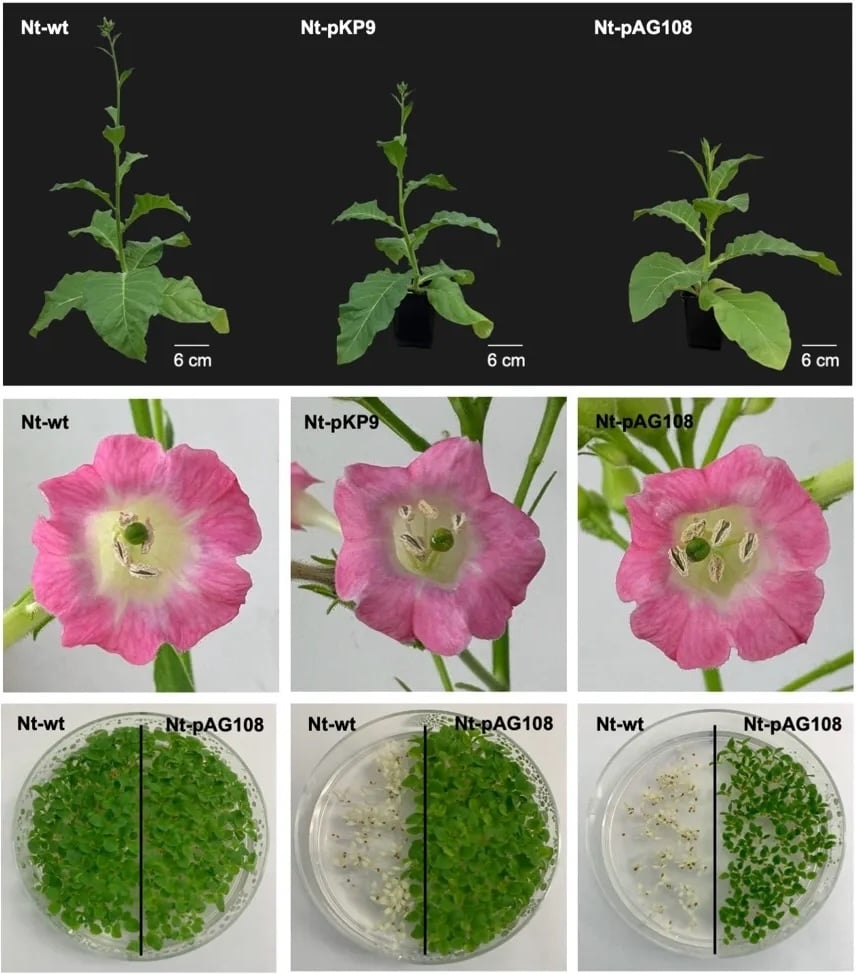
In the study, published in Frontiers in Plant Science, researchers cloned the genes for pig and cattle myoglobin, then used a “gene gun” to physically shoot their copies into the chloroplasts – the part of plant cells that carry out photosynthesis – of tobacco and lettuce seedlings.
The researchers found that some of the seedlings had subsequently integrated the gene into the short, ring-like genome of their chloroplasts. The plants were then grown to adulthood, and flowered and passed the transgene on to the next generation.
The team also inserted the gene into the much larger nuclear genome of both plant species, as well as into the chloroplast genome of Chlamydomonas reinhardtii, a single-celled alga.
“Due to their bacterial ancestry and their high number of copies per cell, chloroplasts are generally much better at making large amounts of protein than the cell nucleus,” said Groff. “Here, we used tobacco because it is the best model plant for developing this technology, and lettuce because it is an edible crop that could eventually be used for food ingredient production.”
The resulting myoglobin yield totalled 800mg per kg of dry weight of tobacco, and 810mg for the same amount of lettuce – that’s at least three times higher than the yield from tobacco plants where the transgene was spliced into the nuclear genome, but at least 10 times lower than the myoglobin found in animal muscle.
“Despite this, plant cultivation is far more resource efficient than livestock production; consequently, plant-derived myoglobin could achieve protein yields per hectare that rival – or even potentially exceed – those of animal agriculture, while also benefiting from substantially lower water use and greenhouse gas emissions,” the study stated.
The scientists added that growing the protein in crops rather than in bioreactors could lower the cost of operating the bioreactors. However, microbes proved to be a much more efficient factory for myoglobin production than plants – 80% of the protein extracted from them was heme-binding (which is crucial for myoglobin’s function), compared to just 35% for the version extracted from tobacco.
This may be because plants can’t produce enough heme to keep up, partly because the same chemical pathway supplies chlorophyll as well.
Myoglobin could be purified for use as an ingredient in plant-based meat
The goal of the study isn’t to produce finished plant-based meat products. Instead, since the extracted myoglobin is identical to its animal-derived counterpart, it could be purified and added as an ingredient to meat alternatives to improve their colour, flavour, and nutritional value (since iron bound in heme is better absorbed by the body than the iron in conventional plants).
Nearly two billion people, or a quarter of the global population, suffer from anaemia, with cases increasing rapidly for women, expectant mothers, young girls, and children under five. Iron deficiency is linked to conditions like heart failure, pregnancy complications, ADHD, autism, and impaired motor skills in children.
“We hope that edible lettuce, modified to express myoglobin, could also one day serve as a heme-iron-enriched biofortified food, depending on legislative approval,” said co-author Kyoko Morimoto, CSO of Kyomei, a Cambridge-based plant biotech startup that partially funded the research.
The idea is reminiscent of Impossible Foods’s process to produce its flagship burger. The US company uses precision fermentation to produce soy leghemoglobin, another heme-containing protein, which enables its patties to ‘bleed’, smell and taste like beef.
The study’s approach falls in the plant molecular farming category. Elsewhere, Luxembourg-based Moolec Science has used this tech to produce bovine myoglobin in genetically engineered pea seeds.
Derek Stewart, co-director of the National Alternative Protein Innovation Centre at the James Hutton Institute, highlighted that expressing myoglobin in tobacco “does raise concerns in that it innately produces bioactive alkaloids that would undoubtedly prove problematic” in terms of extraction and food safety. That said, the study reported “little evidence of oxidative damage from myoglobin expression in the tobacco chloroplast”.
Two of the study’s authors are part of the Bezos Centre for Sustainable Protein at Imperial College. The hub’s director, Rodrigo Ledesma-Amaro, was not involved in the study, though he called it an “important advance” on earlier research.
“Demonstrating stable myoglobin production in plant chloroplasts, including in an edible crop, raises the possibility of using plants as scalable, low-input production platforms alongside microbial fermentation,” he said.
“In the longer term, this could diversify how and where these ingredients are produced. Its wider potential will depend on improving haem incorporation so myoglobin can deliver the colour, flavour and cooking properties expected in meat alternatives.”