

New York City Ups Spending on Plant-Based Food to Hit 2030 Emissions Goal Early

The New York City government has increased its plant-based protein purchases by 130% and lowered meat and dairy volumes by 15% to reach its 2030 climate goals four years ahead of schedule.
Proving its public-sector leadership in food sustainability, New York City has already surpassed its 2030 emissions-reduction goal.
New data shows the city government’s food-related greenhouse gas emissions reached 1.04 million tonnes of CO2e in 2025, a 36% improvement from 2019. That is well ahead of the 33% reduction it had promised by the end of the decade.
The catalyst behind this achievement is the city’s commitment to the protein transition. New York City has been a trailblazer in plant-based food policy, and it has backed that up with its food spending across public schools, hospitals, prisons, elderly centres, homeless shelters, and other public institutions.
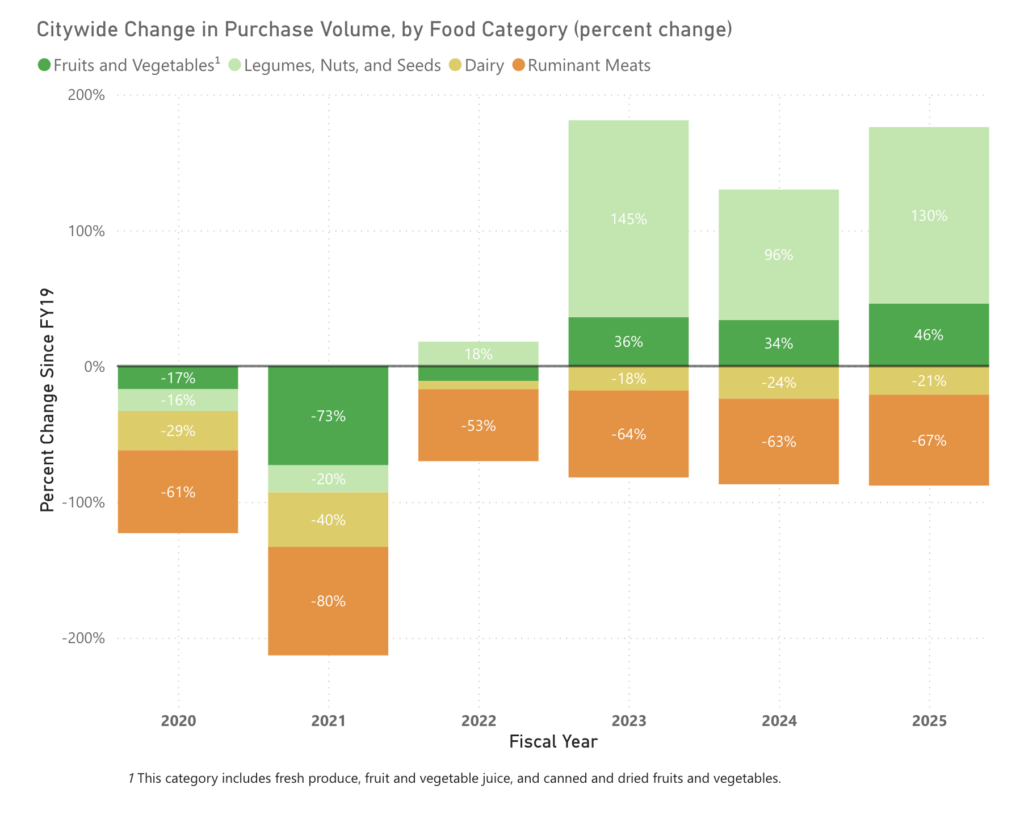
The local administration boosted its purchases of plant-based proteins like legumes, nuts and seeds by 130% since 2019, alongside a 46% increase in volumes of fruits and vegetables.
At the same time, the city bought 21% fewer dairy products and 67% fewer ruminant meats (like beef and lamb) in 2025, compared to six years ago. Overall, the purchase volumes of animal proteins decreased by 15%.
“These numbers reflect the collective work of the Mayor’s Office of Food Policy […], the NYC Health Department […], and food- and meal-buying agencies to serve healthy, delicious meals while advancing values-based procurement,” Sierra Hollowell, senior policy analyst at the food policy office, said in a LinkedIn post.
Meat and dairy dominate New York City’s food emissions and carbon costs
In 2022, New York City established its Good Food Purchasing programme to encourage institutions to buy food based on five values: local economies, environmental sustainability, valued workforce, animal welfare, and nutrition.
The purpose is to increase transparency about the food the city buys, and where it comes from. The new data shows that between 2019 and 2025, the government spent the most on dairy ($439M), which accounted for 35% of all food purchased by weight and nearly a quarter of total spending.
This was followed by grains ($394M) and produce ($345M), which, alongside roots, tubers, legumes, nuts, seeds, and plant-based milk, accounted for around half of food purchases by weight.
The city government spent $241M on poultry, accounting for 13% of total spending, even though it was responsible for only 6% of purchases by volume, highlighting the high cost of meat. Ruminant meats, pork and seafood made up less than 3% of the food bought by New York City.
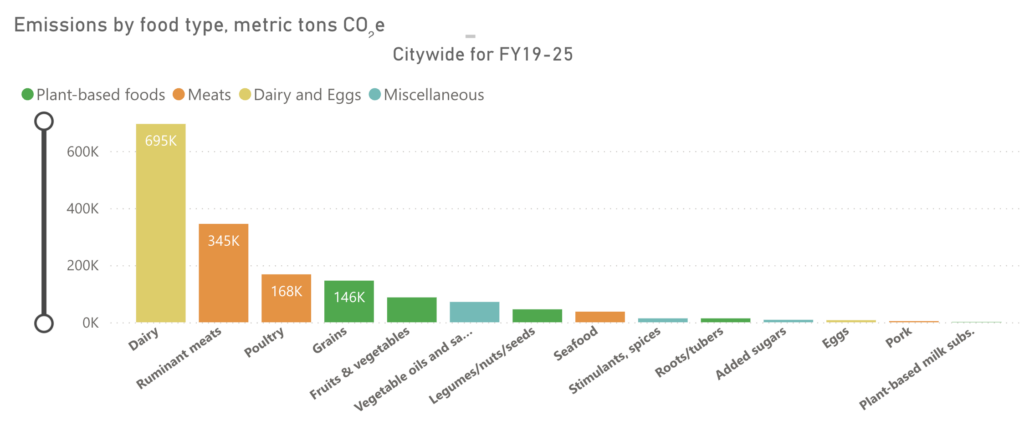
Being the largest beneficiary, dairy is also the top driver of the administration’s food-related emissions, accounting for 42% of the total. It’s followed by ruminant meats (21%) and poultry (10%), underscoring that even low meat volumes have a disproportionately high impact on the climate.
In contrast, all plant-based foods (excluding oils, spices and sugars) are responsible for just 17.5% of New York City’s food-linked emissions.
The picture is similar for land use, which is dominated by ruminant meat (30%), dairy (21%), and poultry (13%). In terms of total carbon costs (emissions plus the carbon opportunity costs incurred when land is used to grow food instead of restoring native vegetation and sequestering carbon), these three food groups make up 79% of the total.
NYC’s plant-forward policies target public and planetary health
While animal proteins have remained prominent on New York City’s procurement list over the last six years, things have been changing recently. In the 2024-25 fiscal year, the government actually purchased and spent more on fruits and vegetables than on dairy.
This is part of its aim to increase plant-based purchases to promote healthier diets. As part of that, the government last year instructed 11 of its agencies to eliminate all processed meat and increase the amount of minimally processed plant proteins used in meals and snacks. The change is set to take effect next month.
New York City has spearheaded food policies that promote both public and planetary health. In 2022, under then-mayor Eric Adams (who followed a plant-forward diet), it launched a ‘plant-based by default’ scheme in the city’s 11 public hospitals, making vegan meals the preexisting choice for patients and their families.
Half of all patients have chosen to eat meat-free dishes because of the initiative, with 90% satisfied with the food. As a bonus, it helped hospitals cut their emissions and costs.
In 2023, a resolution signed by 1,400 US mayors promoted a shift to plant-based diets across the country, taking inspiration from Adams’ hospital campaign.
And last year, the city government launched the Plant-Powered Carbon Challenge, with non-profit Greener by Default helping partners track emissions and share best practices on designing plant-forward menus. It has been taken up by Columbia University, The Rockefeller Foundation, catering giant Aramark, and the US Open, among others.