

Oatly Calls on Food Industry to Remove Barriers to Sustainable Consumer Choices

Swedish oat milk giant Oatly is urging the food industry to address the biggest hurdles that prevent consumers from making more sustainable choices, outlining five clear areas of action.
Oatly is bolstering its climate leadership with a new report asking the food and drink sector to drive consumer behavioural change by making sustainable options tastier and cheaper.
The oat milk pioneer interviewed 29 food industry stakeholders and surveyed more than 12,000 consumers from the UK, the US, Germany, France, Sweden and the Netherlands to understand how to accelerate the transition to a more climate-friendly food system.
“For almost a decade, we have been reporting yearly on our environmental footprint. However, to really push on in this arena, we wanted to look beyond our own impact in isolation to understand what more we can do to influence food system transformation,” said Caroline Reid, Oatly’s senior sustainability director.
“In a year marked by some of the clearest reminders yet of the impacts of climate change, it can be tempting to focus on what isn’t working. But despair doesn’t drive change,” she added. “Inaction simply isn’t an option.”
Last year, Oatly was named the world’s first climate solutions company in the food and beverage category, after it updated its sustainability strategy to reduce emissions by 89% by 2050 (from a 2020 baseline). Its barista oat milk was recently found to be 58-71% more planet-friendly than chilled cow’s milk in several European countries.
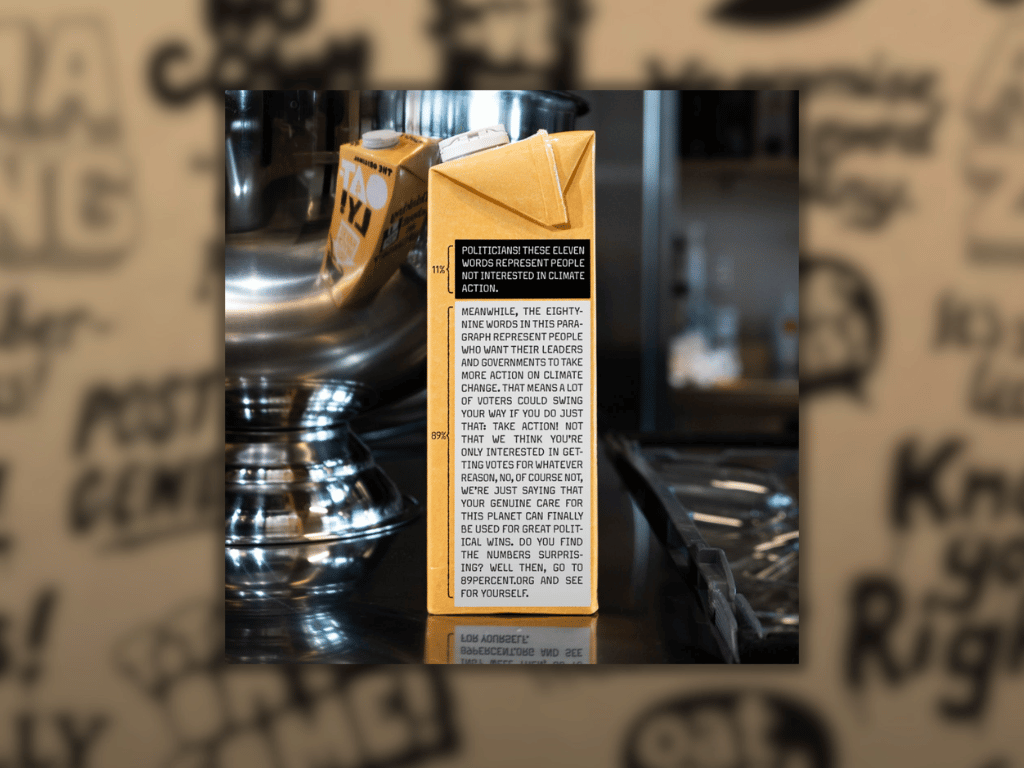
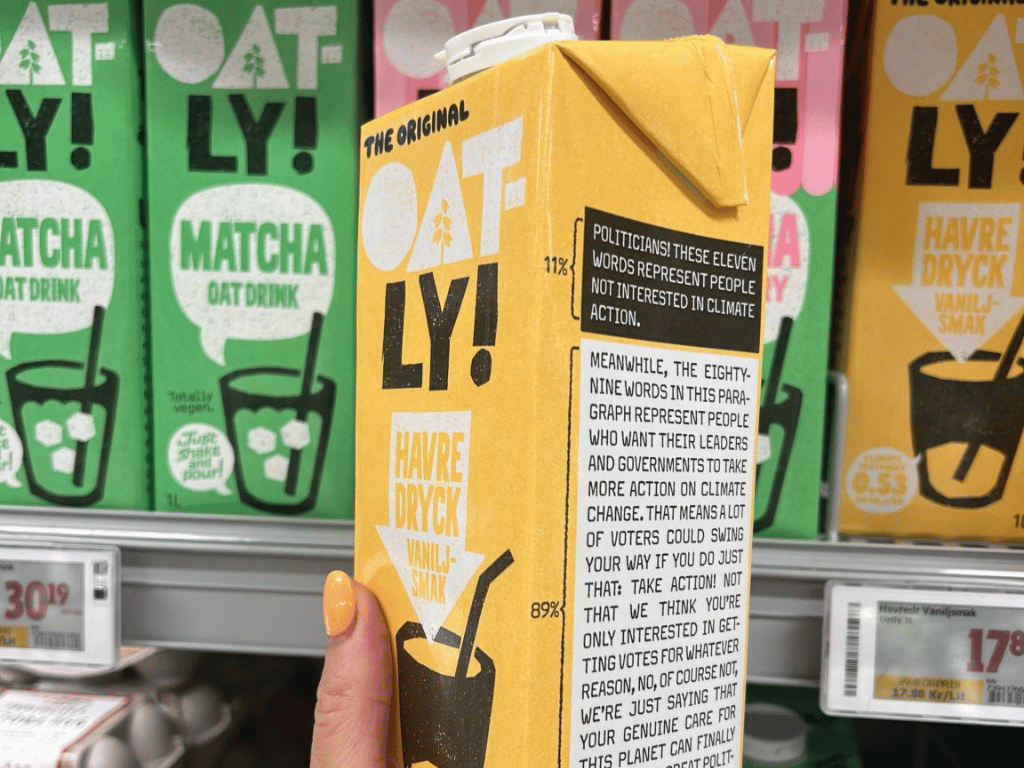
And last month, it updated the packaging of some of its products in Sweden to highlight the 89 Percent Project, a global journalistic coalition that entails reporting on studies that show 80-89% of people want to see more political action to fight the climate crisis.
“Our research highlights the potential for industry, policymakers, media and others to work together to create a food environment where the sustainable choice becomes the easy choice,” said Reid. “The challenge is urgent, but the progress already being made gives us every reason to believe further change is possible.”
Oatly’s cross-industry research, which comes on the heels of its participation in NYC Climate Week (September 20-27), outlines sentiments and action points across five key themes:
1) Optimism is underrated
In Oatly’s research, optimism emerged as a “key ingredient for systems change”, with interviewees viewing it as a deliberate practice instead of just a feeling.
The report notes how switching to ‘plant-based by default’ approaches can cut emissions and encourage sustainable consumption, how nutrition and climate science are converging, how banks are increasingly investing in sustainable agriculture, and how entire categories are approaching tipping points.
Expanding on the latter, it cites a 2026 UN report suggesting that several climate solutions are close to becoming self-reinforcing (the point where progress no longer needs to be pushed). Electric vehicles went from under 3% of global car sales in 2019 to 25% last year. In Oatly’s industry, more new people are trying plant-based milk every day as it becomes the norm in coffee shops.
Public sentiment is more nuanced: around 80% of consumers said the future of food matters to them, though a third believe they worry about it more than others (a gap that exists with broader climate concerns too). That disconnect, Oatly says, can lead to silence and inaction, discouraging people from taking small actions and from advocating for broader change by voting or influencing businesses.
“For close to a decade, we have spent much of our time educating the public, customers, and partners about the climate impact of our food system, and that meant pointing out what was wrong. We must move away from pointing fingers,” it notes.
It’s calling on the food industry to commit to sustained sustainability efforts even when policy stalls, progress looks slow, or they’re hit with backlash. Media, brands and platforms should reframe the narrative and use recent examples to demonstrate the impact of climate change and question portrayals that treat natural disasters as unlinked events.
2) Taste is the primary lever
“If we want diets to change, desirability is a must-have, not a bonus,” Oatly says, outlining how a quarter of people (26%) believe taste and quality are among the most important things that need to improve to make people eat more sustainably.
The company cited a blind taste test it conducted in eight cities last year, in which half the people preferred a coffee made with its oat milk over dairy. That’s way higher than the number of consumers who have tried oat milk. “Why are hundreds of thousands of people walking around having their second-choice coffee every day?” it asks.
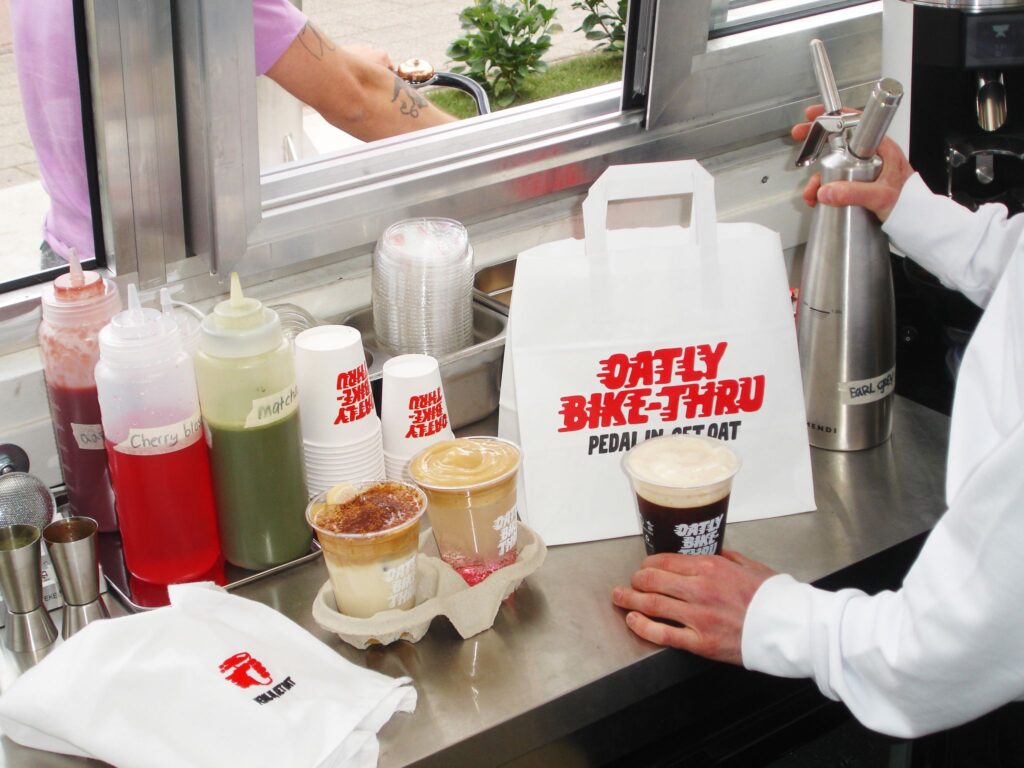
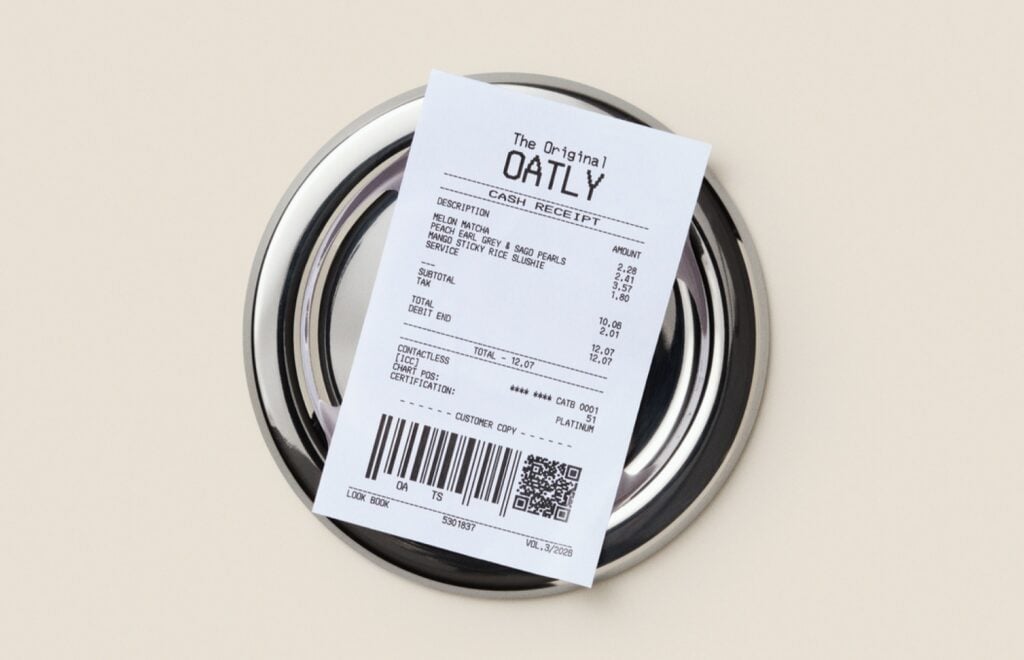
The focus on taste is also why Oatly has adopted a taste-led strategy, with partnerships and events focused on trendy beverages, seasonal recipe ‘lookbooks’ inspired by the fashion industry, a Future of Taste trend report to court Gen Z, and an expansion of its lineup with in-demand flavours.
Its data shows that people hold food manufacturers the most responsible for ensuring they eat healthily and sustainably (44%), above farmers (39%), supermarkets (37%), individuals themselves (35%) and government (32%).
This is why it’s calling on food companies to develop healthy, sustainable foods that genuinely taste good and aren’t pitched as alternatives that are a backup option. Retailers and foodservice operators must design food environments that encourage better food choices, and digital platforms must acknowledge how food options are shared, displayed and promoted.
3) Misinformation must be tackled head-on
According to the World Health Organisation, we’re experiencing an “infodemic” – an overload of information, including false or misleading data, in digital and physical environments.
Oatly’s poll shows that 72% of people think decisions about the health and sustainability of the food system are only “sometimes” or “rarely” based on science. It points to orchestrated misinformation campaigns against the Eat-Lancet Commission’s Planetary Health Diet report as a key example.
“Across our research, it has become increasingly apparent that many consumers reach the moment of choice with strong views shaped by a crowded and often confusing information landscape, where knowing which sources to trust is becoming harder,” the report reads.
“To combat a world rife with misinformation, we must keep seeking answers from reputable, qualified experts and understand what is at stake when we let inaccurate claims circulate.”
Oatly’s calls to action on this front include establishing clear accountability standards for misleading nutrition and sustainability claims online, keeping food, health and climate policy decisions rooted in independent scientific evidence, and food companies and qualified experts becoming the trusted signal with transparent storytelling and no greenwashing.
4) Sustainable options should be the default

Oatly argues that people tend to accept change more effortlessly when the alternative becomes the default. When asked to select three of the most important things that need to change, 38% of its survey respondents chose “making sustainable and healthy options the default”.
In fact, two-thirds (68%) of people said they wouldn’t mind if oat milk was the default option in coffee shops, with most asking only that cost and choice remain preserved.
This means focusing less on persuading and more on establishing what’s normal and readily accessible. “It means the sustainable option (often the plant-based one) is no longer the alternative, and it removes the idea that it is ‘second best’. It means changing a decision from opt-in to opt-out,” says the oat milk maker.
It’s calling on public institutions to use procurement and meal programmes to make plant-rich meals aligned with the Planetary Health Diet the default in schools and hospitals, which would shift millions of meals without asking anyone to change their mind.
Foodservice operators should use placement, menu design and default approaches to make healthy choices easy – the trick is forcing people to opt out, not in, of this new default. Manufacturers, meanwhile, must build products that let partners transition quietly and at scale.
5) Levelling the price playing field is critical
Most consumers (53%) name affordability and access as the biggest barriers to eating more sustainably, with Oatly highlighting how price is not an even playing field. As mentioned above, two-thirds of respondents are open to oat milk being the default in cafés. That said, only 28% of them still hold that sentiment if it would cost them more.
“Across the globe, plant-based alternatives seek to compete with an industry propped up through subsidies, procurement rules, and pricing structures, all within decades of embedded infrastructure built around them,” the report outlines. “The question we really should be asking is not: ‘Why is X food so expensive?’, but: ‘How can X food be so cheap?'”
There are some promising signs that show what’s possible within this distorted system. One analysis this year found that a shopping basket aligned with the Planetary Health Diet is 25% cheaper in Germany than the current national diet, saving a two-person household €1,315 a year.
Retailers like Lidl have been selling plant-based alternatives for the same price as or cheaper than meat and dairy for years now, and Rewe was one of the co-signatories with Oatly on a petition calling for the German government to lower the VAT rate on plant-based milk from 19% to 7% (in line with cow’s milk).
Oatly is doubling down on this effort now, asking finance ministries and tax authorities to level the playing field for plant-based and cow’s milk, and redirect subsidies and school scheme support to lower-carbon, healthier foods.
Legislators and regulators should reform outdated promotion schemes, procurement standards, and labelling rules, and support farmers and public institutions with the lead time they need to make a viable transition. Finally, businesses and farmers can share risk through multi-year contracts and transparent pricing.
“None of the five shifts we’ve identified happen in isolation either: food, health, climate, finance, and trade policy all has to move through that same narrow point together, or progress on one can undo progress on another,” the report concludes.
“Collectively, this ‘powerful middle’, supported by the policymakers who set the rules, can shape a food system that supports both human and planetary health, and is easy, delicious, and affordable. Not virtuous or effortful. But normal.”