

Opinion: Health, Resilience & Growth – Building On the UK’s Alternative Protein Progress


Linus Pardoe, senior UK programme manager at the Good Food Institute Europe, outlines why the UK government must embrace alternative proteins in its new food strategy, or risk falling behind.
The UK government plans to implement a new food strategy this spring with an ambitious vision – a food system that is healthier, more resilient, and drives economic growth.
With climate change, military conflicts and trade wars causing ever more frequent shocks to global supply chains, there is an urgent need to achieve these goals, and now is the time to double down on the progress the country has made in developing alternative proteins.
Ministers have already recognised the central role that food innovation can play in delivering on the Starmer government’s missions for growth and public health, highlighting that the UK’s science and research base is accelerating “new products and markets, including for healthier products and in alternative proteins”.
In fact, the UK has grown to become Europe’s largest national funder of alternative protein research, investing more than £100 million since 2020 and establishing several major research centres.
Why the future food sector needs government funding
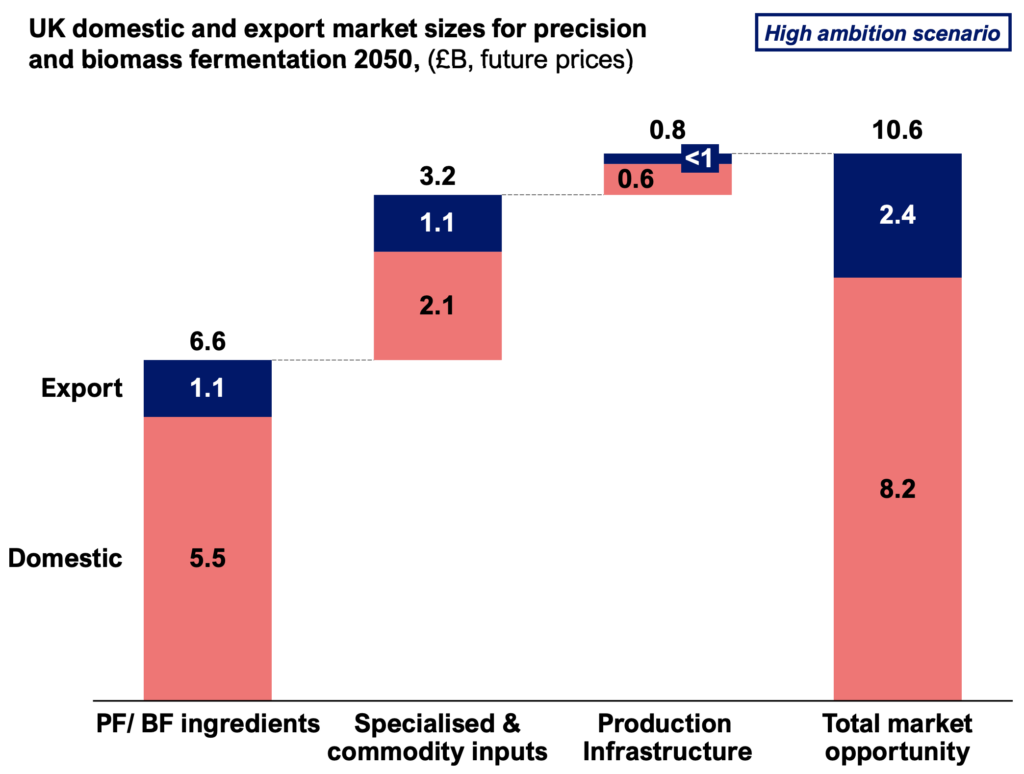
The economic case for these investments is clear. Analysis from Systemiq estimates that advanced fermentation alone could contribute up to £10B to the UK economy by 2050, while Green Alliance found that if plant-based meat consumption grows in line with the Climate Change Committee’s 2035 scenario, the market would be worth £2.7B.
Regulatory barriers have been persistently highlighted as a constraint on producing affordable alternative proteins at scale. However, serious efforts have been made to boost regulatory expertise in recent years, with the Food Standards Agency launching a pioneering cultivated meat sandbox and precision fermentation innovation research programme.
The question now is whether the UK will act decisively enough to deliver at scale on the potential of these foods to contribute to a healthy, resilient and innovative food system.
Doing so means making alternative proteins tastier and more affordable – the basic metrics on which widespread public adoption depends.
Plant-based meat has not yet consistently met consumer expectations on taste and price, while cultivated meat remains technically and commercially immature. Without targeted public investment and policy choices, these barriers will persist.
The next generation of alternative protein producers can’t become the ‘industries of the future’ that the government is desperately seeking to establish without much-needed funding, such as providing the infrastructure to help them navigate the ‘valley of death’.
How the UK government can boost alternative proteins

At the Good Food Institute Europe, we’re calling for a range of measures to ensure the food strategy enables sustained growth in the plant-based food sector and catalyses the scale-up of fermentation and cultivated meat.
At the core of these proposals is a £150M public investment package over the next five years, delivered through UK Research and Innovation (UKRI) and the Department for Science, Innovation and Technology.
At £30M per year, this would represent a small fraction of UKRI’s £9B annual budget, yet evidence suggests it would crowd in significant private investment. Green Alliance analysis indicates that every £1 of public funding in the plant-based sector attracts £1.92 in private capital.
Within this, a £30M plant-based innovation fund could play a catalytic role, helping support domestic production and reducing the UK’s dependence on imports.
Home-grown crops such as peas and fava beans can serve as key ingredients for plant-based meat, offering farmers new, higher-value markets, just as growing demand for oat milk is currently creating new markets for arable farmers – with brands such as Oatly, Alpro and Moma sourcing from UK farms.
Such a fund would also help to further enhance the nutritional profiles of plant-based food, achieving the food strategy’s goal of making healthier foods accessible to everyone. While many plant-based meat products are already lower in saturated fat, further R&D is needed to improve micronutrient profiles, particularly in iron and vitamin B12, and reduce salt content.
Other major economies are busy developing national strategies to diversify protein production, and the UK’s ability to retain this position will depend on whether it follows through on the ambitions set out in its own food strategy.
A relatively modest, targeted investment in alternative protein R&D and infrastructure will help build on the progress the government has already made, unlocking the next chapter in the UK’s leadership in protein diversification.