

Herbalife, IIT Madras Open Plant Cell Fermentation Centre to Fuel India’s Biomanufacturing Wave

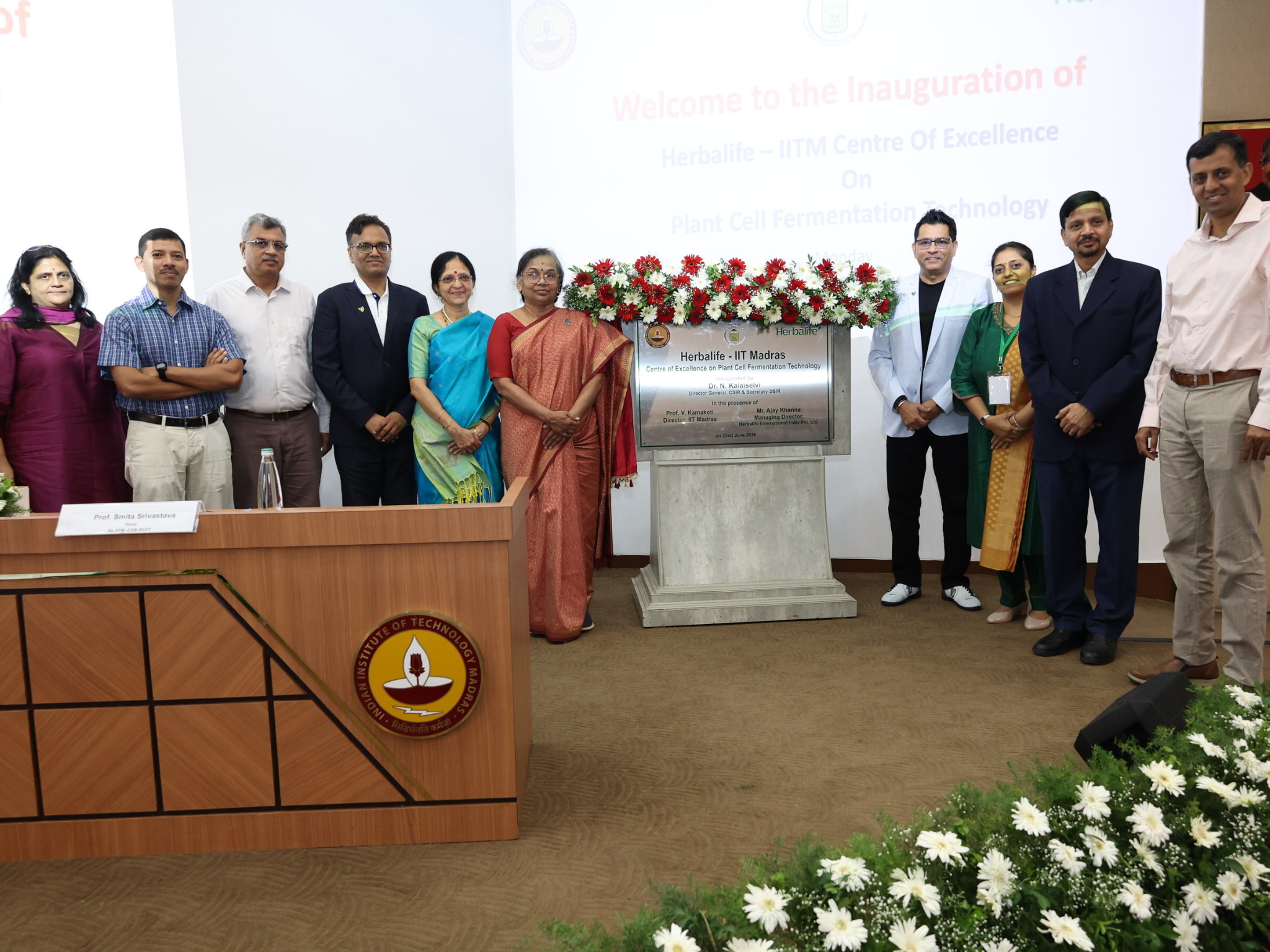
US supplements corporation Herbalife and the Indian Institute of Technology Madras have launched a plant cell fermentation hub to advance biomanufacturing and next-gen health products.
India’s bid to become a global biomanufacturing hub has received yet another boost, this time from a multinational corporation.
US dietary supplements giant Herbalife has teamed up with the Indian Institute of Technology (IIT) Madras to open a centre of excellence on plant cell fermentation technology.
This is India’s first dedicated facility for translational research and innovation in this category, aiming to position the country as a global leader in biomanufacturing and next-generation health and wellness products.
“By combining cutting-edge science with translational research and strong industry partnerships, we aim to accelerate innovation, nurture talent, and develop sustainable technologies that will shape the future of plant-derived health and wellness products,” said Prof Smita Srivastava, head of the new hub.
Plant cell fermentation hub to boost academia-industry collaboration
Plant cell fermentation entails growing plant cells in suspension within controlled bioreactors, rather than soil, to produce high-value ingredients in a sustainable manner.
The Herbalife and IIT Madras centre seeks to conduct innovation and R&D activities with this technology to enable the scalable production of herbal biomass, develop enriched herbal extracts and high-value phytochemicals, and bridge the gap between lab discoveries and industrial applications.
The Chennai hub will combine advanced upstream cultivation systems with state-of-the-art downstream processing and metabolomics platforms to promote technology transfer, foster innovation and entrepreneurship, and build a skilled workforce in the biomanufacturing space.
It’s equipped with customised plant cell bioreactors, advanced analytical platforms, and pilot-scale processing facilities, which will help researchers, entrepreneurs and industry professionals develop future-friendly plant-derived ingredients and health and wellness products.
In that vein, the centre is set to catalyse national and international academia-industry collaborations, facilitate IP generation, nurture startups, and reduce import dependence through sustainable production systems.
“IIT Madras’s partnership with Herbalife and the establishment of Centre of Excellence on Plant Cell Fermentation is an exemplar of how industry and academia can work together to build enduring assets for the nation,” said Prof Ashwin Mahalingam, dean of alumni and corporate relations at IIT Madras.
“With the high-end research facilities at the Centre, we are now confident to push the boundaries of plant cell bioprocessing to translate into solutions for societal impact,” he added.
Building on India’s biomanufacturing policy and advancements

The hub is looking to position India on the global map of commercial plant cell fermentation via industry partnerships, blue-sky research, training programmes and entrepreneurial spin-offs.
Moreover, it contributes to national policy goals like the BioE3 strategy, which focuses on accelerating tech development and commercialisation by setting up biomanufacturing hubs and biofoundries across the country.
“We believe this centre will not only strengthen India’s self-reliance in sustainable bio-manufacturing, but also create new opportunities for innovation, entrepreneurship and global leadership in next-generation plant-derived products,” said Mahalingam.
Herbalife and IIT Madras’s new centre is among a number of new biomanufacturing facilities and research hubs established in India over the last couple of years.
In 2024, Bengaluru saw the launch of the Centre for Smart Protein and Sustainable Material Innovation (an incubation hub) and the Alternative Proteins Innovation Center (a scale-up facility).
And last year, the government opened the National Institute of Animal Biotechnology in Hyderabad. It’s India’s first animal stem cell biobank, and is aimed at revolutionising animal health, regenerative medicine, agricultural productivity, and cultivated proteins.
This March, India formally launched the BIRAC-BioNest Incubation Centre in Mysore to help startups advance their research and achieve commercial viability for technologies like precision fermentation and CRISPR. A month later, the foundation stone was laid for an upcoming ₹42 crore ($4.5M) BioFoundry Centre, aimed at bridging the gap between lab research and industrial application of alternative proteins.
The private sector is building on this. This year, Swiss startup Planetary signed a partnership with DCM Shriram Bioseeds to bring mycoprotein production to one of the latter’s sugar mills in India, while local firm PreferCo teamed up with German biotech giant Glatt to launch a precision fermentation scale-up centre in Hyderabad.
Herbalife is the latest example. “We aim to create opportunities for researchers, students, and innovators to explore new applications of plant-based technologies and contribute to advancements in nutrition science,” said Ajay Khanna, managing director of the company’s India arm.