

Friends & Family Pet Food Expands Cultivated Meat Lineup Ahead of Packaging Refresh

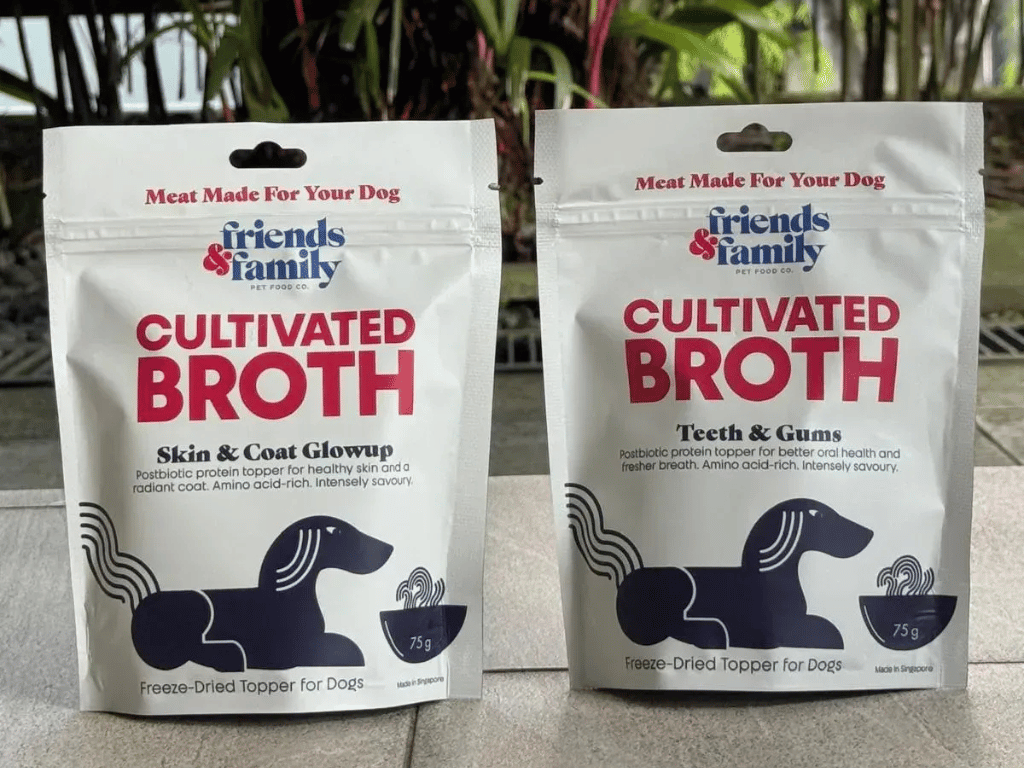
US startup Friends & Family Pet Food has added four broth toppers to its cultivated quail lineup for cats and dogs in Singapore, as it works to update the packaging to plug the consumer awareness gap.
Three months after entering the Singapore market with a range of cultivated meat treats, Friends & Family Pet Food is already expanding its range to move “from an occasional reward into everyday feeding” for cats and dogs.
The Californian firm has launched four freeze-dried toppers that can be scooped dry or stirred into hot water for a savoury broth, boosting either wet or dry food with 68% protein and a dose of functional postbiotics.
The products are based on the startup’s cultivated Pharaoh quail, a game bird native to Japan, which received regulatory approval from Singapore’s Animal and Veterinary Service in June 2025.
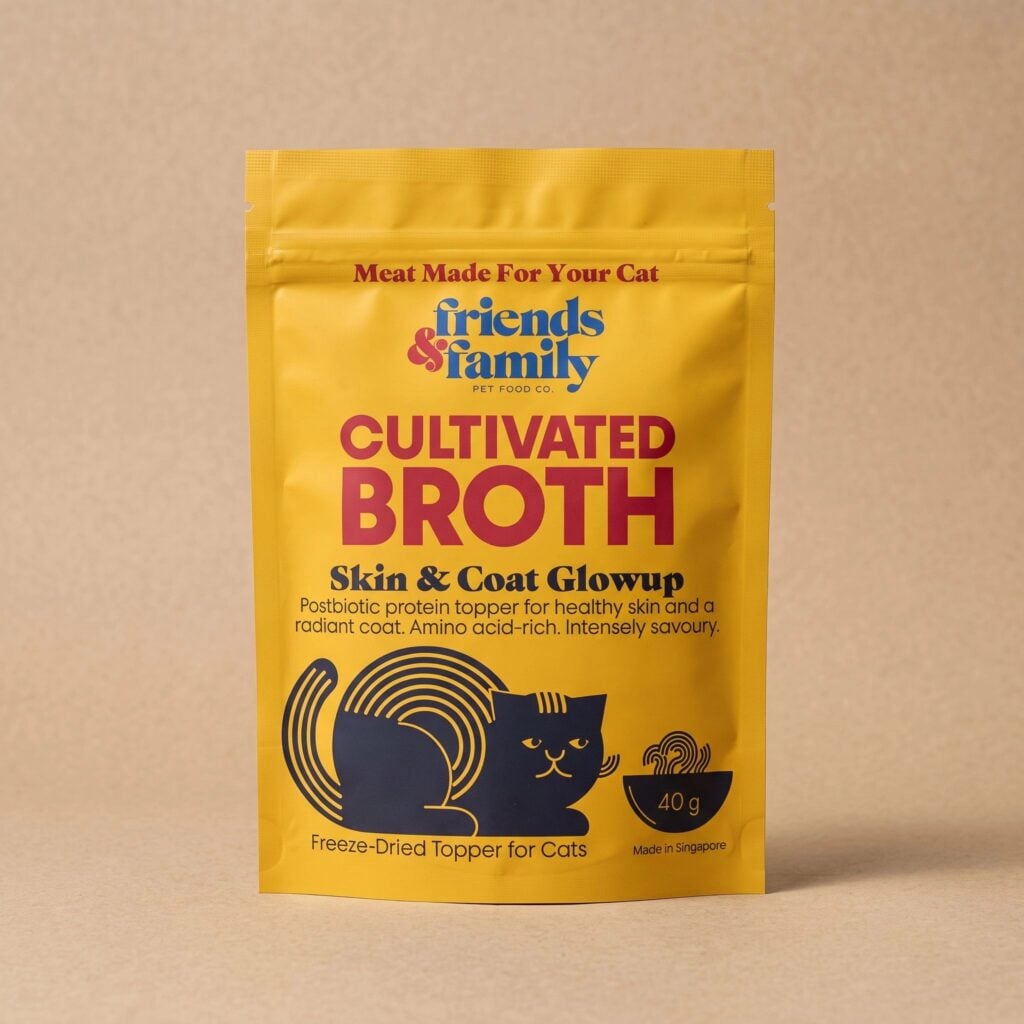
They come in two postbiotic formats each for cats and dogs: the skin and coat glow variants support skin health and reduce noticeable itching within a month, and the teeth and gum care versions enhance oral health for fresher breath.
“We want to earn our place in the bowl,” Friends & Family co-founder and CEO Joshua Errett tells Green Queen. “Our first products were treats, deliberately, because treats are the fastest way to prove the technology works, taste good and look amazing on the retail shelf.
“Consumers will experiment with new treats; this is seen as a low-stakes purchase. Our treats offer measurable health benefits, contribute to the pet’s daily protein requirements, and serve as excellent training treats (due to the high protein-to-fat ratio and low calorie count).”
The broth, he says, is the “next logical step”, embedding cultivated meat into daily feeding rituals. “It’s still lower stakes because we are not asking pet guardians to replace their cat or dog’s entire sustenance with cultivated meat. It’s a pour-over/rehydratable supplement/topper that owners add to a meal, so instead of a few treats a day, you’re building cultivated into the daily bowl,” Errett says.
“Supplements also tell our functional nutrition story better than treats. I argue cultivated meat is superior nutrition for cats and dogs compared to conventional meat, and a supplement is the best way to prove that.”
Friends & Family sold 400 packs in first six weeks of launch
Friends & Family blends cultivated quail cells with nutritional yeast to make its meat products, which are grown over seven to 10 days and harvested in small batches at a dedicated food facility. For this latest line, the cultured meat and its nutrient-rich broth are freeze-dried together to create a gamey, high-protein topper.
Commercial broths for pet food are typically made from industrial leftovers, and come with what Errett argues are “frankly sketchy health claims about collagen or gelatin”. His startup only leverages the parts it wants pets to eat, eschewing bones, meals, and animals.
Clinical studies have proven its products’ benefits. The broth has a “naturally broad amino acid profile” and is packed with vitamins, minerals and postbiotics, with an “intensely moreish” savoury flavour that can make plain or picky meals more palatable.
This aligns with sensory testing on its treats, too. “The product is hitting all the marks with cats and dogs. We have an astonishing acceptance rate with pets – validation of all the work we did on palatability,” says Errett.
“So we’ve been focusing a lot on sampling, going to events around Singapore where people bring their dogs. As soon as a cat or dog tries the treat, it’s a very easy sell.”
He reveals that Friends & Family sold around 400 packs within the first six weeks of launch. “I know there have been some limited sales, tastings or trials of pet products made with cultivated meat, plus a few more recent launch announcements,” Errett acknowledges.
“But I don’t see anyone else selling it the way we are: we’re the first cultivated meat pet food that’s in stores and online every day. It’ll be a little while before I’m bragging about sales, but for these very early days, I’ll take it.”
The company now has eight SKUs, covering the treats and toppers, and plans to release six more in the coming months. “These are brand new formulations I’m really proud of, so I can’t wait till they’re out,” reveals Errett. “We’ll also come out with different-sized packs – a smaller trial pack, and one that doubles the size of the current pack.”
As for price, the broth products sit in the premium category, costing S$28 per 40g pack for cats and S$48 for dogs. Each bag delivers three weeks of servings – that’s around S$0.67 per meal for the former and S$1.14 for the latter.
New packaging to address awareness gap amid fundraising drive
The cultivated pet food category has come out of its cocoon in the last year or so. Last year, Meatly launched Chick Bites, a limited-edition hybrid chicken product, in the UK (it has since raised £10M ($14.1M) to build a factory and re-enter the market next year). Still in Europe, BeneMeat teamed up with Forza10 to establish Coolty Meat, a hybrid hamster meat innovation for dogs, set to launch this quarter.
Like BeneMeat, Biocraft Pet Nutrition and Umami Bioworks too have registered their cultivated proteins as feed materials in the EU, enabling them to sell them as ingredients to manufacturers. And Melbourne’s Magic Valley is currently commercialising cultivated dog treats under its Rogue Pet brand within the voluntary framework developed by the Pet Food Industry Association of Australia.
The road ahead isn’t without bumps. Friends & Family kept its launch small – its products are only available in eight retail stores in Singapore – and has yet to spend capital on paid advertising.
“We need to find the right messaging, positioning and product before we can scale, and the best way to do that is with customer feedback. And you can only get true consumer feedback from paying customers,” says Errett.
“Unfortunately, cats and dogs don’t have bank accounts. And there is some consumer reluctance to try the products. We worked with the University of Hong Kong on this challenge, and they conducted great in-depth consumer panels and interviews.
“Immediately, we learned that consumers don’t know what cultivated meat is – at all. We purposefully didn’t want to go into too much depth on the science. This was a decision I made: to focus on the product, not the process. No other pet brand explains how it gets its meat.”
Errett admits he overestimated consumer awareness of cultivated meat: “When you introduce a new ingredient, people will have questions. So we need to better explain what cultivated meat is, and that explanation has to be right on the package and click with the consumer within seconds. We have a new iteration of packaging coming out in a couple [of] months that we think will do a better job of this.”
The company secured an undisclosed sum in December, and is now working to raise $1.1M to expand beyond Singapore. “The funding will go to our next launch, which will be a significantly larger scale, with more cultivated meats, more products and different markets,” he says.