

Alpro Launches Greek-Style Yoghurt Prioritising ‘Extra Creamy’ Texture Over Protein

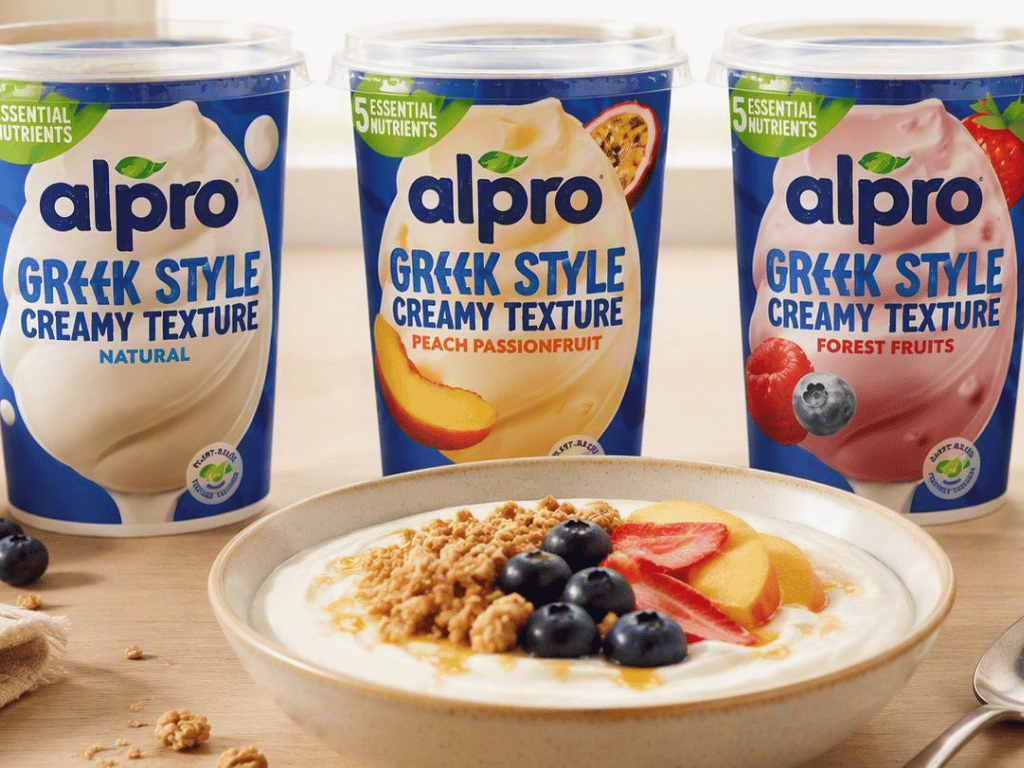
Danone has unveiled a new line of dairy-free Greek yoghurts under its Alpro brand, which will be rolled out across Europe with an emphasis on creaminess rather than protein density.
Alpro is promising a “very different” taste and texture profile with its new line of plant-based Greek-style yoghurts, which are making their way onto supermarket shelves across Europe.
The Danone-owned brand has launched three flavours of non-dairy Greek yoghurts – natural, forest fruits, and peach-passionfruit – which prominently display “creamy texture” as the chief characteristic front-of-pack.
Alpro already sells yoghurts branded as “Greek-Style” in the UK, with a similar recipe marketed as “Skyr Alternative” or “Kwark” in other European markets. However, its latest range is an entirely different proposition in response to consumer demand for creamier options.
“Those new Greek-style [yoghurts] are focusing on delivering an outstanding creamy texture, not on the protein content density (as in the current UK Greek & Skyr styles),” Guillaume Millet, the European VP of plant-based food for Danone, tells Green Queen.
“So the taste and texture [are] very different for consumers, [with the] two key attributes highlighted being ‘extra creamy’ and ‘light on my stomach’,” he adds.
How Alpro’s new Greek yoghurts differ from existing alternatives
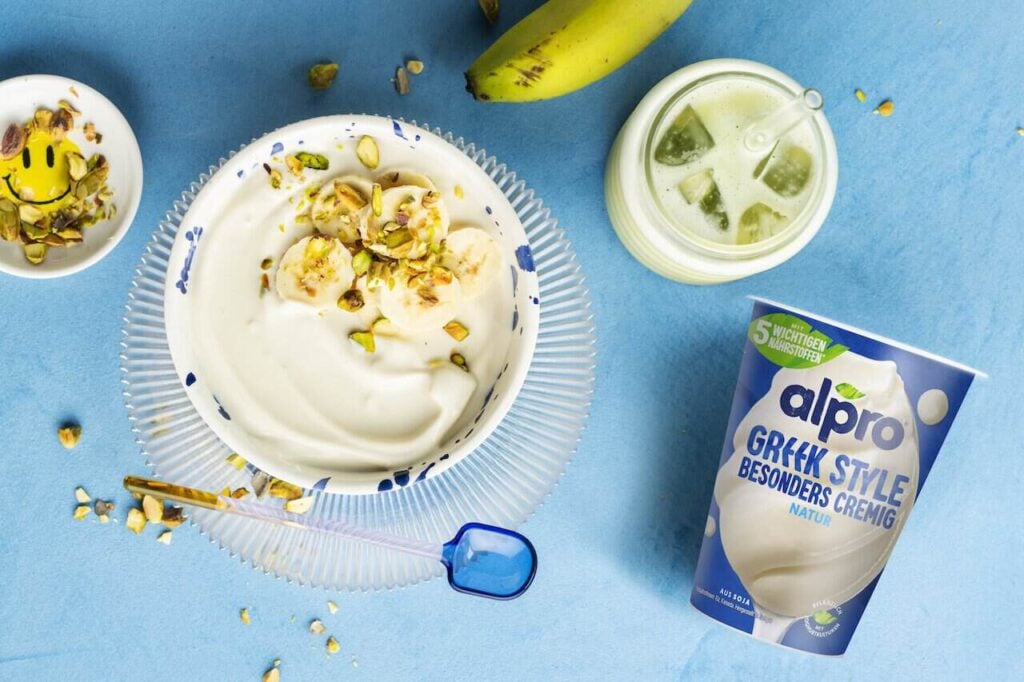
Alpro’s existing crop of Greek yoghurt, skyr and quark alternatives comprises a base of 15.7% soybeans, with over 5.6 of protein, 3.3g of fat, and 1.3g of fibre per 100g.
To dial up the creaminess in the new versions, the company has lowered the soybean content to 9.8-11.1% and added coconut cream and sunflower oil to the mix.
The result is a richer yoghurt with 3.8-4.2g of protein, up to 1.1g of fibre, and 5.3-6g of fat per 100g. Each of the new variants contains calcium, iodine, and vitamins B12 and D2, while the fruit-flavoured options also supply vitamin B2.
“Providing good nutrition is always at the heart of what we do,” says Millet. “Same here: 5 Essential Nutrients, source of protein, and limited sugar content and saturated fat.”
The Greek yoghurts, which are free from artificial colours and sweeteners, can be used in both sweet and savoury recipes, including breakfast meals, snacks, and desserts.
They’re being sold in 400g pots for €2.19. “We started to produce [them] two weeks ago. Distribution will be scaled in Europe within one or two months,” reveals Millet.
He confirms that the updated Greek yoghurts will be launched in the UK, too. The existing version will be rebranded as “Greek Protein”, while the new range will be sold as “Greek Creamy”.
It’s worth noting that, despite the emphasis on texture over protein density, the new products still contain a good amount of the latter. In fact, Alpro has been doubling down on its protein lineup, launching protein-rich meal replacement drinks and landing its high-protein soy milk in Starbucks stores across Europe this year.
Double-digit growth bumps Alpro’s vegan yoghurt market share
With this latest rollout, Alpro is aiming to capitalise on the fast-growing Greek yoghurt market. NielsenIQ data cited by the brand shows that sales of these products rose by 16% in the 12 months to July 2026. Separate research from Circana reveals that Greek yoghurt exports jumped by 42.5% to reach €559M in 2025.
“Greek-style products are currently among the most exciting trends in the refrigerated section. With Alpro Greek Style, we are launching our creamiest plant-based alternative yet and demonstrating that plant-based enjoyment no longer needs to compromise,” explains Christine Borghardt, Danone’s plant-based category director for Germany, Austria, and Switzerland.
“This appeals not only to people who follow a plant-based diet, but to everyone who wants to treat themselves to something special every day – creamy, versatile, and incredibly delicious,” she adds.
The launch builds on Alpro’s existing leadership in Europe’s vegan yoghurt market. Last year, the brand held a 54% share here (a three-point increase from 2024), and its dairy-free alternatives made up 40% of its retail value.
Millet declines to comment on the current revenue share of its yoghurts, but indicates that their overall market share has witnessed another three-point bump.
“Our growth is double-digit for the third year in a row, and our European market share now is above 57% in the plant-based yoghurts category,” he says. “Iberia, Italy, France and Germany are [the] fastest-growing markets with still an immense reservoir of growth.”
Alpro, which partnered with Swedish popstar Zara Larsson to promote its 5 Essential Nutrients range, is enlisting Instagram and TikTok influencers to create content that generates high relevance and word-of-mouth recommendations for its Greek yoghurts among the target groups. Secondary placements and eye-catching materials at the point of sale will help achieve additional visibility in retail.