

Exclusive: All G Awarded NSW Govt Grant to Scale Recombinant Breast Milk Protein for Infant Formula


Australian precision fermentation startup All G has received an A$1.1M ($775,000) grant from the New South Wales government to expand production of its human beta-casein protein.
Amid calls for greater public investment in the Australian alternative protein sector, the New South Wales government has pumped A$1.1M ($775,000) into All G, a startup using fermentation to produce recombinant milk proteins, via the state’s Biosciences Fund (BioSF).
The company says it will use the grant to expand its human beta-casein, which makes up 20-45% of the protein content in breast milk and boosts calcium absorption, growth, development and satiety.
It will support All G’s mission to transform the infant formula sector by progressing from lab development towards scalable manufacturing in Australia.
“The funding will support proof-of-concept scale-up of our human beta-casein and preparation for regulatory submissions, allowing All G to advance both the technical and commercial readiness of this protein,” co-founder and CEO Jan Pacas tells Green Queen. “We will be working hard to bring it to market as quickly as possible.”
Why All G is working on breast milk casein
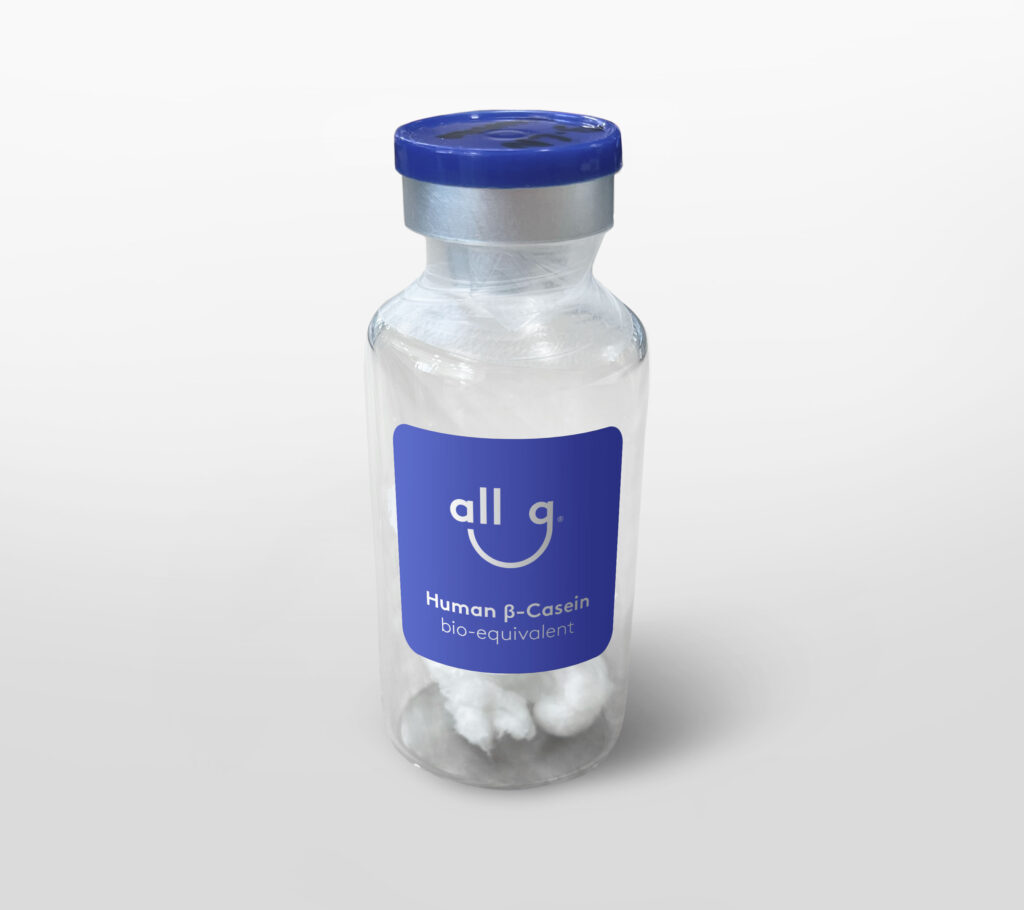
Precision fermentation involves inserting specific DNA into microbes to instruct them to produce desired molecules when fermented. All G uses the technology to make several bovine and human milk proteins, with beta-casein being the focus of the BioSF grant.
All G is working on human casein micelles, highly complex structures comprising thousands of interacting milk proteins, which are critical to the nutritional profile of breast milk.
“Our patent filing covers several areas of casein micelle technology. This includes the assembly of casein micelles using a single casein protein rather than the full set of four caseins typically present in milk, simplifying the process while still enabling micelle formation,” explains Pacas.
“Our portfolio also covers scalable methods for producing stable casein micelles compatible with fermentation-based production, as well as the use of human casein micelles in infant formula incorporating human milk proteins. Together, the filings address both the production of micellar casein structures and their potential application in nutrition.”
Globally, a handful of precision fermentation startups are developing breast milk proteins, though most are focused on lactoferrin (a whey protein) or osteopontin. So far, All G is the only one publicly working on human milk casein.
“Caseins are particularly challenging because they must be correctly phosphorylated and assembled into micellar structures to replicate how they exist in milk,” notes Pacas.
He points to the expertise of All G’s CSO, Jared Raynes, who has been working on casein micelles for over 12 years and “was the first to demonstrate” how casein micelles can be recreated outside of milk using precision fermentation: “This work forms the foundation of our process.”
Casein and lactoferrin will ‘narrow the gap’ between formula and breast milk
The World Health Organization estimates that around 40% of infants under six months are exclusively breastfed globally. A range of medical, physiological and social factors means that many families rely on formula for infant nutrition.
But while formula provides essential nutrition to support a baby’s growth, All G says it cannot fully replicate the biological complexity of human milk. Research suggests that formula-fed infants may face higher risks of gastrointestinal infections in early life, childhood obesity, and Type 2 diabetes later in life.
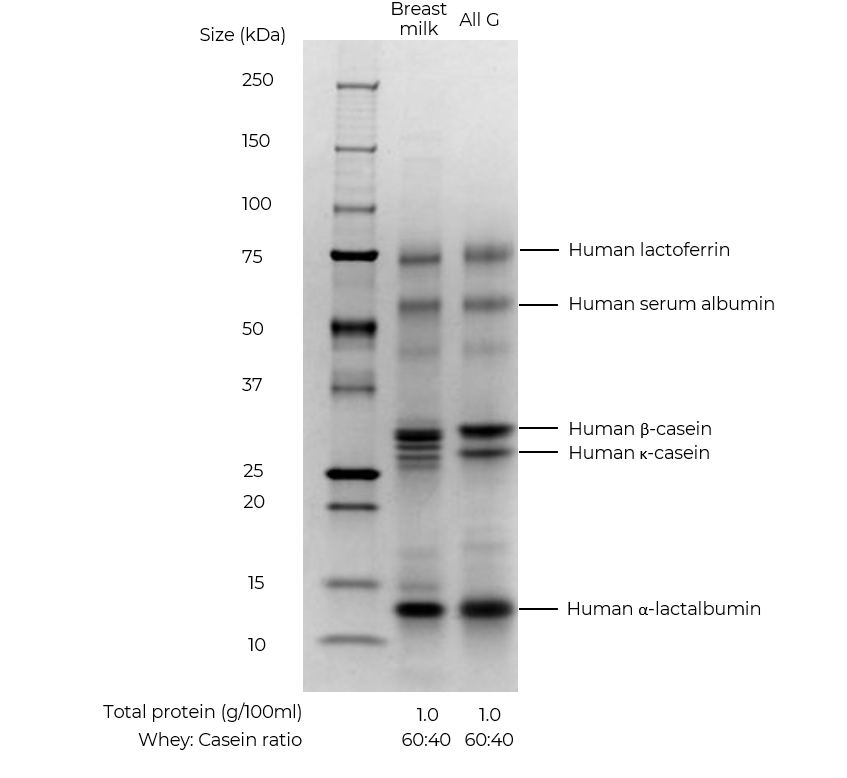
All G is working on both casein and lactoferrin, both of which represent different components of human milk and are crucial for healthy infant nutrition.
The startup has already secured clearance to sell its bovine lactoferrin in the US and China for adult nutrition and personal care, respectively, and now, it is advancing its efforts to produce human lactoferrin for the infant formula space.
“The majority of infant formulas today rely on bovine milk proteins, which naturally contain a higher proportion of casein and much lower levels of lactoferrin than human milk,” says Pacas.
“Human beta-casein is the predominant casein protein in human milk, and forms part of the nutritional protein fraction of milk, contributing to milk structure and digestion characteristics of milk proteins in the infant gastrointestinal tract,” he explains.
“[It] is relevant for infant nutrition because casein proteins contribute to the protein structure of milk and influence how milk proteins coagulate and are digested in the gastrointestinal tract.
“Lactoferrin, by contrast, is an iron-binding glycoprotein associated with iron regulation and innate host defence and is present in relatively high concentrations in human milk, particularly early lactation. Together, our human lactoferrin and human beta-casein are part of our pipeline to help narrow the gap between the protein composition of infant formula and human milk.”
Is New South Wales’s investment a marker of broader public support?
The New South Wales grant comes three months after the startup secured $6.6M in pre-Series B bridge funding, taking its total raised to $36M since its establishment in 2020.
BioSF is a competitive government commercialisation programme supporting biotech and life sciences companies working on innovative technologies. The aim is to attract private investment and build advanced biomanufacturing capabilities within New South Wales.
Experts have long called on Australia’s federal and state governments to shore up their support for the future food and biotech industry, which could make the country a global hub for biomanufacturing.
One white paper suggests that public funding should be linked to progress against food security and climate targets, and at least 30% of agrifood R&D funding in the next funding cycle should prioritise food biotechnologies and biomanufacturing.
New South Wales, for its part, has unveiled a prospectus to attract plant protein manufacturers to produce locally, and hosted cultivated pork startup Magic Valley at the state parliament for a tasting event (months after the federal government granted A$100,000 ($62,800) to the firm).
“It’s an encouraging signal,” Pacas says of the state’s investment in All G. “Australia has strong capabilities in both biotechnology and food production, and targeted programmes like this help bridge the gap between research and commercialisation.”
All G to seek US clearance for human lactoferrin
Looking ahead, All G is preparing to enter the market with its precision-fermented ingredients this year. “Our first commercial product will be bovine lactoferrin supplied as a B2B ingredient. It will initially be used in applications where lactoferrin is already well-established, including nutrition products and personal care,” says Pacas.
“We are progressing the regulatory work for bovine lactoferrin in infant formula. In parallel, we are seeing strong interest from infant formula companies exploring use once we have approval,” he adds.
The human lactoferrin is progressing in parallel to the bovine version, currently tracking around “nine to 12 months” behind the latter. “We’re leveraging the R&D and manufacturing developed for bovine lactoferrin, which will allow us to move the human protein through development more quickly,” the CEO notes. “We expect to complete a self-affirmed GRAS assessment in the US in Q3 this year.”
As for its beta-casein, the regulatory focus is on infant formula, and All G will be accelerating the path to market “as quickly as possible”.
The startup has signed a joint venture with bioactives leader Armor Protéines (owned by dairy major Savencia) to produce and commercialise its proteins. The French firm’s experience in large-scale manufacturing of infant formula ingredients and long-standing relationships with leading nutrition companies will help All G expand its footprint across global markets.
Other companies working on recombinant lactoferrin (whether bovine or human) include Helaina, TurtleTree, PFx Biotech, Daisy Lab, De Novo Foodlabs, Eclipse Ingredients, Vivici, Guoke Xinglian, and Eden Brew. The latter is developing precision-fermented casein too, as are New Culture, Those Vegan Cowboys, Standing Ovation, and Fooditive Group.