

Planetary Nets $28M to Scale Full-Stack Fermentation Platform for Sustainable Proteins

Swiss biomanufacturing startup Planetary has raised $28M in fresh funding to expand its global fermentation infrastructure and licensing platform, and diversify its alternative protein product portfolio.
Months after establishing a mycoprotein production partnership in India, Planetary has attracted new investment to take its novel fermentation technology and licensing platform global.
The Geneva-based startup has secured 16 million Swiss francs ($20.4M) in Series A financing, supplemented by another six million francs ($7.6M) in credit, taking its total funding to around 32 million francs ($41M).
The investment was led by Radikal Capital and Oetker Ventures, with further participation from Royal Cosun, Arc Investors, Green Generation Fund, AgriFoodTech Venture Alliance, and existing backers Astanor Ventures and XAnge.
Armed with the new capital, Planetary aims to achieve several milestones over the next 18-24 months, including “building out our international technology licensing business, gaining core profitability on [an] asset level, [and] branching out into a more diversified product range”, co-founder and CEO David Brandes tells Green Queen.
A business model driven by circularity and unit economics
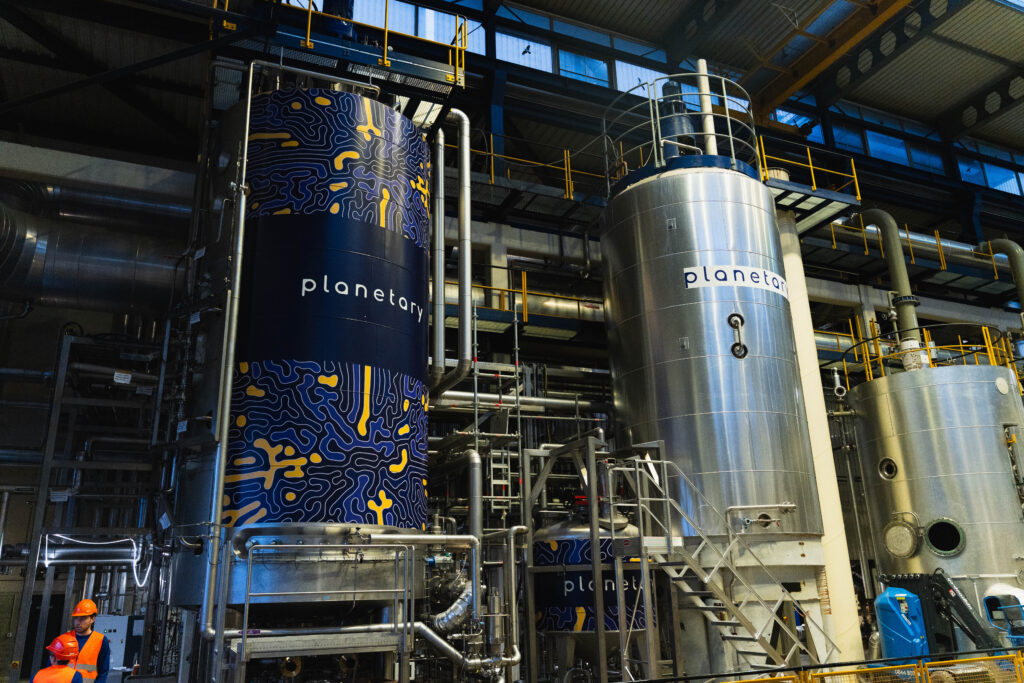
Planetary operates a full-scale biomass and precision fermentation platform, titled BioBlocks, that encompasses bioprocess design, scale-up, and industrial manufacturing. It’s designed to support the development and industrialisation of future-facing food and material solutions, using a wide array of feedstocks.
At the heart of its IP-rich strategy is the global licensing of its tech to agro-industrial partners – particularly sugar companies – enabling the conversion of low-value byproducts into high-value proteins, fibre and enzymes. This, the company says, unlocks a “new circular bioeconomy”.
“Our fermentation platform helps partners to convert sugar, sugar sidestreams, and other agricultural sidestreams into biomanufactured compounds via aerobic industrial fermentation,” says Brandes.
“We are focusing on mycoprotein as a first biomass fermentation application, but due to Planetary’s versatile and deep industrial bioprocess competency, bundled in our BioBlocks fermentation platform, we have also supported partners across blue-chip CPG and startups to bring precision-fermented products to life,” he explains.
“The concepts – ranging from proteins to fats, colouring agents, enzymes and certain materials – are promising, and we expect breakthroughs in selected areas, which we stand ready [to] produce industrially at the right time.”
The company is expanding this sugar-to-protein upcycling tech globally, including plans to enable ultra-low-cost mycoprotein production (under $1 per kg) via partnerships with industrial players in sucrose-rich and protein-deficient geographies.
“We have onboarded a range of agro-industrial partners on the technology licensing front. Public partnerships include Schweizer Zucker (Switzerland), Cosun (Netherlands), and DBO (India),” says Brandes.
“Every opportunity is assessed individually. Ultimately, unit economics (cost of goods sold) are the main decision criteria [for] whether or not to engage in establishing production capacity in a given context,” he notes. “If we can significantly beat the price of conventional protein, and if there is a consumer market in a specific region, then we are excited about the opportunity.”
Planetary plans new products and second closing of funding round

Planetary has already established industrial-scale production at its facility in Aarberg, Switzerland, and is now looking to onboard engineers, commercial leaders and product innovators, alongside customers seeking to co-develop future food products.
As reported by Green Queen, the firm acquired the core brand, IP and key assets of Spanish mycelium meat maker Libre Foods last June. Shortly after, it rolled out a mycoprotein fillet under Aldi Suisse’s MyVay brand nationwide, which was at price parity with chicken.
The company is now rolling out additional B2B launches under the Libre label across Europe. “Our technology is fit to serve a range of applications, [including] meat alternatives, hybrid meats, dairy alternatives, protein/fibre fortification, and pet food, always in a B2B context,” says Brandes.
“We are working with approved strains, which may require regional certification in some regions,” he adds when asked about regulatory approval. “However, this process is very light and not comparable to novel food regulations.”
Planetary, whose BioBlocks platform is a WIPO GREEN-listed innovation, has secured a hefty amount in what is the toughest food-tech funding environment in a decade. “Raising capital outside AI and defence now requires far more focus and resilience than it did just a few years ago,” says Brandes.
“Yet, recent geopolitical turmoil and commodity volatility only strengthen the case for a sovereign, circular, and high-quality food system: stay the course and hold the line, nothing worth building comes easy.”
He continues: “In order to prevail in the current environment, Planetary had to prove full-stack capabilities, from industrial in-house bioprocess development to production infrastructure control and product distribution, all proven by hard data: a bioprocess delivering below price-party COGS; an industrial infrastructure you can see and touch; [and] distribution generating real revenue.”
And now, the company is selectively engaging with investors for a second closing of its round, earmarked for later in the summer.