

North America Defies Global Decline in Alternative Protein Jobs in 2025


Employment opportunities in the future food sector declined in 2025 amid shifting investment priorities and business models, though North America bucked the trend.
Funding for alternative protein companies fell below the $1B mark for the first time in 7 years in 2025, leading to the closure of several leading players in the space.
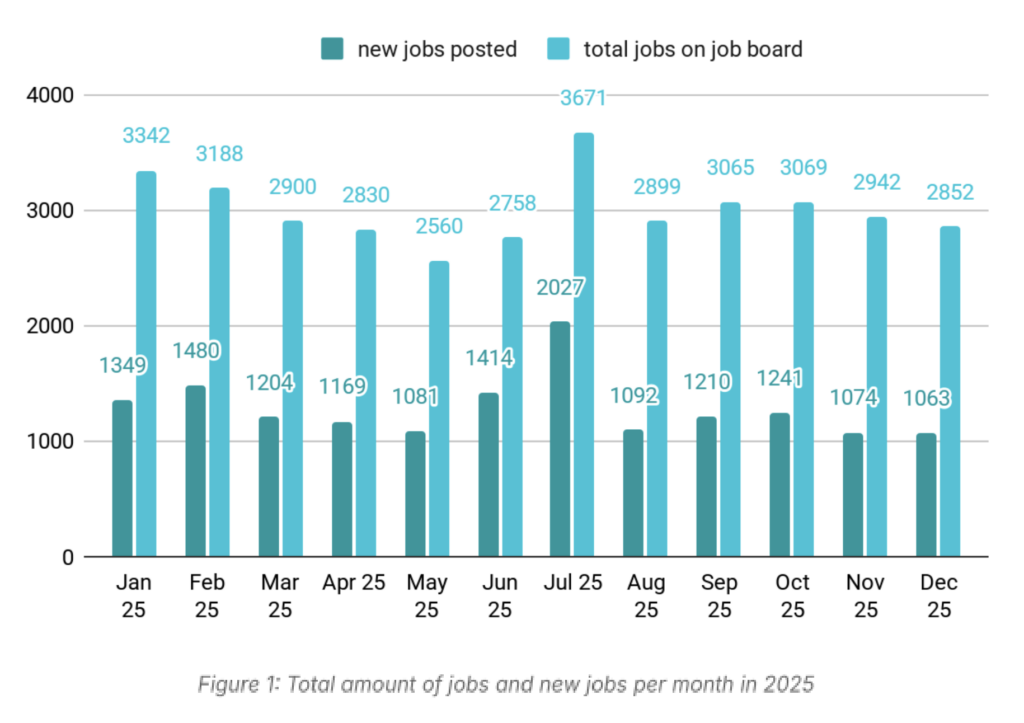
This significantly impacted job opportunities in the future food sector, with the number of available roles declining globally. Between October 2023 and 2024, AltProtein.Jobs saw 16,010 positions posted on its jobs board. In 2025, this fell to 15,404.
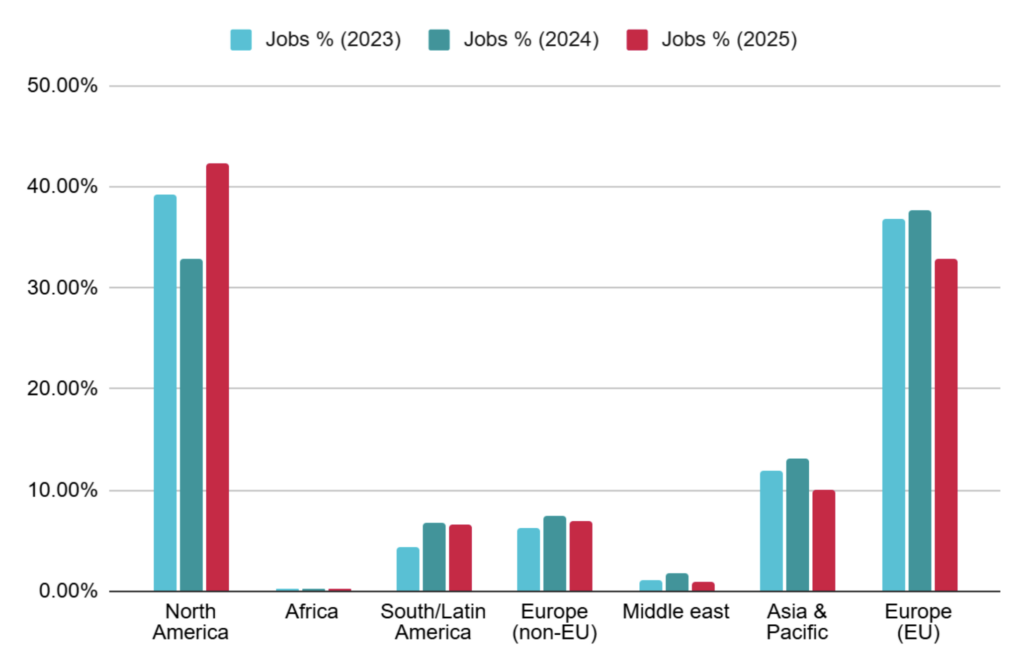
North America was the exception, witnessing a 9.3% year-on-year increase in alternative protein job numbers in 2025. In fact, last year’s total even surpassed that of 2023.
“Whereas 2021-22 marked an expansion in interest and funding for the alternative protein sector, in part driven by the advent of cultivated meat, this boom was followed by steady development, but also by depletion of existing resources,” states a new report by AltProtein.Jobs.
“With a decline in investments, 2025 saw a number of companies and branches closing, and others reevaluating their positions in response to the present economic pressures.”
North America’s dominance could indicate start of ‘stabilisation period’
North America and Europe still dominate the global future food workforce, collectively home to over 70% of all job openings. The US had the highest vacancy rate last year (6,103), or nearly 40% of the total. It was followed by Germany (1,863), followed by France, the UK and the Netherlands (around 800-1,000 each).
Elsewhere, companies in Brazil and India posted 500-600 jobs each, reflecting an increase from the previous year and indicating a developing market that could become increasingly important in the years to come. Other European countries, Canada, Mexico, Israel, Thailand, and Singapore each saw over 100 roles made available.
In the EU, Asia-Pacific, and the Middle East, job vacancies declined even compared to 2023. The former reached an all-time high in 2024 but fell 4.6% last year.
“The only region with recorded growth in job openings in 2025, North America, actually experienced a decrease the year before (2023 to 2024). While in other regions the growth phase seems to have ended, North America’s recovery may indicate the beginning of a stabilisation period ahead,” the report notes.
“As the world’s leading economy, political and economic trends of the US have a global influence, and other regions could experience a similar bounce-back in the coming years.”
The data is consistent with research from recruiting group Food Impact Partners, which found that the US had posted more alternative protein roles than any other country last year, and Europe was the second most prolific region.
No company posted more jobs than Ingredion (573) last year, followed by Coperion, Griffith Foods, Ardent Mills, and Roquette (all with more than 400).
And though there was no rise in the number of job openings, AltProtein.Jobs recorded greater diversity of job functions, including roles related to technical services, equipment, and ingredient production.
Manufacturing, agricultural science, and project management were the top three job functions across all postings in 2025, and policy and advocacy was the most competitive, with 3.4 times more applicants than positions available.
The data shows continued demand for roles in cell biology, software development, automation, and law. And as more companies commercialise their products, sales and marketing professionals may find more opportunities. “This shift marks a promising area for career growth or switch as companies emphasise market presence and customer engagement,” the report states.
Job opportunities expected to diversify, not grow, in 2026
AltProtein.Jobs did not witness a significant decrease in plant-based protein positions, indicating that the industry’s most established and popular segment remains in demand. These technologies still accounted for over 60% of all job vacancies in 2025.
Fermentation-related roles accounted for 12.2% of the postings, with precision fermentation alone accounting for 9.1%. Cultivated protein positions represented 6.3% of the total.
The biggest increase was reserved for other technologies, which include plant molecular farming, explicitly hybrid technologies, production-related services, and non-technical roles. Their share rose from less than 1% in 2024 to 19.3% last year.
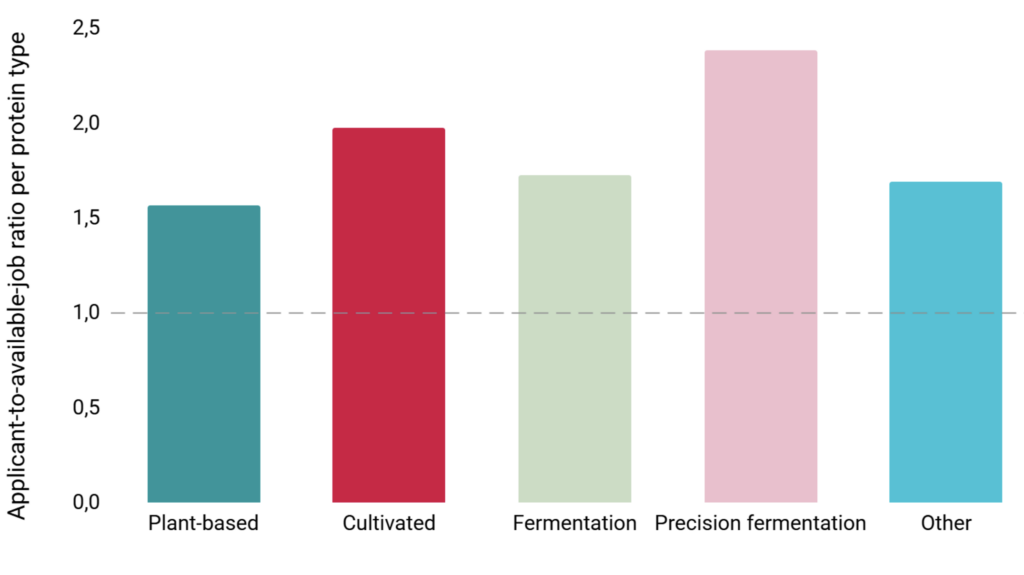
“In contrast to role availability, the application data suggest that positions in the precision fermentation sector were among the most popular, followed by cultivated meat, with around 2.4 and twice as many applicants as roles, respectively,” the report reads.
Other sectors had similar average numbers of applicants per role, ranging from 1.5 to 1.7. “This indicates that the competition for positions in the cultivated meat and precision fermentation sectors [is] higher, while other sectors offer more opportunities, both in terms of candidate preference and role numbers,” it explains.
The research further revealed a hike in the use of artificial intelligence (AI) for recruitment. “AI technology is continuing to find more uses in food tech and alternative protein industries; we have recorded a global uptick in AI-related vacancies,” says the jobs board, which last year transitioned to a non-profit model. “Workforce development and educational programs should prioritise skills training in these areas.”
AltProtein.Jobs does not expect job availability to grow significantly in 2026. However, it expects the diversification of roles to continue as companies mature and more startups enter the space.
“We expect alternative proteins to keep being used as political instruments, but we also anticipate a backlash from the industry. In line with our data, we predict that roles in policy and advocacy are going to continue enjoying high application rates, as professionals seek to make a difference through political action,” it outlines.