

Sure, Beef’s Emissions Can Be Reduced – But It Can Never Be ‘Climate-Friendly’

Low-carbon beef is a fantasy, and the only way to guarantee a reduced impact of this meat is to buy less of it, according to a new study.
Livestock producers may make claims of sustainability or even carbon neutrality, but beef can never be truly climate-friendly.
That’s the consensus of the latest research by the World Resources Institute (WRI), which notes how ruminant meats have a higher climate impact than all other protein-rich foods. More so than anything, the report pins the blame on land use.
Ruminant livestock require over 10 times more land to produce in the US and Europe than chicken or pork, and 20 times as much as beans, per gram of protein. And growth in demand for grazing land to produce beef is the leading direct driver of tropical deforestation globally, accounting for over 40% of forest-clearing in the region between 2005 and 2013.
“While there are technical ways to reduce beef’s emissions, market constraints and the lack of credible, verifiable labels mean that sourcing genuinely lower-emissions beef remains out of reach for most buyers in the US and Europe,” WRI explained in a blog post. “The only way to guarantee you’re lowering the climate impact of your beef is to buy less of it.”
Why beef has an outsized effect on the planet
In the US and Europe, beef production generates 13 times more carbon costs per gram of protein than chicken, and over 20 times more than beans and lentils.
There are several reasons why its climate impact is so high. Beef cattle take longer to mature and produce fewer offspring than pigs or chickens, and thus need much more feed and, subsequently, land.
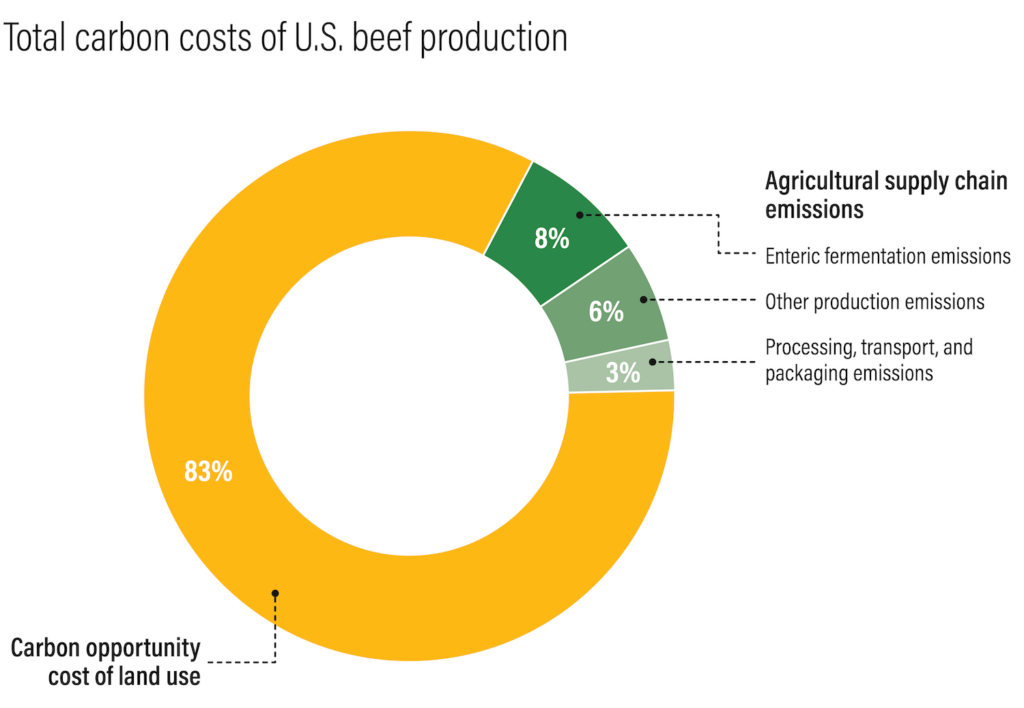
Among the key sources of beef’s greenhouse gas emissions is agricultural production, which includes fertiliser use, manure storage, the use of fuel tractors, and feed production. Emissions from beef processing, transportation, and other post-farm activities also play a part.
Further, ruminant animals have a unique digestive process called enteric fermentation, which releases methane when cows belch or pass gas. Methane is 86 times more potent than carbon over a 20-year period, and makes up the majority of beef’s emissions.
Then there’s the carbon opportunity cost – a measure of the carbon losses from plants and soils occurring when natural ecosystems are converted to agriculture. It accounts for the fact that land used for crops or pasture could otherwise be used to sequester carbon.
For every unit of beef produced globally, the average carbon opportunity cost is four times higher than the equivalent emissions from activities in the agricultural supply chain.
In terms of water use, beef uses less irrigated water per serving than pork, lamb, or farmed fish, and twice as much as milk, eggs, and plant-based foods. And even more worryingly, it has the largest nitrogen and phosphorus footprints of all major foods, accounting for 39% and 49% of the total released, respectively, every year in the US.
Do location and farming methods matter?
The report suggests that well-managed grazing can offer significant benefits, providing livelihoods for millions of pastoralists and preserving native grasslands (which are essential for carbon storage and water supply).
Only 37% of land used globally to graze or feed cattle is unsuitable for crops – the rest occurs on land where it would be far more efficient to grow plants or where forests could be restored. This is why producing beef in the West requires over three times as much cropland per kg of edible protein as milk, eggs, pork and chicken, and seven times more than for beans.
In any case, as global demand for beef continues to rise, it’s unrealistic to limit its production to land unsuitable for crops or for forest restoration. And though the emissions intensity of beef has declined over the last few decades, the impact of new mitigation strategies may be overstated.
A 2021 report estimated that all these measures – including producing feed additives with solar energy, growing legumes on pastures, and ramping up carbon sequestration with better grazing practices – could reduce the US’s per kg beef emissions by 48% by 2030. WRI’s analysis, which incorporates the full impact of land use, puts that number at just 18%.
What about regenerative, ‘carbon-neutral’ beef?

Many proponents of beef tout the purported climate benefits of organic, grass-fed, or regenerative beef. However, these systems require more land than conventional agriculture, thereby increasing the carbon cost of beef.
WRI’s research has previously found that the carbon footprint of grass-fed beef is more than double that of feedlot-finished beef. Organic beef’s carbon cost is 28% higher than meat produced from conventionally farmed cattle.
Less research has been done on regenerative agriculture, which is focused on improving soil quality. Many practices overlap with the aforementioned systems, so the same land use and emissions concerns apply here, too, WRI said.
Climate journalist Michael Grunwald, author of We Are Eating the Earth, called regenerative farming a “wildly oversold” climate solution in an interview with Green Queen last year.
“It’s the ultimate silver bullet narrative: ‘Farm a little kinder, go back to the old ways, diversify crops, be nice to the soil, and all that atmospheric carbon will magically return to the earth – Kumbaya!’”, he said. “Carbon farming isn’t entirely bullshit, but mostly.”
And what about those beef products touting ‘carbon-neutral’ and ‘climate-friendly’ claims on their packaging? These statements are largely based on carbon offsetting, which has itself come under fire as a greenwashing tool for businesses.
Plus, it’s currently impossible to independently verify any of these claims – none of the US labels reviewed by WRI provide publicly available data to reflect the cattle’s full lifespan. More data is needed to evaluate each certification’s impact on yield and understand its effect on total carbon costs.
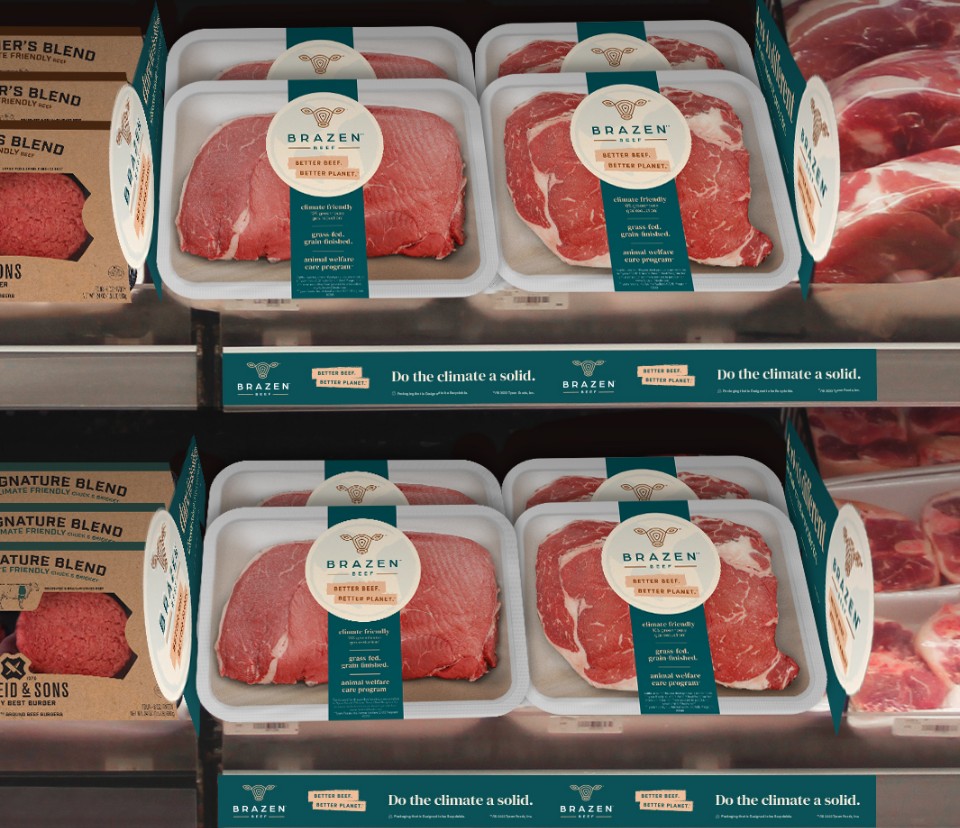
It’s why Tyson Foods has agreed to stop marketing its Brazen Beef as “climate-smart” or claiming it will reach net-zero by 2050, after settling a lawsuit that alleged it had no proven way to reduce emissions using existing or anticipated technology.
Which emissions-reducing measures are actually effective?
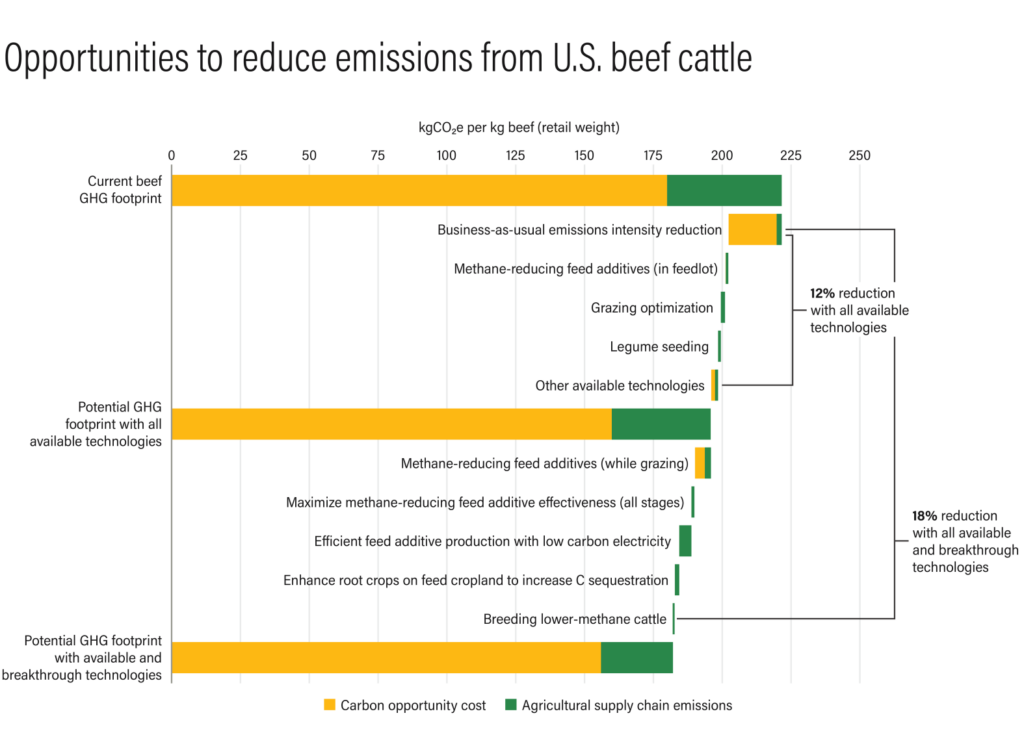
WRI suggests that some emerging measures can indeed help cut beef’s climate footprint, such as continued efficiency gains, optimised grazing, improved disease management, more effective feed additives, and changes in animal breeding and genetics.
Still, beef can never be a climate-friendly product, and one of the best ways for companies and consumers to lower these emissions is to serve and eat less beef. Reducing per capita beef consumption is essential to meeting climate targets, and food businesses can encourage this shift by offering plant-forward options with a more diverse range of protein sources (such as legumes, seeds, nuts, meat alternatives, and blended meat).
Companies aiming to balance animal welfare, antibiotic use, and sustainable sourcing priorities may wish to source grass-fed or organic beef; in reality, they’ll need to source even less of it in order to meet their climate goals.
Food businesses should also work directly with existing producers and suppliers to adopt emissions-reducing practices. One lever could be to fund projects that help farmers adopt mitigation practices, thereby driving the shift at scale.
“While achieving carbon-neutral beef is likely unfeasible, reducing beef-related emissions as much as possible is an important tool in the climate toolbox,” WRI wrote in its blog. “At the same time, efforts to support lower-emissions practices must go hand-in-hand with reducing overall demand for beef.”