

Believer Meats Was Nearly $225M in Debt Before Shutdown, Shows Bankruptcy Filing


A bankruptcy filing by Israeli cultivated meat firm Believer Meats has revealed that the company was nearly $225M in debt, and sheds light on how approval delays stalled its financing efforts.
Weeks after Believer Meats abruptly announced its closure, the cultivated meat startup’s insolvency application has been approved by the Lod District Court in Israel.
The company has appointed Gissin & Co attorney Yoel Freilich as a temporary trustee to manage its assets, according to local tech publication Calcalist. Moreover, the court has issued a 40-day freeze on all freezes against the firm.
In the bankruptcy filing, Believer Meats stated that its debt in Israel totalled $11M, and its US subsidiary owed the parent company around $213M.
The startup had received regulatory clearance to sell its cultivated chicken by the US Food and Drug Administration (FDA) and Department of Agriculture last year, and completed the construction of what it claimed was the world’s largest facility for cultivated proteins.
However, Believer Meats was unable to raise funds over the last year, citing a range of factors, including a delay in the aforementioned FDA approval. “The company fell into a severe economic crisis from which it was unable to recover, despite many attempts,” the filing read.
This led to its sudden shutdown in December, with the document suggesting that “all attempts to obtain financing and all efficiency procedures were exhausted”.
Construction delays, geopolitical tensions, and lawsuits
The bankruptcy petition was filed on December 31, and sheds light on the “significant challenges” behind the scenes that determined Believer Meats’s fate.
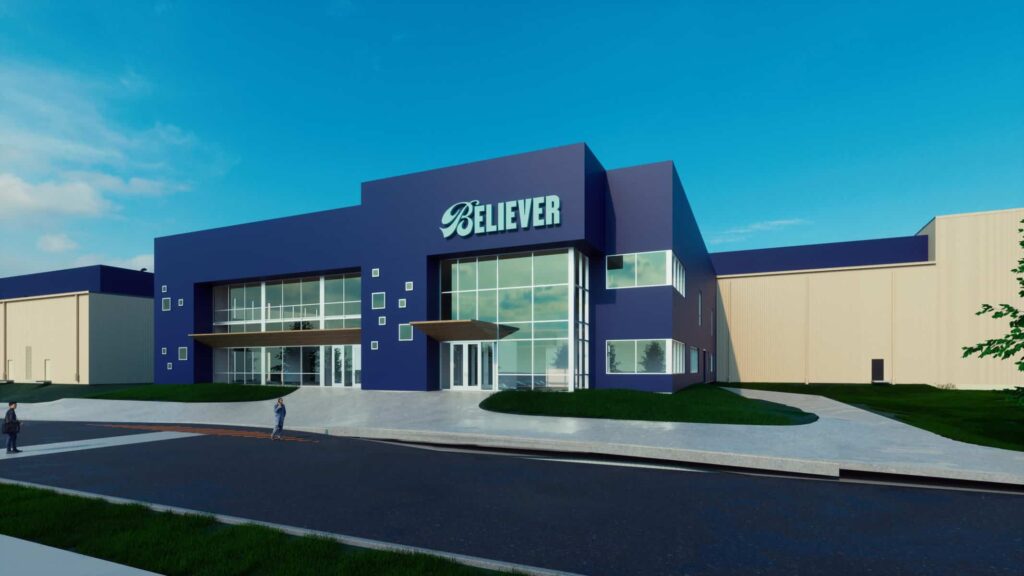
These included delays in the construction of its 200,000 sq ft factory in North Carolina, which began in early 2023 and was only completed in September 2025. The process “took longer than expected” and the plant itself is still in the process of being commissioned by engineers.
This drove up costs too. The initial budget for the facility was expected to be $138M, but the final expenditure was closer to $154M (without including equipment).
Believer Meats further cited prolonged regulatory delays due to changes in FDA policy, as well as political factors like the ongoing consequences from the Israel-Hamas war and the naval blockade imposed on the Gaza Strip.
The company was also a victim of the increasingly tough fundraising climate in the food tech sector, both globally and “for an Israeli company in particular, given the geopolitical situation”.
Shortly before it ceased operations, Believer Meats was hit with a $35.2M lawsuit by Gray Construction, which alleged that the startup hadn’t paid all its bills for the firm’s work on the North Carolina facility. In the filing, the cultivated meat producer called this “the straw that broke the camel’s back”.
The Israeli startup said it “took all possible steps” to alleviate the situation. It cut its workforce from a peak of 100 in December 2022 to 75 at the end of 2023, to just a few employees by the end of last year. “The company has actively worked to reduce operating expenses in all areas, including cancelling engagements with external consultants and subcontractors that are not necessary,” the filing stated.
Believer Meats failed to fundraise despite multiple efforts

Concerns about the implementation of Believer Meats’s cell culture technology following its FDA submission caused changes in the team and policies of the business. The FDA process was delayed by more than a year and “critically affected” the company’s ability to fundraise and launch its product commercially.
The delay was also caused by the war in Gaza, with essential employees from the R&D team called up for extended reserve duty, which pushed back trials and ongoing regulatory work. The geopolitical tensions likewise drove investors away from Israeli companies, according to the filing.
Believer Meats had raised $387M in funding since 2018. And during 2024 and 2025, it approached a “large number of banking and financial entities” to raise debt from local and foreign banks. It separately attempted to engineer a leaseback transaction for its North Carolina plant, in which it would sell the plant and lease it for a long term in exchange for rental payments.
“The company did not manage to raise the necessary financing to continue its operations,” it said. “In particular, the path to obtaining a loan through the American company has been cut off, as this would have involved encumbering the factory and its future operations.”
The startup wasn’t alone in its fundraising struggles. Fellow Israeli cultivated meat player Aleph Farms reportedly lowered its valuation by 73% in an “emergency fundraising” round last year. Overall, startups in this segment only received $36M in the first nine months of 2025. In contrast, this technology attracted $139M in 2024, itself a 40% decline from the previous year.
Shortly after Believer Meats’s shutdown, another leading cultivated meat startup, Meatable, announced its closure too, citing funding difficulties.