

How China is Deploying Its Green Energy & EV Playbook to Lead the Protein Transition

A new report explores how China is aligning policy, capital and technology to become the world’s alternative protein capital, following its lead from the green energy and mobility sectors.
China is in “year zero” of a food systems transition, with the government making alternative proteins a strategic priority amid its bid to turn into a major food exporter.
That’s according to new analysis by Systemiq and the Gordon and Betty Moore Foundation, which charts the East Asian country’s path to becoming an alternative protein leader by 2050.
It points out how China’s population grew by 450 million and per capita income expanded 25-fold between 1978 and 2020, which helped drive a dietary shift away from starchy roots and pulses to animal proteins, processed foods and convenience products.
In fact, animal protein intake increased tenfold during this period, with meat, dairy, fats and sugars driving the rise in per-capita food consumption. However, animal-based foods require far more land, water, and feed than the plant-based staples they replaced, so the growth in consumption has “tightened the link between diets, environmental stress, and food security”, the report states.
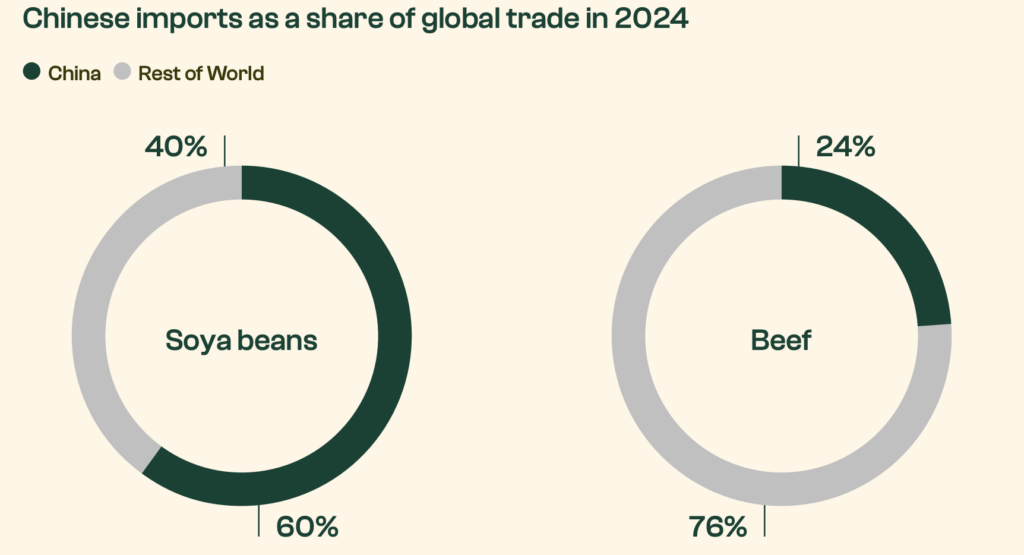
The country has been at the centre of global agriculture demand for the last two decades, and is currently the world’s largest agricultural importer, with a trade deficit of $124.5B. It accounts for 60% of all soy imports and a quarter (24%) of beef.
However, climate shocks, geopolitical tensions and trade disputes have led China’s policymakers to make food sovereignty a core pillar of national security. Systemiq predicts that the demand for animal protein will plateau in 2030, before declining through to 2050 and beyond. That, in turn, will have immense implications for the global protein landscape.
Tapping the green energy and EV playbook
According to the report, early indicators suggest that China is applying the same industrial strategy to agriculture as it did to the green energy and mobility sectors, where it is an undisputed leader.
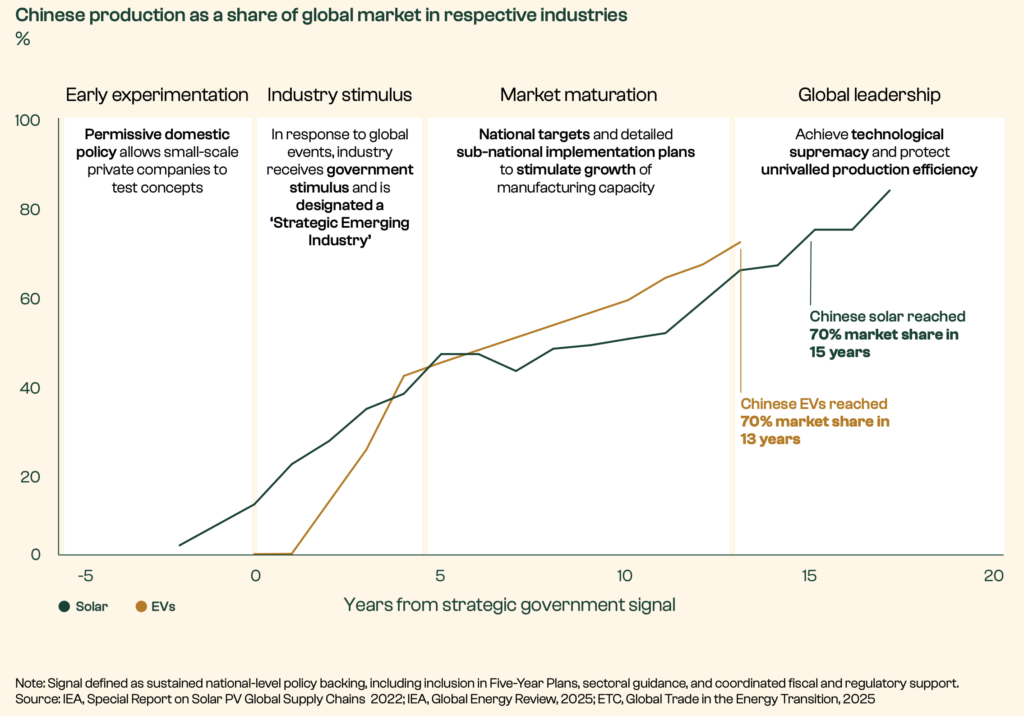
Global solar energy capacity has expanded by more than 30-fold over the last decade, and sales of electric vehicles (EVs) have increased 50-fold – they now make up 7% and 20% of global electricity and vehicle use, respectively.
China has been a catalyst for both transitions, rising from zero to 70% of global solar energy and electric vehicle (EV) production within 15 years. This speed reflects the efficacy of its strategy and its ability to act decisively in response to global signals.
Its policymakers elevated solar power within strategic industrial plans, mobilising export incentives and concessional finance to build capacity well ahead of domestic demand. As global deployment accelerated, costs fell and scale expanded, transforming China from a marginal producer to the world’s leading solar manufacturer.
In both transitions, incumbent systems continued to function, though they could no longer be optimised to resolve their underlying constraints. At the same time, alternative technologies already existed, but were commercially immature, so their success hinged on the alignment of targets, capital, regulation and manufacturing.
Systemiq noted that agriculture is fundamentally different from the energy and mobility sectors – the food system is influenced by biological and physical constraints, deeply embedded in culture, and politically sensitive in ways other industries aren’t. That makes substitution more complex.
Still, it is important to draw parallels with other transitions, since the differences don’t preclude large-scale change. With solar power and EVs, the goal was to achieve technological leadership and reduce dependence on fossil fuels. Similarly, with food, China aims to become more self-sufficient and build capabilities for future-friendly innovations.
Its policymakers recognise this: food security was placed alongside energy and finance in the country’s 14th five-year plan (2021-25). The latest plan, running until 2026, deepens this focus, emphasising food security, agricultural modernisation, protein diversification, and novel foods.
China’s future food playbook
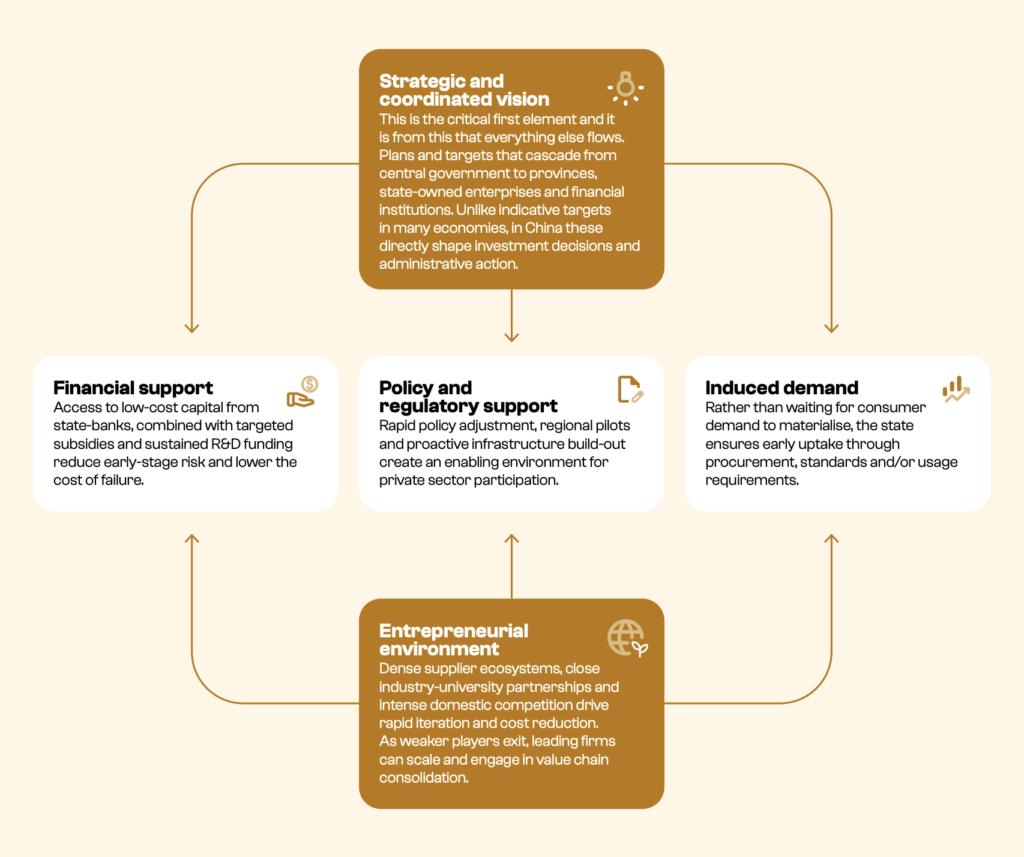
The government’s embrace of alternative proteins indicates that China is now in “year zero” of its food system transformation, with Systemiq laying out a strategic playbook of five mutually reinforcing mechanisms driving this shift.
The first element involves a strategic and coordinated vision, with national five-year plans cascading from the centre to provinces, state-owned enterprises, and financial institutions. These targets shape direct investment decisions and administrative actions, and signal intent.
The report then points to an entrepreneurial environment in which dense supplier ecosystems, close industry-university partnerships, and intense competition drive rapid iteration and cost reduction. Once a sector is prioritised, entry barriers are lowered and competition encouraged. As weaker players exit, leading firms can scale and engage in value-chain consolidation.
Financial support is critical. Low-cost capital from state-owned banks, targeted subsidies, and sustained R&D funding can reduce early-stage risk and the cost of failure. This enables companies to invest at scale before commercial viability is fully proven, speeding up learning curves and enabling rapid expansion.
Policy and regulatory support are equally important tools. Clear political signalling reduces long-term uncertainties, and the country’s ability to rapidly amend regulations in response to global developments allows policy to evolve alongside technology. Meanwhile, proactive infrastructure build-out creates the physical and institutional landscape for new industries to scale.
Finally, the playbook hinges on inducing consumer demand, instead of waiting for it to materialise. China does so by ensuring early uptake through procurement and usage standards, providing firms with the certainty to invest in novel technologies and helping accelerate learning and lowering costs. Mandates, quotas and fleet or deployment targets actively create markets for these emerging technologies.
The three phases of China’s protein transition
Following year zero, the report envisions how this strategy could play out over the next few decades, turning China into a major food exporter and a leader in the alternative protein ecosystem.
2030 is all about optimisation
Daily food consumption will look much the same at the end of the decade as it does today, with demand for animal protein largely unchanged; China’s efforts to reduce import dependencies will lead to a 25% drop in soybean imports.
Alternative proteins are set to remain niche in 2030, having yet to significantly change consumer habits or reduce meat and dairy consumption, thanks in large part to their still-higher price tag. However, consistent signalling from China’s leadership will drive the industry to keep innovating.
As experience and scale expand, costs will fall and businesses across retail and foodservice will experiment with alternative proteins. Fermentation-derived ingredients will be the first to reach price parity with their animal-based counterparts (by 2028), and plant-based alternatives will account for a 19% share of the overall dairy market.
2040 will kickstart structural change
By 2040, as they scale from pilot to commercial deployment, plant-based and fermentation-derived proteins will have disrupted the most expensive animal protein categories first. They will reach parity with beef and high-value seafood, capturing 14% and 16% of those markets, respectively.
Genetically modified and engineered crop adoption will continue to improve yields for maize and soy, whose imports will be 30% lower than in 2025. Fermenting the mazine can increase its native protein content, making it a suitable soy substitute and a key input for alternative protein production. Notably, China will become a net exporter of animal protein by this year.
2050 will usher in a new equilibrium
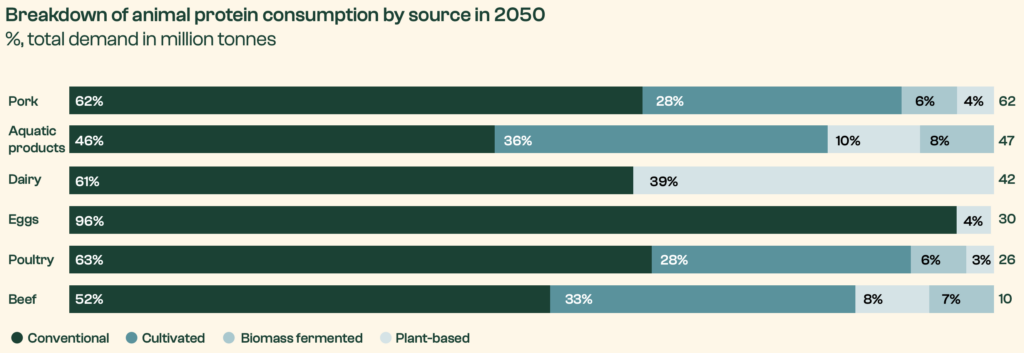
China’s food system will look vastly different come mid-century. A “third wave” of innovation in the preceding decade will make cultivated meat commercially viable, unlocking large segments of the animal protein market. In fact, alternative proteins would be responsible for 37-54% of meat and dairy consumption by 2050.
Soy imports will be down by 32% from a 2025 benchmark, though maize imports will double thanks to its role as a feed crop and key feedstock for microbial and cultivated proteins. Other sources of sugar will also be necessary, so alternative protein producers will adopt potatoes and sugarcane and test cellulosic inputs such as grasses and agricultural residues.
The country’s investment in biomanufacturing will make it a global leader of another of the 21st century’s defining technologies. It will be the world’s leading producer of amino acids and other inputs, as well as the dominant supplier of alternative protein infrastructure, making the food system more stable and diverse.
How will this impact the global food system?
China’s dominance of the future food economy will have major implications for stakeholders worldwide. It currently purchases the majority of soy exported by Brazil, Argentina, and the US, and a significant amount of beef from Brazil, Argentina, and New Zealand. A sustained contraction in Chinese demand not only reduces volumes in these countries but also risks price declines and export revenue losses.
These producer countries will be the first to feel the effects of China’s transition, and can strengthen their resilience by improving productivity on existing farmland, advancing deforestation- and conversion-free commodities, diversifying markets, and avoiding investments that may not generate expected returns.
For the alternative protein industry, the East Asian country’s industrial approach can accelerate the path to price parity faster than the sector currently anticipates, posing both an opportunity and a challenge for existing producers (especially in Europe and the US).
Following the solar energy and EV model could significantly reduce the cost of bioreactors and fermentation systems. While that may be a win for the industry overall, it could erode the advantage of early movers who built at higher costs, Systemiq suggests.
Future food players must be prepared for Chinese alternative protein products to enter export markets, potentially leading to direct competition with established players. In addition, they must keep pace with regulatory advancements, with novel food approvals and labelling requirements set to shape the pace of consumer adoption.
“For years, China has been the engine of global agricultural demand, but recent climate shocks, geopolitical tensions and trade disruptions have exposed the vulnerability of that model,” said Shenggen Fan, chair professor at the China Agricultural University.
“The new Five-Year Plan signals that Beijing has taken note, responding with characteristic resolve and embedding food security and sovereignty as a core strategic priority,” he added. “Those who have watched China’s previous industrial transitions know not to underestimate what could come next.”