

Chunk Foods Set to Double Sales & Defy Plant-Based Meat Slowdown


New York-based plant-based meat startup Chunk Foods expects to double its sales and reach profitability next year. Its CEO explains why demand isn’t the main problem facing this sector.
Despite repeated declines in US sales of plant-based meat over the last few years, Amos Golan thinks companies in this sector face a far simpler challenge today than the years they spent convincing people to try their products.
“Plant-based meat doesn’t have a demand problem. It has a repeat-purchase problem,” says the founder and CEO of Chunk Foods, a New York-based food tech startup known for its whole-cut meat alternatives.
Analysis from the Good Food Institute shows that retail purchases of plant-based meat fell by 10% in 2025, with these products only entering a tenth (11%) of households. Only 62% of customers who bought them came back for more.
That has led to a consolidation wave – since September 2024, at least 82 alternative protein companies have been bought out or acquired, merged, fallen into some form of insolvency, or shut down. And 72% of them were focused on plant-based technologies, with investors and founders blaming, among other things, a saturated market for the trend.
“Prices came down. Distribution expanded. Yet the category stayed flat. Consumers didn’t suddenly reject plant-based food. Too many products simply gave them no reason to buy them again,” says Golan.
“That’s why we actually welcome this reset. As brands that overpromised disappear from shelves, retailers naturally consolidate around products that consistently perform. At the same time, consumers are eating more protein than ever before, and that trend is moving in our direction,” he adds.
“Our job isn’t to convince people to eat differently. It’s to give them one less reason not to.”
It’s that philosophy that has underlined its growth in an otherwise struggling category. Chunk Foods, with its range of whole-muscle steak fillets and cuts and pulled meat alternatives, is approaching $10M in annual revenue, and expects to roughly double this next year.
“Our products are already profitable on a unit basis, and we’re targeting company-wide net profitability during the second half of 2027,” notes Golan. “Growth alone is no longer enough. Growth with healthy unit economics is.”
Chunk Foods grew by 140% in 2025
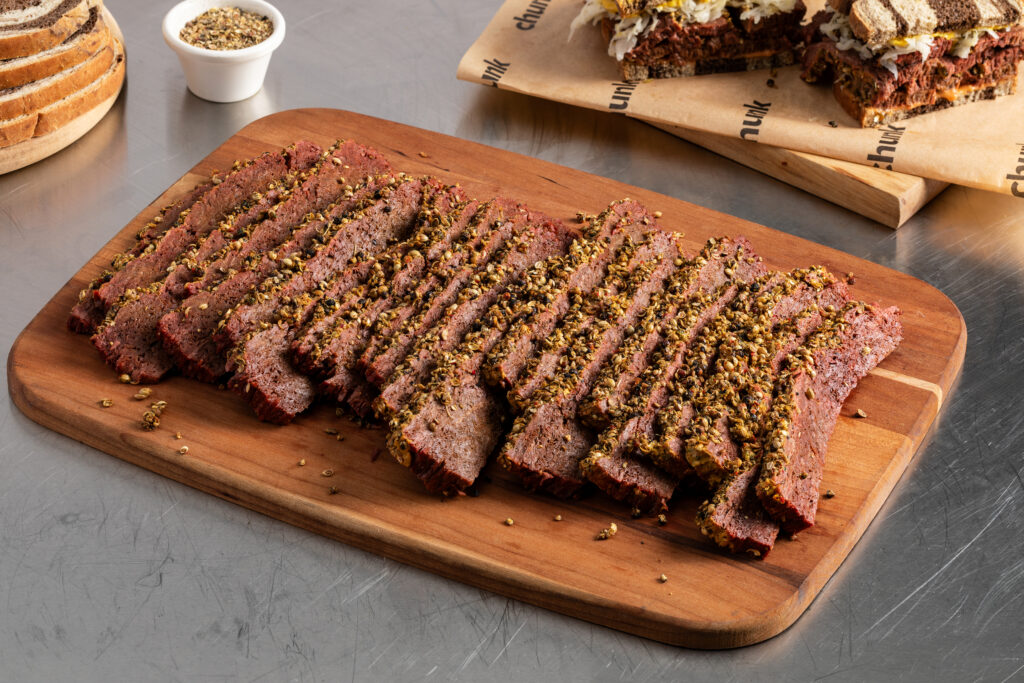
Distribution is a big part of Chunk Foods’s success – its products can be found in over 3,000 locations across the US, a market that accounts for around 85% of its entire business. It’s stocked in national retailers like Whole Foods Market, Sprouts, H-E-B and Giant, and supplies hundreds of foodservice customers via nearly 100 distribution centres across Sysco, US Foods, Chefs’ Warehouse, and PFG.
“Our philosophy has always been to grow deep before we grow wide. We’ve turned down opportunities to launch in thousands of additional stores because we’d rather prove velocity than simply accumulate distribution,” says Golan.
For him, 3,000 isn’t the actual interesting number. “The interesting part is who chose us: some of the largest tech campuses, steakhouses and luxury hotel chains in the country. Foodservice is where products earn credibility. Retail is where they scale,” he says.
In 2025, Chunk Foods experienced a 140% growth in its business. “Foodservice is growing significantly, but retail is clearly becoming our fastest-growing channel,” he reveals. “We’ve achieved or exceeded every single revenue milestone in the past eight quarters.”
Despite the dip in sales for meat alternatives, some products enjoyed a successful year in the US. For instance, chunks, shreds and strips – the key segment for Chunk Foods – saw an 8% hike in unit sales.
“Most burgers and nuggets compete directly with inexpensive, familiar products, so plant-based versions are often perceived as the more expensive compromise. Whole cuts are different. They’re a centre-of-plate protein, and if the eating experience delivers, consumers don’t compare them the same way,” explains Golan.
“We also committed to frozen from day one, which today sits at the intersection of convenience, prepared meals and high-protein eating. People don’t buy dinner because it checks a sustainability box. They buy it because they expect it to taste great, and it puts a protein-rich meal on the table for the whole family in minutes.”
He believes that taste, texture, value and trust are the biggest pain points for the meat alternative category. “Most products struggle with the first two. Value and trust are the quieter issues,” he outlines.
“Consumers turn over the pack, read a long ingredient list filled with unfamiliar ingredients and put it back. They see the cost of a plant-based burger and feel it’s too expensive. The solution isn’t better marketing. It’s a genuinely better product with ingredients people recognise and clear value.”
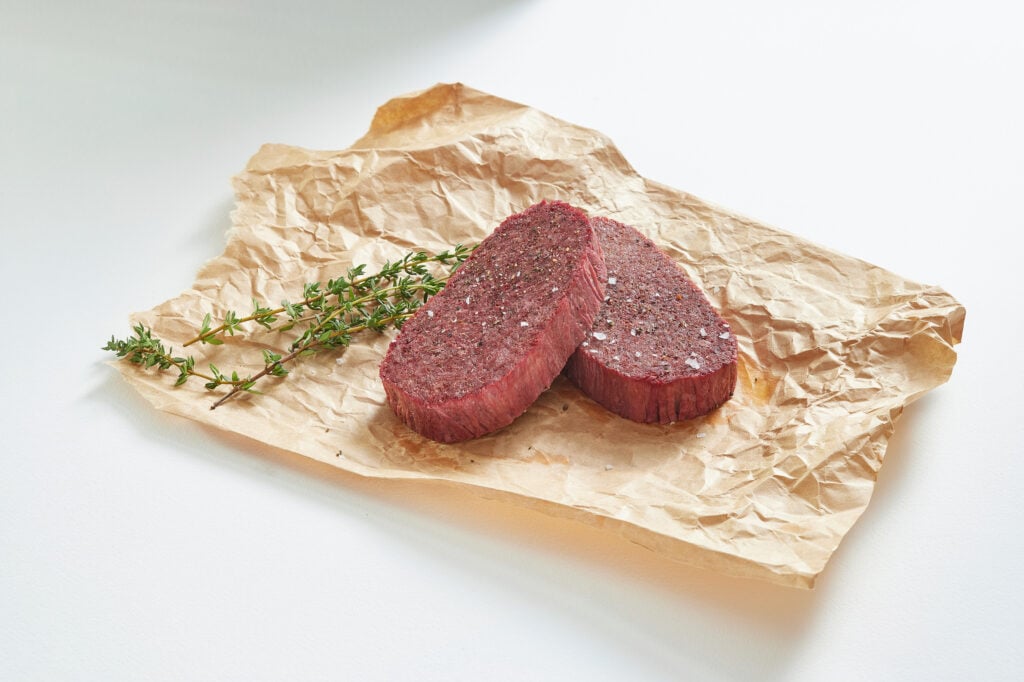
That’s where products like Chunk Foods’s classic steak come in, delivering 25g of protein with just 160 calories in a 4oz cut. “it also fits today’s protein-focused consumer, including people using GLP-1 therapies who increasingly evaluate protein per calorie and per dollar.”
Economics and control Chunk Foods’s ‘biggest advantages’ ahead of fundraise
The consolidation era has hit fermentation companies hard. Bolder Foods, Arkeon, NovoNutrients and Planetarians all called it quits. Libre Foods was acquired by Planetary, Bosque Foods was snapped up by Infinite Roots, and Meati Foods was rescued from the brink in a $4M buyout.
“This is more about economics than science,” suggests Golan. “Many fermentation companies built beautiful state-of-the-art facilities before they built sustainable economics and a viable market. Some technologies require enormous upfront investments in infrastructure before they ever generate meaningful commercial revenue.”
Chunk Foods’s model scales differently. “Solid-state fermentation uses soy flour as the fermentation medium, eliminating the need to ferment in large stainless steel reactors and separate biomass from the liquid afterwards. That means simpler facilities, lower capital requirements, less waste, and production capacity that grows alongside demand rather than years ahead of it,” he says.
“Beyond economics, our biggest advantage is control. We can precisely control fibre direction, texture, thickness and appearance without binders or gums, while still delivering the juicy eating experience people expect from a steak. I’m a chemist and a classically trained cook. I don’t want a product that survives the lab. I want one that survives dinner.”
Chunk Foods is a vertically integrated business, which Golan says is relatively unusual in the category. “We manufacture in our own facility and ship frozen products to the US. Our capital-light model allows us to expand production alongside demand rather than committing to a single large facility years in advance,” he notes.
“Some of our newer production lines are already designed around future US manufacturing, and we expect a US production partnership to mature around 2027-28.”
The six-year-old startup has secured $24M in funding to date, and is now raising a small round to accelerate US growth and establish the working-capital facility to support its expansion as it works towards profitability.
“Capital should accelerate a good business. It shouldn’t be the only thing keeping it alive,” Golan says.