

No Country on Track to Meet Food System Emissions Goal for 2030, Shows UN-Backed Report

Most of the world is moving too slowly to meet food system transformation goals, with the measure for agrifood greenhouse gas emissions exhibiting one of the largest gaps, according to a new report.
The vast majority of countries will not meet internationally agreed food systems goals for 2030, warns a new interdisciplinary report backed by the UN.
Using the latest data points available for all countries in the analysis and considering the global direction, the researchers found that reducing greenhouse gas emissions from food systems is one of two indicators where the global mean is over 75% away from the agreed target. Only one goal has been fully met: mobile phone subscriptions, which is a proxy for connectedness and resilience.
The study, published in Nature Food, was carried out by the Food Systems Countdown Initiative (FSCI), a global interdisciplinary collaboration co-led by Johns Hopkins University, Cornell University, the UN Food and Agriculture Organization (FAO), and the Global Alliance for Improved Nutrition.
“What makes this countdown paper different is that it doesn’t just tell countries whether they’re moving in the right direction – it tells them how far they still have to go, and against a benchmark that’s actually within reach,” said lead author Bianca Carducci. “That distinction between tracking trends and measuring performance is what turns a monitoring exercise into a tool for accountability.”
Food system emissions must reduce annually by 60% to meet targets
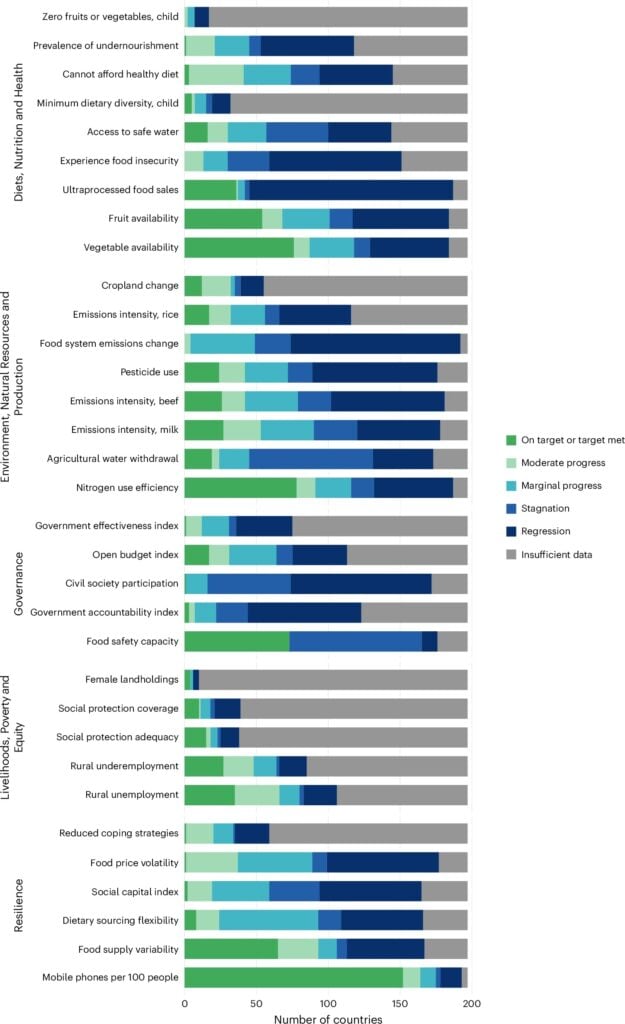
The study is described as the “most comprehensive performance assessment of food systems to date”, spanning 197 countries and 44 indicators across five themes: diets, nutrition and health; environment, natural resources and production; livelihoods, poverty and equity; governance; and resilience.
It is the third such report published by the FSCI, and for the first time, it goes beyond tracking trends to assess progress, and measures how food systems are actually performing and how much more needs to improve to meet globally set targets.
For 22 indicators, fewer than a third of countries are on course to meet their global target or benchmark by 2030. And for three of them, none is likely to meet the goal – that includes food system emissions change, which the researchers said we’re not moving fast enough on.
Globally, the agrifood industry accounts for up to a third of GHG emissions, behind only the fossil fuel sector. Meat and dairy production alone account for up to a fifth of worldwide emissions. The report says food system emissions change will require annual reductions exceeding 60%, which is challenging even for 2050.
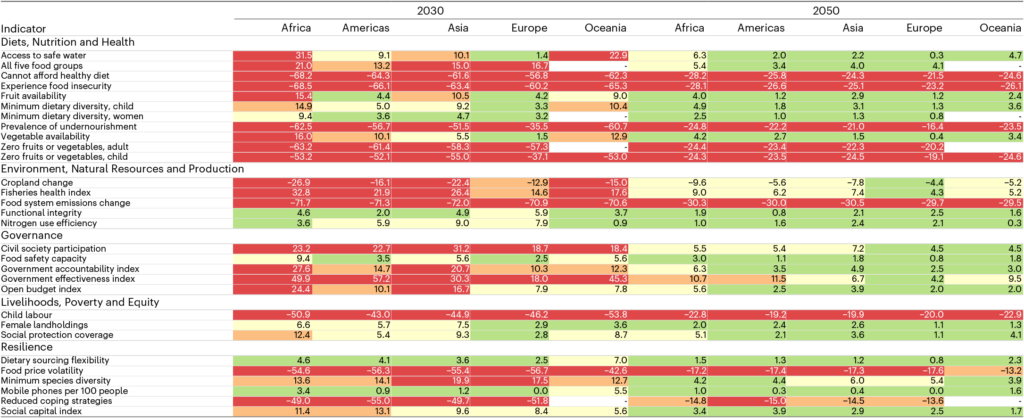
It shows that most regions would need dramatic annual changes to achieve their 2030 goals alone. Africa, for example, will need a 15-20% improvement across 23 indicators each year, and Asia would have to cut food insecurity by more than 63% annually. In Europe, 19 indicators remain unattainable by the end of the decade.
Some indicators are actually moving in the wrong direction, including civil society participation, governmental accountability, pesticide use, and the cost of a healthy diet, which are now joined by sales of ultra-processed foods and food system emissions.
“Accountability for food systems transformation requires accelerated progress – without it, efforts risk becoming performative rather than transformative. We can no longer afford to continue at the present pace,” said Mario Herrero, a professor at Cornell University’s Ashley School of Global Development and the Environment.
“Even with an additional 20 years of effort, targets for some indicators remain essentially out of reach, such as food systems emissions change, child labour and food insecurity,” the study stated.
“This is because many countries are either stagnating, moving in the wrong direction or would require rates of change that far exceed any historically observed annual progress, making these 2050 targets challenging to meet even under optimistic assumptions.”
Improving government efficacy and accountability is a critical lever
All, however, is not bleak. For seven of 33 indicators, a third of countries are already on track to meet the 2030 target. And half the indicators have been moving in a desirable direction on a global level.
In some cases, regional and income benchmarks provide more realistic milestones that can motivate countries. For instance, African nations are, on average, 58.7% away from the global benchmark for affordability of healthy diets, but the gap narrows to 32.2% when calculated against a regional measure set by the average of the top 20% of countries in the continent.
“Bold global targets are vital for inspiring ambition. But they can become a source of inertia if they seem permanently out of reach,” said Jessica Fanzo, a professor of food policy and climate at Johns Hopkins University’s School of Advanced International Studies Europe.
“Therefore, regional and income-group benchmarks keep progress within sight and help identify the exemplar countries that can show others how it is achievable,” she added.
The research highlights an urgent need for speedier action across all indicators, with a priority focus on where progress is most off track, like affordability, food insecurity, government effectiveness, and agrifood emissions. In fact, improving policies and government accountability are the critical leverage points that interact with the highest number of indicators.
“Extending the timeline for achieving the goals to 2050 makes achievement more feasible: most global targets and benchmarks are achievable across at least some regions, and some are achievable across all regions,” the researchers said in a briefing. “However, this requires maintaining steady momentum from today forward through consistent, concerted effort supported by concomitant investment.”
“The kind of comprehensive assessment that this countdown study provides is critical for governments and all other partners to set priorities, direct investments and resources, and draft and redraft policies,” said José Rosero Moncayo, chief statistician at the FAO. “Our global food systems demand urgent, decisive action – starting now.”