

Gen Z Could Be Cultivated Meat’s Biggest Champions, If the Industry is ‘Transparent & Real’


A new study outlines consumer attitudes towards breakthrough scientific technologies, including cultivated meat, whose potential is greatest among Gen Z.
Gen Z was touted as the climate generation, behind movements like Fridays for Future and holding businesses and politicians accountable for their environmental footprint.
Their eco-consciousness has been hit with a post-pandemic fatigue, a prominent example of which is the rise in meat consumption, especially among young men.
However, this generation continues to champion the climate, and could be the most welcoming demographic for new technologies like cultivated meat.
That’s apparent in a new study by Leaps by Bayer, Boston Consulting Group, and Ipsos UK, which deep-dives into public optimism and caution towards breakthrough science. The research examines technologies such as AI in healthcare, cell and gene therapies, new genomic techniques in agriculture, and cultivated meat.
The aim is to provide a deeper understanding of why people respond differently to emerging technologies, and what innovators can do to build trust and legitimacy.
It builds on the three companies’ 2025 study, which covered over 13,000 people across 13 countries. The pollsters wanted to explore why the public feels the way it does about these new breakthroughs, so they conducted in-depth interviews with consumers in China, the US, and Germany, three nations with the highest nominal GDP, global leadership in R&D, and patent filings.
What did the original survey show?
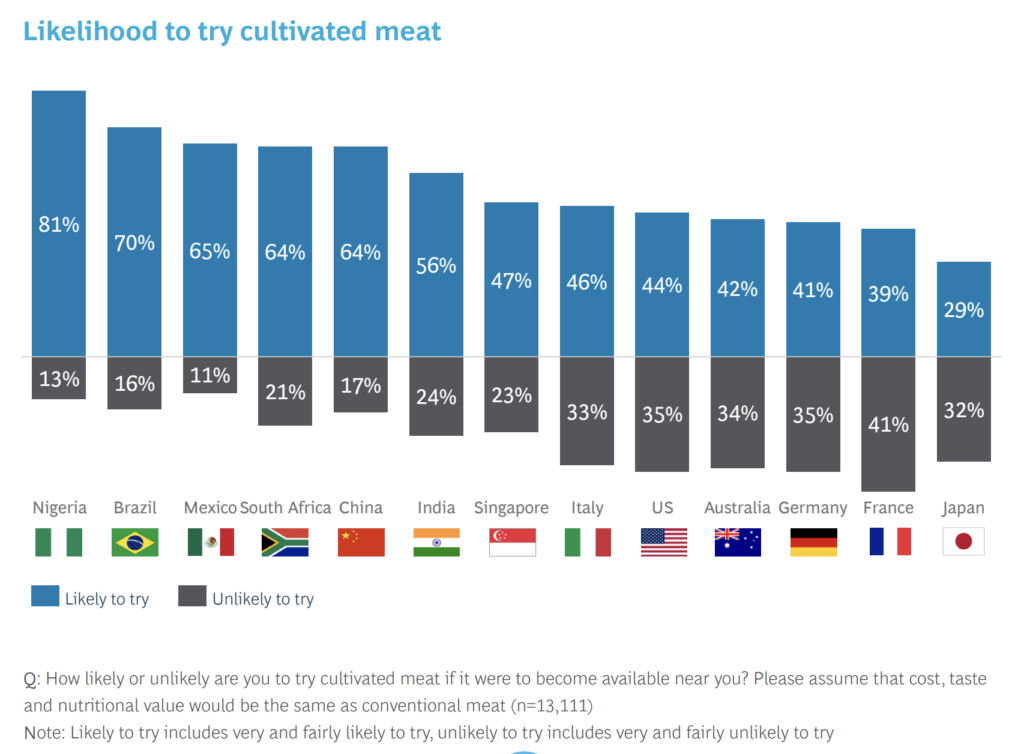
First, some context. The 2025 study, titled How Society Feels About Breakthrough Science, revealed that 39% of people worldwide have a positive opinion of cultivated meat, twice as many as those who view it negatively (19%). Still, 40% remain undecided, the highest of the four technologies examined.
The most pessimistic attitudes towards these proteins came from the West, specifically France (33%), Germany, and the US (both 28%), where concerns over the disruption to the agriculture industry and the safety and authenticity of cultivated meat are factoring into regulatory decisions.
This is why 41% of French citizens and 35% each of Germans and Americans are unwilling to try these foods, higher than the global average of 26%. On the other hand, people are most willing to try cultivated meat in Nigeria (81%), Brazil (70%), Mexico (65%), South Africa, and China (both 64%).
So it appears that countries with high GDPs and meat consumption levels are the most reticent to give cultivated meat a go, compared to nations where the cost and availability of meat may be limiting factors.
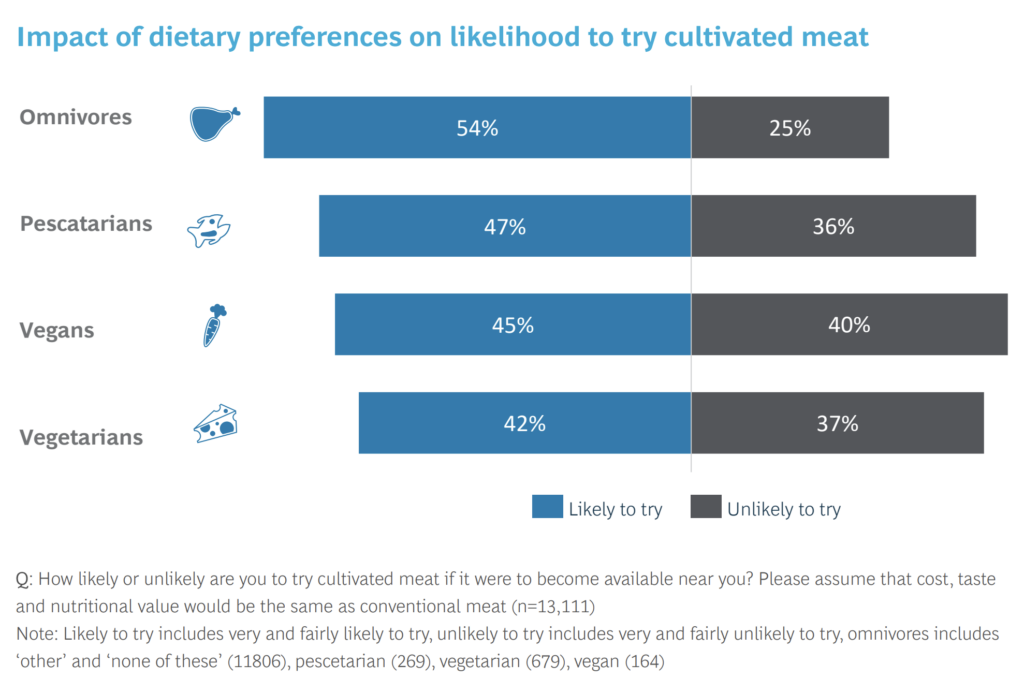
The survey examined how dietary preferences shape perceptions of cultivated meat, finding that 54% of omnivores are likely to try it, more than any other group. And only a quarter of them said they wouldn’t eat it, the lowest of the lot.
Gender and age also play key roles. More men (57%) are interested in trying cultivated meat than women (49%). And younger populations like Gen Zers (46%) and millennials (48%) are much more optimistic about these innovations than Gen Xers (35%) and baby boomers (27%).
The three kinds of cultivated meat consumers
The latest report builds on these findings and is focused on “decoding the why”, and interviews in China, the US and Germany show that cultivated meat stands out as the most emotionally charged food innovation the researchers examined, provoking reactions ranging from “ethical enthusiasm and curiosity to an immediate ‘gut-level no'”.
More knowledgeable participants acknowledged the environmental benefits of cultivated meat, but some say it’s too early to tell whether the land, water and feedstock reductions balance out the increased energy consumption until full-scale life-cycle assessments (LCAs) are possible.
A recent LCA based on industrial-scale models (with a capacity of producing 400-600kg of protein per day) shows that the carbon footprint of cultivated meat could range from 3.3kg to 6.6kg of CO2e, depending on the choice of raw materials and the energy mix. At current rates, this is 95% lower than beef and 55% lower than pork.
Consumer concerns tend to cluster around taste, texture and potential health effects, though the most persistent barrier is psychological: it’s the perception that cultivated meat is “unnatural” or overly processed.
The report examines three types of consumers regarding cultivated meat. The optimists are those who are eager to try it and see it as a major innovation that can improve animal lives and planetary health. The ethical argument outweighs processing concerns, and they believe it can become mainstream quickly if quality and affordability improve.
Then there are the rationalists, who want rigorous testing, transparent labelling, and clear safety evidence before forming opinions. Their acceptance is tied to real-world experience – they would try cultivated meat if its taste, price, and nutritional value are on par with conventional meat, and if its climate benefits are supported by robust, verified LCA data.
Finally, the researchers point to sceptics, who distrust the concept of meat produced outside conventional methods. They are strongly concerned about processing and “messing with nature” and view cultivated meat as a step too far from traditional food systems.
How does Gen Z view cultivated meat?
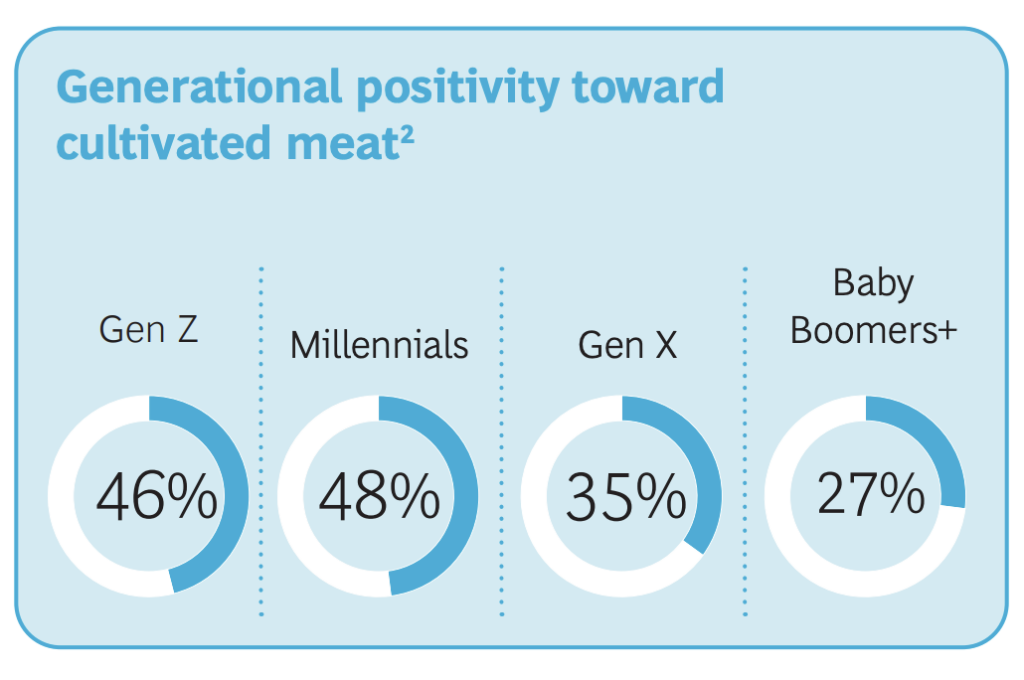
The original global survey showed that Gen Z is far more accepting of cultivated meat than older generations. That said, their openness is less of an endorsement and more conditional curiosity.
They’re strongly motivated by the ethical and environmental benefits, especially around animal welfare, though like their older counterparts, they are uneasy about artificiality and distance from nature.
Unlike older sceptics, though, their hesitation is forward-looking rather than nostalgic. Their worries are less about tradition or upbringing, and more about the potential health effects, processing, transparency, and governance.
Gen Zers are also concerned about cultivated meat’s production processes, long-term consequences, and who will ensure safety as it unfolds. That makes them more open to persuasion, if addressed through transparency – according to the report, this means clear labelling and honest explanations on manufacturing are essential to further court this cohort.
“Cultivated meat has the potential to move from emotional flashpoint to cautious mainstream if it can match conventional meat on taste, price and convenience, while making its safety, nutritional value, and climate/animal welfare benefits visible and independently verified,” the report states.
“The large neutral middle remains undecided, but could move toward openness with clear labelling, honest communication about how cultivated meat is made, and reassurance that farmers and rural economies will be meaningfully supported through transition.
“However, should rollout feel opaque or corporate‑driven, cultivated meat risks solidifying as a symbol of ‘unnatural food’ across markets, instead.”